Concrete Patio vs Pavers: Long-Term Repair & Troubleshooting Guide
Compare concrete patio vs pavers for long-term repair. Discover common failure modes, troubleshooting steps, and exact 2026 fix costs for both surfaces.

The Hidden Cost of Hardscapes: Installation vs. Lifetime Repair
Most residential hardscape guides evaluate a concrete patio vs pavers based strictly on Day 1 installation costs and aesthetic preferences. However, hardscapes exist in a dynamic environment subject to frost heave, expansive soils, hydrostatic pressure, and thermal expansion. The true cost of ownership is dictated by Year 10 repairability. Poured concrete and interlocking concrete pavers fail in fundamentally different ways, requiring entirely different troubleshooting methodologies, toolsets, and material budgets. This guide bypasses surface-level comparisons to provide a deep-dive technical analysis of failure modes, structural repair protocols, and exact 2026 cost metrics for both systems.
Poured Concrete Patios: Failure Modes and Troubleshooting
Poured concrete is a rigid, monolithic slab. While it boasts high compressive strength (typically 3,000 to 4,000 PSI for residential patios), its tensile strength is remarkably low—roughly 10% of its compressive strength. When internal tensile stresses exceed this threshold, the slab fractures.
Structural Settling vs. Drying Shrinkage
Before initiating repairs, you must diagnose the crack type. According to the Portland Cement Association, cracking generally falls into two categories:
- Drying Shrinkage Cracks: These occur as moisture evaporates from the cement matrix. They are typically narrow (under 1/8 inch), shallow, and run perpendicular to the slab's longest dimension. If the installer failed to saw-cut control joints at intervals of 24 to 36 times the slab thickness (e.g., 8 to 12 feet for a 4-inch slab), the concrete will crack randomly to relieve tension.
- Structural Settling Cracks: Caused by subgrade erosion, frost heave, or inadequate soil compaction prior to the pour. These cracks are often wide (1/4 inch or more), feature vertical displacement (faulting), and indicate a compromised base.
Routing and sealing a crack caused by active subgrade settling is a temporary bandage. If the underlying soil void is not addressed, the seasonal freeze-thaw cycle will destroy the new sealant within 12 to 18 months.
Concrete Repair Protocols and 2026 Material Costs
1. Slab Jacking (Polyurethane Foam Injection)
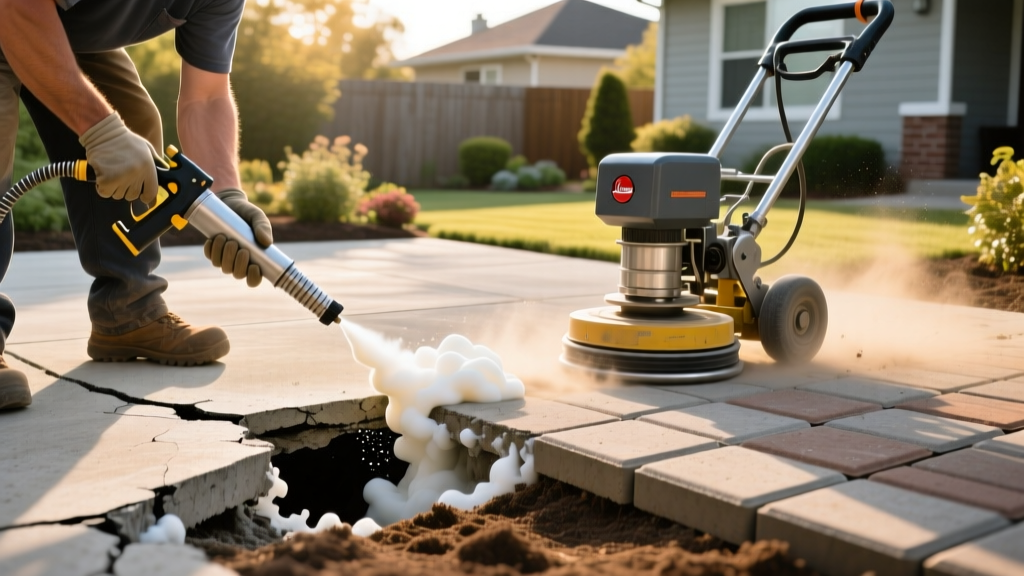
For slabs suffering from differential settlement, polyurethane foam jacking has entirely replaced traditional mudjacking. Technicians drill 5/8-inch holes through the slab and inject high-density, closed-cell polyurethane resin. The foam expands to fill subgrade voids and lifts the slab back to grade.
Cost: $8.00 to $18.00 per square foot, depending on the depth of the void and resin density required (typically 2.5 to 4.0 lbs per cubic foot). The foam cures in 15 minutes and is impervious to water washout.
2. Routing and Sealing (Active Cracks)
For non-structural shrinkage cracks that experience thermal expansion and contraction, the crack must be widened using a diamond-blade angle grinder to create a 1/4-inch V-groove. After blowing out the dust with compressed air, inject a self-leveling polyurethane sealant (e.g., Sikaflex Self-Leveling Sealant).
Cost: $1.50 to $3.50 per linear foot for DIY; $4.00 to $7.00 per linear foot for professional routing and sealing.
Interlocking Concrete Pavers: Shifting, Settling, and Sand Loss
Unlike rigid concrete, pavers form a flexible pavement matrix. Manufactured to ASTM C936 standards, concrete pavers possess a minimum compressive strength of 8,000 PSI and will almost never crack under residential loads. When a paver patio fails, the failure is always systemic—occurring in the base, the bedding sand, or the edge restraints.
Edge Restraint Collapse and Rotational Creep
The most common catastrophic failure in paver systems is edge restraint collapse. Pavers rely on granular interlock; without rigid confinement on all sides, vehicular traffic and thermal expansion cause the units to slowly creep outward, opening the joints and allowing the bedding sand to wash away.
- Diagnose the Restraint: Many older patios use plastic edging secured with 10-inch spikes. In freeze-thaw climates, frost heave pushes these spikes upward, rendering the restraint useless.
- The Permanent Fix: Excavate a 12-inch wide, 8-inch deep trench around the patio perimeter. Pour a concrete collar (using 4,000 PSI mix) and use a heavy-duty structural adhesive to bond the outer row of pavers directly to the cured concrete. Alternatively, install deep-spike aluminum restraints (like Perma-Edge) driven into a stabilized aggregate base.
Polymeric Sand Washout and Joint Failure
Polymeric sand contains water-activated polymers that bind the sand grains together. Failure usually occurs due to improper installation (over-watering during activation, which washes the polymers to the surface, creating a brittle crust) or high-pressure washing during maintenance.
Before applying new polymeric sand, the paver joints must be bone-dry. If rain is in the forecast or the base is holding moisture, the polymers will activate prematurely underground, leading to joint failure and weed intrusion. Always check a 5-day weather window before starting joint remediation.
Paver Repair Cost Breakdown
| Repair Scenario | Required Tools & Materials | 2026 Avg. Cost (Pro) | DIY Feasibility |
|---|---|---|---|
| Edge Restraint Replacement | Shovel, concrete mix, structural adhesive | $12 - $22 / linear ft | Moderate |
| Polymeric Sand Re-application | Pressure washer, polymeric sand, fine mist nozzle | $1.50 - $3.00 / sq ft | High |
| Subgrade Sinkhole Remediation | Plate compactor, 3/4" crushed angular aggregate, bedding sand | $6.00 - $12.00 / sq ft | Low (Heavy equipment) |
| Surface Stain / Efflorescence Removal | Efflorescence cleaner, stiff bristle brush, sealer | $1.00 - $2.50 / sq ft | High |
Head-to-Head Repair Matrix: Concrete Patio vs Pavers
When deciding between a concrete patio vs pavers for a new build or evaluating an existing property, use this matrix to understand the long-term maintenance liabilities.
| Metric | Poured Concrete Patio | Interlocking Concrete Pavers |
|---|---|---|
| Expected Lifespan (Pre-Major Repair) | 20 - 30 years | 40 - 50+ years (surface units) |
| Primary Failure Mode | Uncontrolled cracking, subgrade settling | Edge spread, joint sand loss, base washout |
| Repair Visibility | High (patches and foam injection ports are visible) | Low (individual units can be swapped seamlessly) |
| Utility Access (Under-Slab) | Destructive (requires jackhammering and repouring) | Non-destructive (units are unzipped and reinstalled) |
| Winter De-icing Damage | High (calcium chloride causes surface spalling and scaling) | Moderate (efflorescence, but structural integrity remains) |
Decision Framework: When to Patch, When to Replace
Troubleshooting hardscapes requires knowing when a repair is viable and when the system has reached the end of its service life. Apply these field-tested thresholds:
For Poured Concrete:
- Patch and Seal: If the slab has fewer than three structural cracks, vertical faulting is less than 1/4 inch, and the subgrade is stable. Use routing and polyurethane sealant.
- Foam Jack: If a large section (e.g., 40% of the patio) has settled uniformly by 1 to 3 inches due to soil consolidation, but the concrete itself is structurally sound and uncracked.
- Demo and Replace: If the slab exhibits "alligator cracking" (intersecting cracks forming small polygons), severe frost heave with multiple fault lines, or if the concrete surface is heavily spalled due to freeze-thaw cycles and improper air-entrainment during the original pour.
For Interlocking Pavers:
- Re-sand and Compact: If joints are empty or weeds are prevalent, but the patio perimeter is perfectly straight and the base feels solid underfoot. Vacuum joints, apply new polymeric sand, and run a vibratory plate compactor over the surface to re-seat the units.
- Rebuild the Base: If you observe localized "birdbaths" (depressions holding water) or soft spots indicating base washout. You must pull the affected pavers, excavate the compromised sand, install a geotextile fabric to prevent future soil migration, and rebuild the base using compacted, angular crushed stone (never rounded pea gravel, which fails to achieve mechanical interlock).
For further technical specifications on segmental pavement design and base material requirements, contractors should consult the engineering guidelines published by the National Concrete Masonry Association (NCMA), which sets the industry standards for interlocking concrete pavement systems. Understanding these underlying mechanics ensures that whether you choose a monolithic slab or a flexible paver matrix, your maintenance strategy is rooted in structural engineering rather than guesswork.
Written by
Elena RodriguezElena Rodriguez is a civil engineer and technical writer specializing in concrete technology, masonry systems, and ASTM/ACI compliance. She earned her B.S. in Civil Engineering from Texas A&M University and spent a decade at a materials testing laboratory, performing over 2,000 concrete compressive strength tests and masonry prism evaluations. Elena is an ACI-certified Field Testing Technician (Grade I) and a member of ASTM Committee C12 on Natural Building Stone. She currently consults on forensic engineering cases involving concrete failures and moisture intrusion. Based in San Antonio, TX, Elena is a proud member of the Society of Women Engineers (SWE) and coaches her daughter's FIRST Robotics team.
More from Elena Rodriguez
View all
Walls & Panels
Cost Analysis: Light Gauge Steel Framing Advantages and Disadvantages
Evaluate light gauge steel framing advantages and disadvantages through a strict cost analysis lens, comparing material, labor, and lifecycle expenses.
Aug 4, 2026

Walls & Panels
Gypsum Board Types: Exact Specifications, Thickness & Dimensions
Compare standard, Type X, and moisture-resistant gypsum board types. Get exact specifications, thicknesses, dimensions, and ASTM standards for your project.
Aug 4, 2026

Fire Resistance
Best Fire-Resistant Outdoor Decking Materials: 2026 Buyer Guide
Discover the best fire-resistant outdoor decking materials for 2026. Compare Class A PVC, aluminum, and hardwood options for WUI compliance and safety.
Aug 4, 2026