Concrete vs Fiberglass Pools: Cost, Lifespan, and Installation
Compare concrete vs fiberglass pools for your backyard project. Explore installation costs, structural lifespan, maintenance, and soil mechanics.

Material Science: Pneumatically Applied Concrete vs. FRP
Choosing between concrete and fiberglass requires understanding the fundamental structural differences of the materials. Concrete pools are typically constructed using gunite (a dry-mix pneumatically applied concrete) or shotcrete (a wet-mix alternative). According to standards outlined by the American Concrete Institute (ACI), a properly engineered pool shell utilizes a #3 or #4 steel rebar grid spaced 10 to 12 inches on center, encased in a 6-inch to 8-inch thick concrete shell yielding 4,000 to 5,000 PSI compressive strength. This creates a rigid, monolithic structure that becomes an integral part of the surrounding soil matrix.
Fiberglass pools are manufactured off-site using Fiberglass Reinforced Plastic (FRP). The shell consists of woven roving glass mats saturated in polyester or vinyl ester resin, built up to a structural thickness of 3/16 to 1/4 inch. The interior is coated with a 20 to 30-mil layer of marine-grade gelcoat. Unlike rigid concrete, FRP possesses high flexural strength, allowing the shell to absorb minor ground movement without catastrophic failure, though it lacks the sheer mass of a concrete shell.
Upfront Installation Costs and Timelines (2026 Data)
The financial and temporal investments for these two materials diverge significantly during the construction phase. As of 2026, regional labor rates and material logistics heavily influence final pricing, but baseline averages remain distinct.
| Cost & Timeline Metric | Concrete (Gunite/Shotcrete) | Fiberglass (FRP Shell) |
|---|---|---|
| Average Base Cost (30,000 Gallon) | $85,000 - $130,000+ | $65,000 - $95,000 |
| Excavation & Soil Removal | $8,000 - $15,000 (larger footprint) | $6,000 - $12,000 |
| Interior Finish Cost | $8,000 - $18,000 (Marcite to Pebble) | $0 (Integrated Gelcoat) |
| Installation Timeline | 3 to 6 Months | 3 to 6 Weeks |
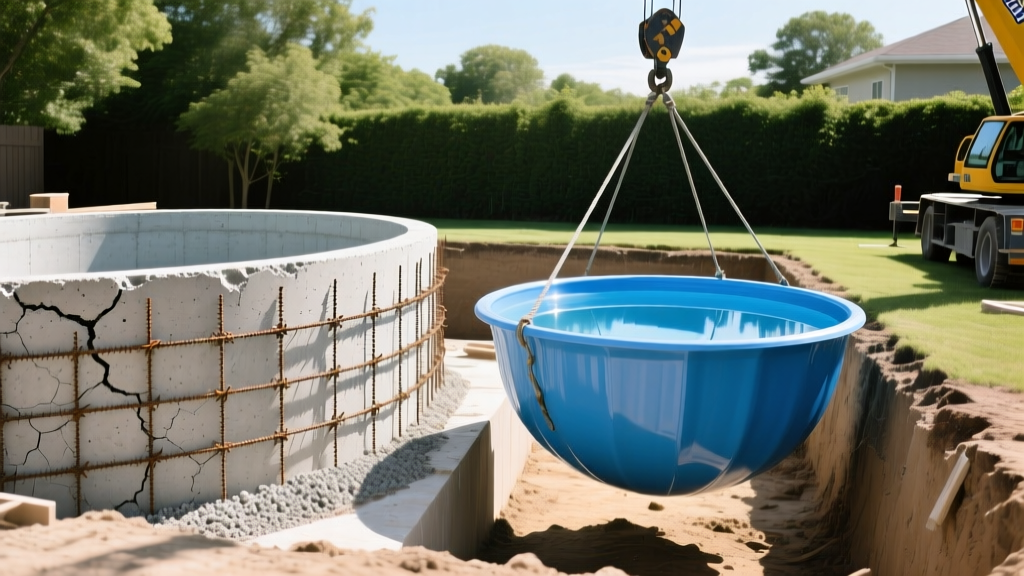
| Heavy Equipment Required | Skid steers, concrete pump trucks | 100-ton+ mobile crane for shell set |
Hidden Cost Variables in Concrete Construction
Concrete pools carry a higher risk of budget overruns. If excavation reveals unstable soil, engineers may require over-excavation and the importation of structural fill or helical piers, adding $5,000 to $15,000. Furthermore, premium interior finishes like Pebble Technology International's exposed aggregate finishes add significant upfront cost compared to standard white marcite plaster, though they extend the resurfacing interval from 7-10 years to 15-20+ years.
Structural Durability, Soil Mechanics, and Hydrostatic Pressure
The interaction between the pool shell and the surrounding earth dictates long-term structural integrity. Concrete's immense weight (often exceeding 80,000 lbs empty) anchors it firmly against hydrostatic uplift. Fiberglass shells, weighing roughly 2,500 to 4,000 lbs, rely entirely on the engineered backfill (usually clean crushed gravel or a flowable fill/cement slurry) to prevent 'pool pop'—a phenomenon where a high water table pushes the empty shell out of the ground.
If your site features highly expansive clay (common in regions like Texas and Colorado), concrete pools require specialized engineering, such as carton forms (void forms) beneath the shell to absorb soil swelling. Fiberglass pools in expansive soils are prone to 'spider cracking' in the gelcoat near the coping and skimmer throats if the surrounding backfill shifts unevenly during freeze-thaw cycles.
Both systems require hydrostatic relief valves in the main drain sump to allow groundwater to enter the pool during heavy rains or when the pool is drained, equalizing pressure. However, the Pool & Hot Tub Alliance (PHTA) strongly advises against completely draining fiberglass pools without professional dewatering systems in place, due to the extreme risk of structural flotation.
Long-Term Maintenance and Water Chemistry
The interior surface of the pool dictates the ongoing chemical consumption and labor required to maintain sanitary water.
The Porosity and Algae Factor
Concrete pool finishes (even polished pebble) are inherently micro-porous. These microscopic voids provide anchor points for algae spores. Consequently, concrete pools require rigorous weekly brushing and higher baseline chlorine levels (2.0 - 4.0 ppm) to prevent biological growth. Fiberglass gelcoat is entirely non-porous, offering no mechanical grip for algae. Fiberglass pools typically maintain clarity with lower chlorine levels (1.0 - 2.0 ppm) and require significantly less brushing.
pH Buffering and Alkalinity
Concrete is highly alkaline. A new concrete pool will continuously leach calcium hydroxide into the water for the first 12 to 18 months, causing the pH to drift upward constantly. Owners must frequently dose muriatic acid or dry acid to maintain the ideal 7.4 to 7.6 pH range. Fiberglass is chemically inert; it does not interact with the water chemistry, resulting in highly stable pH levels and reducing annual chemical expenditures by approximately 30% to 40% compared to concrete.
Design Constraints and Customization Limits
Concrete offers absolute geometric freedom. Because the shell is formed on-site using steel rebar and pneumatically applied concrete, it can be engineered to any depth, shape, or size, including infinity edges, integrated shallow tanning ledges, and custom vanishing edge catch basins.
Fiberglass pools are constrained by the manufacturing molds and highway transportation regulations. The maximum width of a fiberglass shell is strictly limited to 16 feet to comply with Department of Transportation (DOT) wide-load highway permits without requiring expensive escort vehicles. While modern manufacturers offer varied shapes (freeform, geometric, L-shaped), depth is generally capped at 8.5 feet, and customization is limited to selecting from pre-engineered mold options and add-on features like pre-formed swim-out benches.
Concrete Pros & Cons
- Pro: Unlimited custom shapes, sizes, and depths.
- Pro: Extreme structural mass resists hydrostatic uplift.
- Pro: High resale value in luxury real estate markets.
- Con: High lifetime maintenance and chemical costs.
- Con: Requires complete interior resurfacing every 10-20 years.
Fiberglass Pros & Cons
- Pro: Rapid installation (swimming in weeks, not months).
- Pro: Non-porous surface drastically reduces algae and chemical use.
- Pro: No lifetime resurfacing costs; gelcoat lasts 25+ years.
- Con: Width restricted to 16 feet due to transport limits.
- Con: Vulnerable to flotation (pool pop) if drained improperly.
Expert Decision Framework: Which Material Fits Your Site?
Selecting the correct material requires evaluating your specific site conditions, timeline, and long-term maintenance tolerance. Use this framework to finalize your decision:
- Assess Site Access: If your property has narrow access roads, overhead power lines, or dense tree canopies, a 100-ton mobile crane cannot reach the backyard to set a fiberglass shell. In these scenarios, concrete (which only requires access for small excavators and concrete hose trucks) is the only viable option.
- Evaluate the Water Table: If your geotechnical report indicates a seasonally high water table, choose concrete. The sheer mass of the cured concrete shell acts as a natural anchor. If you insist on fiberglass in a high-water-table zone, the contractor must install a permanent, automated groundwater sump pump system adjacent to the pool.
- Calculate Lifetime Cost of Ownership: While concrete costs 20% to 35% more upfront, the true divergence occurs at year 15. A concrete pool will require an acid wash or complete replastering (costing $10,000 to $20,000+ depending on finish). A fiberglass pool will require zero structural refurbishment at this interval, effectively equalizing the 20-year cost of ownership between the two materials.
Ultimately, concrete remains the undisputed choice for bespoke, architectural water features and challenging topographies, while fiberglass provides a highly efficient, low-maintenance solution for standard residential backyards with adequate crane access and stable soil profiles.
Written by
Marcus ChenMarcus Chen is a licensed structural engineer (PE) and building materials analyst with over 12 years of experience across residential, commercial, and industrial construction. He holds a Master of Science in Civil Engineering from UC Berkeley and spent six years at Thornton Tomasetti before transitioning to independent consulting and technical writing. Marcus specializes in material selection for seismic-prone regions, concrete reinforcement strategies, and lifecycle cost analysis. His work has been cited by the American Concrete Institute (ACI) and the Structural Engineers Association of California (SEAOC). When he is not on a job site or at his desk, you will find him hiking the Sierra Nevada or restoring a 1920s craftsman bungalow in Oakland, CA.
More from Marcus Chen
View all
Construction Cost
How Much Did the Eiffel Tower Cost to Build?
How much did the Eiffel Tower cost to build in 1889? We adjust for inflation and compare its budget to modern skyscraper construction.
Aug 4, 2026

Fire Resistance
What Is a Fire Resistant Material? Testing & Certification Guide
Discover what is a fire resistant material through ASTM and UL testing. Learn how fire ratings, certifications, and assemblies work in construction.
Aug 4, 2026

Construction Cost
How Much Did the Burj Khalifa Cost to Build?
How much did the Burj Khalifa cost to build? We break down the $1.5B project and extract 5 money-saving strategies for your next build.
Jul 30, 2026