Concrete vs Stone: 2026 Cost Breakdown & Installation Analysis
Compare the true costs of concrete vs stone for exterior cladding. Get 2026 pricing, masonry labor rates, maintenance data, and long-term ROI analysis.
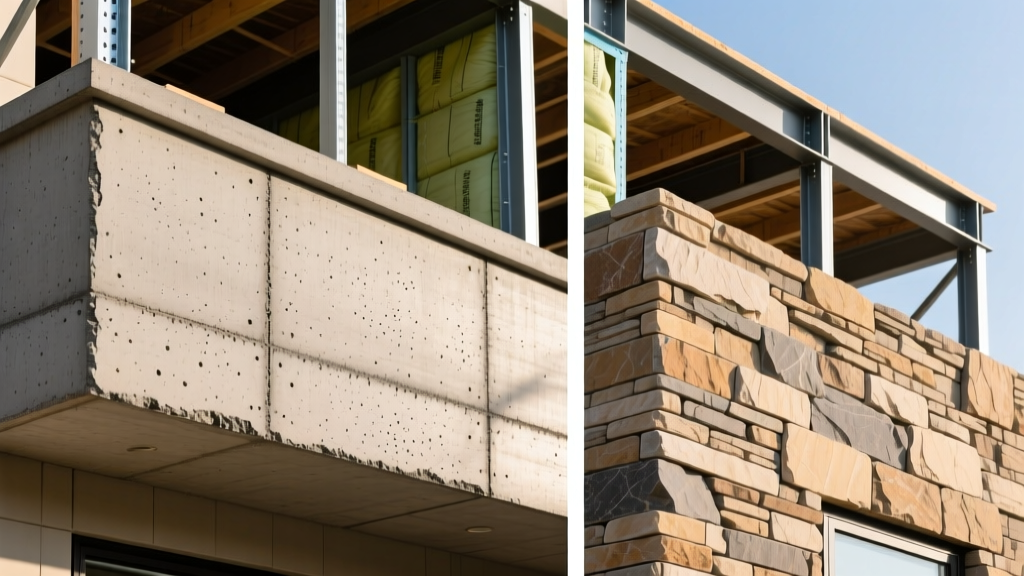
The True Cost of Concrete vs Stone: Beyond the Price Tag
When evaluating exterior cladding, paving, or retaining wall materials, the debate between concrete vs stone often stalls at the initial material quote. However, a professional cost breakdown analysis must account for substrate preparation, structural reinforcement, specialized masonry labor, and long-term lifecycle maintenance. In 2026, supply chain shifts and updated building codes have significantly altered the financial landscape for both natural stone and advanced concrete products.
This guide dissects the exact costs of natural stone, manufactured stone veneer (MSV), and architectural precast concrete, providing builders and homeowners with the data needed to make a structurally sound and financially viable decision.
2026 Material Cost Matrix: Natural Stone, MSV, and Precast
Material costs vary wildly based on density, quarrying methods, and manufacturing processes. Natural stone carries heavy freight premiums due to its weight (averaging 150-180 lbs per cubic foot), while architectural precast concrete can be engineered with lightweight aggregates to reduce shipping costs without sacrificing compressive strength.
| Material Type | Material Cost (Per Sq. Ft.) | Avg. Weight (PSF) | Best Application |
|---|---|---|---|
| Natural Limestone (Ashlar) | $18.00 - $32.00 | 15 - 22 lbs | Premium facades, estate retaining walls |
| Natural Granite (Fieldstone) | $24.00 - $45.00 | 20 - 28 lbs | High-impact paving, heavy-duty retaining |
| Manufactured Stone Veneer (MSV) | $9.00 - $16.00 | 8 - 12 lbs | Residential siding, interior accents |
| Architectural Precast Concrete | $14.00 - $28.00 | 12 - 18 lbs | Commercial facades, modern residential |
| Stamped / Poured Concrete | $8.00 - $18.00 | N/A (Monolithic) | Patios, driveways, continuous paving |
Note: 2026 pricing reflects current quarry output and cement market stabilization. Freight costs for natural stone can add 15-25% to the base material price depending on proximity to the quarry.
Installation Labor and Hidden Structural Costs
The most common budgeting error in the concrete vs stone comparison is underestimating installation labor. Stone masonry is a highly specialized trade, and certified masons command premium rates, typically ranging from $85 to $135 per hour in 2026.
Substrate and Structural Reinforcement
Natural stone veneer requires a robust structural backing. A standard 2x4 wood-framed wall cannot support the dead load of full-thickness natural stone without modification. You must factor in the cost of:
- Wall Ties and Anchors: Heavy-duty corrugated steel ties spaced at 16 inches on center, costing roughly $1.50 to $2.50 per square foot.
- Weep Screeds and Flashing: Mandatory at the base of the wall to prevent moisture entrapment. PVC weep screeds cost about $0.85 per linear foot.
- Scratch Coat and Lath: 2.5 lb self-furring galvanized metal lath and a Type S mortar scratch coat add $3.50 to $5.00 per square foot before the first stone is even laid.
Precast Concrete Panel Installation
Architectural precast concrete panels bypass traditional masonry labor. Instead of hand-laying individual stones, panels are lifted via crane and bolted to embedded steel anchors. While you save on hourly masonry rates, you must budget for crane rental ($1,200 to $2,500 per day) and a specialized rigging crew. For large commercial or multi-story residential projects, precast concrete installation is 30-40% faster than hand-laid stone, significantly reducing overall labor overhead.
Lifecycle and Maintenance Cost Analysis
Both concrete and stone are durable, but their failure modes and maintenance requirements differ significantly. Understanding these long-term costs is critical for accurate lifecycle budgeting.
Efflorescence and Sealing
Concrete is highly susceptible to efflorescence (white, powdery salt deposits) due to the migration of calcium hydroxide. Natural stone, particularly limestone and sandstone, is porous and can suffer from freeze-thaw spalling if moisture penetrates the surface.
- Concrete Sealing: Requires a silane/siloxane penetrating sealer every 3 to 5 years. Professional application costs $1.50 to $2.50 per square foot.
- Stone Sealing: Requires a breathable silicate-based sealer to prevent moisture trapping. Application costs $2.00 to $3.50 per square foot, typically needed every 5 to 7 years.
Repointing and Mortar Degradation
Hand-laid natural stone uses mortar joints that will inevitably degrade due to weathering. Repointing a natural stone facade typically costs $8.00 to $14.00 per square foot and is usually required every 25 to 30 years. Precast concrete panels use specialized polyurethane or silicone sealants at the joints, which cost less to replace ($4.00 to $7.00 per linear foot) but may require maintenance on a shorter 15 to 20-year cycle.
According to the Natural Stone Institute, properly maintained natural stone can easily exceed a 100-year lifespan, making its higher initial cost justifiable for legacy or institutional buildings where lifecycle cost is amortized over decades.
ROI and Resale Value: Which Pays Off?
When analyzing the concrete vs stone debate from an investment perspective, natural stone consistently yields a higher return on investment (ROI) in the luxury residential market. Data from the Remodeling Magazine Cost vs. Value Report indicates that natural stone veneer additions recoup an average of 92% to 95% of their cost at resale. Manufactured stone veneer (MSV) also performs exceptionally well, often recouping 85% to 90%.
Architectural precast concrete, while highly prized in modern commercial architecture, does not always carry the same emotional premium in the traditional residential resale market, typically recouping 70% to 80% of its installation cost. However, for stamped concrete driveways and patios, the ROI is excellent due to the low initial entry cost, often yielding a 100%+ functional return by preventing the need for expensive paver replacements.
The BuildMat Decision Framework: Concrete vs Stone
Use this practical framework to determine which material aligns with your specific project constraints.
- You are building a legacy home or high-end commercial facade.
- The structural framing is already designed to support heavy dead loads (e.g., masonry block or reinforced concrete backing).
- You require a 100% unique, non-repeating aesthetic that only natural geological variation can provide.
- You are executing a large-scale commercial build with strict timeline constraints.
- You need precise, repeatable modular dimensions and integrated structural insulation.
- You want to minimize on-site masonry labor and shift the burden to off-site controlled manufacturing.
- You are retrofitting an existing wood-framed residential exterior.
- Your budget restricts you from natural stone, but you demand a high-end visual profile.
- You need a lightweight material that does not require additional structural footing or wall reinforcement.
Frequently Asked Questions (FAQ)
Is stamped concrete a viable alternative to natural stone paving?
Yes, for budget-conscious projects. Stamped concrete costs between $8 and $18 per square foot installed, compared to $25 to $50 for natural flagstone. However, stamped concrete is prone to cracking in freeze-thaw climates if the sub-base is not properly compacted to a minimum of 95% Proctor density, and repairs are highly visible due to color-matching difficulties.
Does precast concrete require a different mortar than natural stone?
Precast concrete panels generally do not use mortar for assembly; they rely on mechanical connections (stainless steel anchors, dowels, and bearing pads) and are sealed with elastomeric joint sealants. Natural stone veneer typically requires a Type N or Type S mortar, depending on the compressive strength of the stone and the exposure conditions. The Portland Cement Association provides detailed specifications for matching mortar compressive strength to the specific masonry unit being installed.
How does the carbon footprint of concrete compare to quarried stone?
Natural stone generally has a lower embodied carbon footprint than concrete, primarily because cement production is highly energy-intensive and responsible for significant global CO2 emissions. However, if the natural stone is imported internationally, the freight emissions can quickly eclipse the manufacturing emissions of locally sourced, regionally manufactured precast concrete. Always request Environmental Product Declarations (EPDs) from your suppliers to make an accurate sustainability comparison.
Written by
Elena RodriguezElena Rodriguez is a civil engineer and technical writer specializing in concrete technology, masonry systems, and ASTM/ACI compliance. She earned her B.S. in Civil Engineering from Texas A&M University and spent a decade at a materials testing laboratory, performing over 2,000 concrete compressive strength tests and masonry prism evaluations. Elena is an ACI-certified Field Testing Technician (Grade I) and a member of ASTM Committee C12 on Natural Building Stone. She currently consults on forensic engineering cases involving concrete failures and moisture intrusion. Based in San Antonio, TX, Elena is a proud member of the Society of Women Engineers (SWE) and coaches her daughter's FIRST Robotics team.
More from Elena Rodriguez
View all
Walls & Panels
Cost Analysis: Light Gauge Steel Framing Advantages and Disadvantages
Evaluate light gauge steel framing advantages and disadvantages through a strict cost analysis lens, comparing material, labor, and lifecycle expenses.
Aug 4, 2026

Walls & Panels
Gypsum Board Types: Exact Specifications, Thickness & Dimensions
Compare standard, Type X, and moisture-resistant gypsum board types. Get exact specifications, thicknesses, dimensions, and ASTM standards for your project.
Aug 4, 2026

Fire Resistance
Best Fire-Resistant Outdoor Decking Materials: 2026 Buyer Guide
Discover the best fire-resistant outdoor decking materials for 2026. Compare Class A PVC, aluminum, and hardwood options for WUI compliance and safety.
Aug 4, 2026