Concrete vs Paver Driveway: Mix Design & Structural Comparison
Compare poured concrete vs paver driveways through the lens of mix design, structural base requirements, failure modes, and 2026 installation costs.

The Material Science: Wet-Cast Slabs vs. Dry-Cast Pavers
When evaluating a concrete vs paver driveway, the decision extends far beyond surface aesthetics. From a materials science perspective, you are choosing between two fundamentally different concrete technologies: wet-cast monolithic slabs and dry-cast interlocking units. While both rely on Portland cement, water, and aggregates, their mix designs, placement methods, and structural behaviors are entirely distinct.
Poured concrete driveways utilize a plastic, high-slump mix that is poured into forms, consolidated, and finished while wet. The structural integrity relies on the continuous mass of the slab and its subgrade support. Conversely, concrete pavers are manufactured using a zero-slump, dry-cast mix that is subjected to extreme vibration and hydraulic compression in a factory setting. This results in a dense, ultra-high-strength unit that relies on mechanical interlock and granular base flexibility rather than rigid continuity.
Poured Concrete Driveway: Mix Design & Specifications
A driveway slab must withstand severe dynamic loads, thermal expansion, and freeze-thaw cycles. Specifying the correct ready-mix concrete is critical to preventing premature scaling, shrinkage cracking, and structural failure. For residential and light commercial driveways, the American Concrete Institute (ACI) recommends a minimum compressive strength of 4,000 PSI.
| Parameter | Specification | Engineering Purpose |
|---|---|---|
| Compressive Strength | 4,000 PSI (28-day) | Resists vehicular point loads and prevents surface crushing. |
| Water-Cement (w/c) Ratio | 0.45 maximum | Limits capillary porosity, reducing water infiltration and freeze-thaw damage. |
| Air Entrainment | 5% to 7% | Creates microscopic voids that provide expansion chambers for freezing water. |
| Slump | 4 to 5 inches | Ensures workability without excess water that weakens the surface paste. |
| Maximum Aggregate Size | 3/4 inch (Crushed) | Provides internal skeletal structure while allowing smooth troweling and brooming. |
Synthetic micro-fibers (e.g., polypropylene) are excellent for reducing plastic shrinkage cracking during the first 24 hours of curing. However, they do not provide structural tensile strength. For driveways subject to heavy loads (RVs, dump trucks) or built on expansive clay soils, a grid of #4 (1/2-inch) epoxy-coated rebar placed at the mid-depth of a 5-inch slab is mandatory to hold the slab together if tensile cracking occurs.
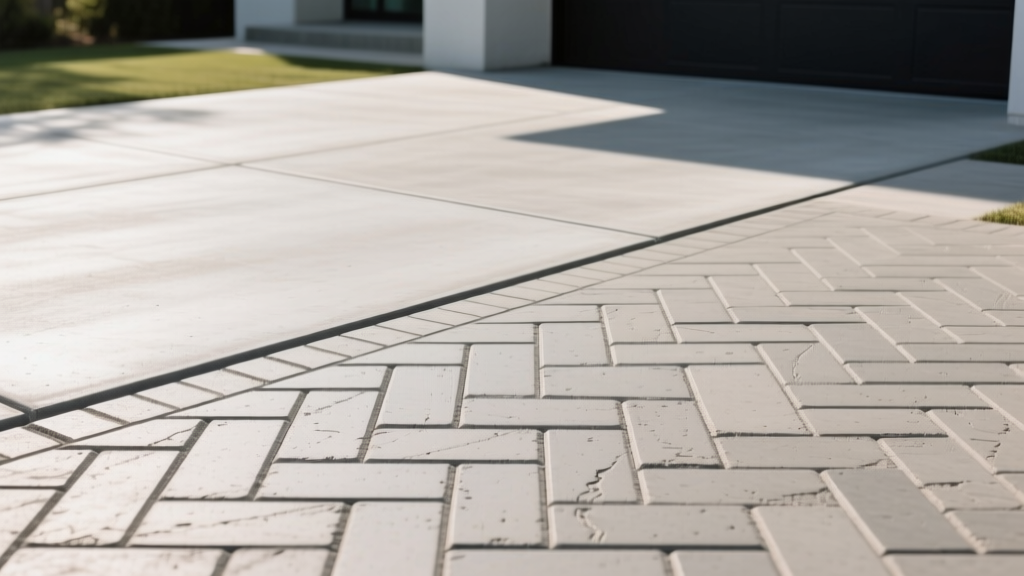
Concrete Paver Systems: Unit Density & Base Architecture
Concrete pavers are governed by ASTM C936, which mandates a minimum compressive strength of 8,000 PSI, maximum water absorption of 5%, and strict dimensional tolerances. Because they are dry-cast and machine-compacted, pavers possess a density and surface hardness that poured concrete cannot achieve without specialized, costly admixtures.
However, the paver units are only 20% of the system. The true structural engine of a paver driveway is the flexible granular base, which must be engineered to distribute loads while allowing water to drain.
The Interlocking Base Profile
Unlike a poured slab that requires a rigid, uniformly compacted subgrade, a paver system utilizes a layered, open-graded or dense-graded aggregate base. A standard heavy-duty residential paver base profile includes:
- Subgrade Preparation: Native soil compacted to 95% Standard Proctor density.
- Base Aggregate (6 to 10 inches): Crushed angular aggregate (typically 3/4-inch minus) compacted in 2-inch lifts. For poor-draining clay soils, an open-graded base (no fines) wrapped in non-woven geotextile fabric is preferred to prevent hydrostatic pressure buildup.
- Setting Bed (1 to 1.5 inches): Coarse, washed concrete sand conforming to ASTM C33. This layer is screeded to a precise grade but never compacted, allowing the pavers to settle uniformly during mechanical vibration.
- Edge Restraint: Rigid, heavy-duty polyethylene or aluminum restraint secured with 10-inch steel spikes every 12 inches. Without edge restraint, the interlocking matrix will spread and fail under vehicular shear forces.
Failure Mode & Maintenance Matrix
Understanding how each system fails dictates long-term maintenance budgets. Poured concrete is a rigid system; when the subgrade fails, the slab cracks. Pavers form a flexible system; when the subgrade fails, the surface settles but remains unbroken.
| Issue | Poured Concrete Slab | Interlocking Paver System |
|---|---|---|
| Subgrade Washout / Settling | Results in severe structural cracking, slab cantilevering, and costly full-depth replacement or mudjacking. | Pavers settle into the void. Fix requires lifting units, adding base aggregate, re-screeding sand, and replacing pavers. |
| Surface Staining (Oil/Grease) | Penetrates the porous cement paste. Requires chemical poultices or pressure washing, often leaving a permanent shadow. | Stained units can simply be extracted, flipped upside down, or replaced individually for near-zero cost. |
| Freeze-Thaw Scaling | Surface paste spalls and flakes if air-entrainment was inadequate or if deicing salts (calcium chloride) were used in year one. | High-density factory-cured pavers resist scaling. Deicing salts do not damage the unit surface. |
| Joint / Weed Intrusion | Control joints are sealed with flexible polyurethane caulk. Weeds rarely penetrate unless the sealant fails. | Relies on polymeric sand. If sand washes out or degrades, weeds will grow. Requires re-sanding every 3-5 years. |
The most common installation error in paver driveways is improper polymeric sand activation. Products like Techniseal PRO or Alliance Gator Maxx require a precise, light misting with a hose nozzle set to 'shower'. Using a high-pressure jet will wash the polymers out of the joint before they activate, leading to immediate joint failure and weed growth. Always follow the manufacturer's exact hydration protocol.
2026 Installed Cost Breakdown
Material and labor costs have stabilized following the supply chain disruptions of the early 2020s, but skilled masonry labor remains at a premium. The following costs reflect national averages for a standard 600-square-foot driveway installation in 2026, assuming moderate site preparation (no massive retaining walls or extreme grading).
| Cost Category | Poured Concrete (Broom Finish) | Concrete Pavers (Standard Pattern) |
|---|---|---|
| Site Prep & Excavation | $2.50 - $4.00 / sq ft | $3.50 - $5.50 / sq ft |
| Base Material & Compaction | $1.50 - $2.50 / sq ft | $3.00 - $4.50 / sq ft |
| Surface Material & Placement | $5.00 - $7.50 / sq ft | $9.00 - $14.00 / sq ft |
| Sealing / Jointing | $1.00 - $1.50 / sq ft | $2.00 - $3.50 / sq ft |
| Total Installed Range | $10.00 - $15.50 / sq ft | $17.50 - $27.50 / sq ft |
Site-Specific Decision Framework
Do not choose your driveway surface based solely on initial budget. Use this decision matrix to match the material to your site's specific environmental and structural demands.
Choose Poured Concrete If:
- Budget is the primary constraint: You need a durable, low-maintenance surface and want to keep initial capital expenditure under $15/sq ft.
- The subgrade is highly stable: Your site consists of well-draining sandy loam or bedrock, minimizing the risk of differential settlement.
- You prefer a seamless aesthetic: You want a minimalist, modern look (especially if upgrading to exposed aggregate or stamped concrete) without visible joint lines.
Choose Concrete Pavers If:
- You have expansive clay or poor drainage: The flexible nature of a paver system accommodates minor soil heaving without cracking. If a section settles, it can be unzipped and repaired invisibly.
- Utility access is required: If your driveway crosses water mains, sewer lines, or irrigation systems, pavers can be removed and replaced without the visible scar of a concrete patch.
- You want maximum surface durability: The 8,000+ PSI density of factory-cast pavers resists deicing salt damage and heavy point loads (like trailer jacks or RV stabilizers) far better than standard poured slabs.
Ultimately, the choice between a concrete vs paver driveway hinges on how you value initial cost versus long-term reparability. Poured concrete offers an economical, monolithic solution for stable sites, while interlocking pavers provide an engineered, flexible pavement system that excels in challenging soils and high-load environments.
Written by
Marcus ChenMarcus Chen is a licensed structural engineer (PE) and building materials analyst with over 12 years of experience across residential, commercial, and industrial construction. He holds a Master of Science in Civil Engineering from UC Berkeley and spent six years at Thornton Tomasetti before transitioning to independent consulting and technical writing. Marcus specializes in material selection for seismic-prone regions, concrete reinforcement strategies, and lifecycle cost analysis. His work has been cited by the American Concrete Institute (ACI) and the Structural Engineers Association of California (SEAOC). When he is not on a job site or at his desk, you will find him hiking the Sierra Nevada or restoring a 1920s craftsman bungalow in Oakland, CA.
More from Marcus Chen
View all
Construction Cost
How Much Did the Eiffel Tower Cost to Build?
How much did the Eiffel Tower cost to build in 1889? We adjust for inflation and compare its budget to modern skyscraper construction.
Aug 4, 2026

Fire Resistance
What Is a Fire Resistant Material? Testing & Certification Guide
Discover what is a fire resistant material through ASTM and UL testing. Learn how fire ratings, certifications, and assemblies work in construction.
Aug 4, 2026

Construction Cost
How Much Did the Burj Khalifa Cost to Build?
How much did the Burj Khalifa cost to build? We break down the $1.5B project and extract 5 money-saving strategies for your next build.
Jul 30, 2026