What Type of Drill for Concrete: The Ultimate Buyer's Guide
Discover what type of drill for concrete you need. Compare rotary hammers, hammer drills, and core drills with expert bit and OSHA safety tips.

The Core Decision Matrix: Matching Tool to Task
Determining what type of drill for concrete you need depends entirely on the diameter of the hole, the depth required, and whether you will encounter rebar. Using an undersized tool leads to motor burnout and shattered bits, while oversized tools waste capital and reduce precision. The fundamental divide in concrete drilling is between mechanical cam-action (standard hammer drills) and electro-pneumatic impact (rotary hammers).
| Tool Category | Impact Mechanism | Max Hole Diameter | Impact Energy | Best Use Case |
|---|---|---|---|---|
| Standard Hammer Drill | Cam-Action Mechanical | 1/2 inch | N/A (Relies on BPM) | Light duty: 1/4" anchors in block/brick |
| SDS-Plus Rotary Hammer | Electro-Pneumatic Piston | 1-1/8 inches | 1.5 - 3.0 ft-lbs | Medium duty: 3/8" to 3/4" wedge anchors |
| SDS-Max Rotary Hammer | Electro-Pneumatic Piston | 2 inches (or 6" core) | 5.0 - 12.0 ft-lbs | Heavy duty: Deep holes, large diameter cores |
| Rotary Core Drill | Water-Cooled Diamond Abrasion | 12+ inches | N/A (Torque dependent) | HVAC, plumbing, and electrical penetrations |
Understanding the Mechanism: Why Standard Drills Fail on Poured Concrete
A common mistake among DIYers and general contractors is attempting to drill into poured, cured concrete with a standard hammer drill. Standard hammer drills utilize two ridged metal discs clicking against each other to create vibration. This mechanism yields high Blows Per Minute (BPM)—often up to 50,000 BPM—but generates virtually zero actual impact energy (measured in Joules or foot-pounds).
In contrast, rotary hammers use an electro-pneumatic system. A drive piston compresses air in a cylinder, which then forces a flying piston to strike the back of the drill bit. This delivers a massive, concussive blow (typically 2 to 8 ft-lbs of impact energy) at a much lower BPM (1,500 to 4,500). This pneumatic hammering literally pulverizes the aggregate in the concrete mix, allowing the carbide flutes to evacuate the dust. If you are drilling anything larger than 1/4 inch into a structural concrete slab or foundation, an SDS-Plus or SDS-Max rotary hammer is mandatory.
Choosing the Right Concrete Drill Bit Geometry
The tool is only half the equation. The bit's shank type and cutter head geometry dictate drilling speed, bit lifespan, and safety when encountering submerged rebar.
Shank Systems: SDS-Plus vs. SDS-Max
The Slotted Drive System (SDS) allows the bit to slide back and forth within the chuck independently of the rotation, maximizing the transfer of pneumatic impact energy.
- SDS-Plus: Features a 10mm shank with four open grooves. Designed for bits up to 1-1/8 inches in diameter. Ideal for standard anchor installations (e.g., 1/2" wedge anchors for sill plates).
- SDS-Max: Features an 18mm shank with three closed grooves and two open grooves. Engineered to handle the extreme torque and impact energy of large-diameter drilling and deep-hole boring.
Cutter Head Geometry: 2-Cutter vs. 4-Cutter
When evaluating bits, you will encounter two primary carbide head designs:
OSHA Silica Dust Compliance and Extraction
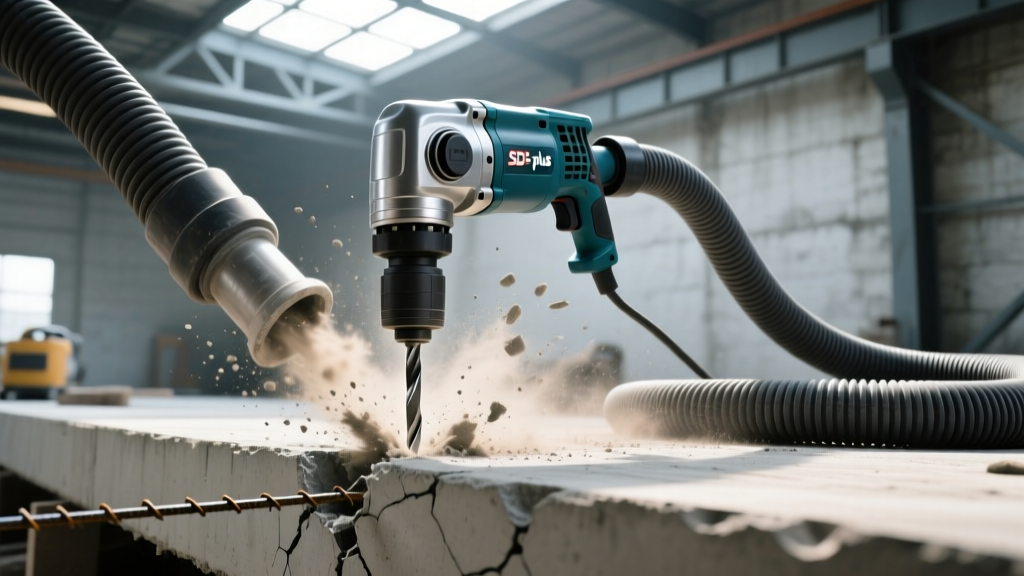
Drilling concrete generates respirable crystalline silica (RCS) dust, a known carcinogen that causes silicosis and lung cancer. Under OSHA Standard 1926.1153, employers must strictly limit worker exposure to RCS. Relying solely on a standard N95 mask is non-compliant for indoor concrete drilling.
To comply with OSHA Table 1 without requiring expensive ambient air monitoring, contractors must use integrated water delivery systems or HEPA-filtered dust extraction shrouds. According to NIOSH guidelines, a HEPA vacuum must capture 99.97% of particles at 0.3 microns. When using a rotary hammer indoors, attach a manufacturer-specific dust extraction shroud (e.g., Bosch HDC100 or Makita DX01) connected to a HEPA vacuum featuring an automatic filter cleaning mechanism to maintain suction velocity.
Step-by-Step Workflow for Clean, Blowout-Free Holes
Proper technique prevents concrete spalling (blowout) on the exit side and ensures anchors achieve their engineered pull-out strength.
- Mark and Punch: Use a center punch to create a divot. Concrete surfaces are often uneven, and a divot prevents the bit from 'walking' upon startup.
- Start Without Hammering: If your rotary hammer has a 'rotation-only' mode, start the hole for 2 seconds without the hammer function. This creates a clean guide channel and prevents surface spalling.
- Engage Hammer Mode and Manage RPM: Switch to hammer-drill mode. Do not run the tool at maximum RPM. High RPM generates excessive heat, which anneals (softens) the carbide tip and glazes the concrete. Maintain a medium trigger pull (approx. 50-70% speed) and let the pneumatic impact energy do the work.
- Clear the Flutes: Every 2 to 3 inches of depth, pull the spinning bit partially out of the hole to evacuate concrete dust. Packed dust insulates the bit, generating extreme heat and drastically slowing penetration rates.
- Handle Rebar Encounters: If the tool suddenly stops advancing and emits a high-pitched metallic whine, you have hit rebar. Do not apply excessive downward pressure. If using a 4-cutter bit, allow the tool to grind through the steel. If using a 2-cutter bit, stop immediately and switch to a dedicated rebar cutter bit, or abandon the hole and move the anchor location.
- Prevent Exit Blowout: When drilling completely through a slab or wall, reduce pressure and RPM during the final 1/4 inch of penetration to prevent the concrete from blowing out in large chunks on the opposite side.
Frequently Asked Questions
Can I use a masonry bit in a standard non-hammer drill?
Yes, but only for very small holes (under 3/16") in soft materials like cinder block or old, degraded mortar. Attempting this on cured, poured concrete will instantly dull the carbide tip and overheat the drill motor.
Why is my rotary hammer drilling incredibly slowly?
Slow drilling is almost always caused by one of three factors: applying too much downward pressure (which stalls the pneumatic piston's stroke), failing to clear dust from the hole (causing the bit to grind against packed dust instead of fresh concrete), or using a bit with worn, rounded carbide tips.
What is the difference between 'Hammer Drill' and 'Rotary Hammer' modes on the tool?
The terminology is often confused. On a rotary hammer, 'Hammer Drill' mode engages both rotation and the pneumatic piston. 'Hammer Only' mode stops the rotation and leaves only the piston striking, which is used exclusively with clay spades and chisels for demolition, not for drilling holes.
Written by
David NakamuraDavid Nakamura is a licensed architect (AIA) and construction technology writer focused on sustainable building methods, mass timber engineering, and high-performance building envelopes. He holds a Master of Architecture from the University of Washington and is a certified Passive House Consultant (CPHC). David spent eight years at the Seattle firm Mithun, where he led the design of three LEED Platinum projects, before founding his own practice specializing in net-zero residential design. He serves on the editorial advisory board of GreenBuilder Magazine and has authored peer-reviewed papers on cross-laminated timber (CLT) connections for the Journal of Structural Engineering. In his spare time, David teaches woodworking at Pratt Fine Arts Center and kayaks the Puget Sound.
More from David Nakamura
View all
Construction Cost
Labor Cost to Build a Deck Per Sq Ft: 2026 Installation Guide
Discover the exact labor cost to build a deck per sq ft in 2026. This installation guide breaks down contractor rates, complexity factors, and hidden fees.
Aug 4, 2026

Construction Cost
How Much Does It Cost to Build a 3 Bedroom House? Financing Guide
Learn exactly how much it costs to build a 3 bedroom house and explore 2026 financing options, construction loan types, and budget frameworks for your build.
Aug 4, 2026

Construction Cost
Cost to Build a Tennis Court: 2026 Guide
How much does it cost to build a tennis court in 2026? Breakdowns for asphalt, concrete, and synthetic surfaces plus fencing and lighting.
Jul 30, 2026