Different Types of Concrete vs. Alternative Building Materials
Compare different types of concrete against steel, timber, and asphalt alternatives. Explore costs, compressive strength, and structural applications.

The Material Matrix: Concrete Variants vs. Non-Concrete Alternatives
Selecting the primary structural or paving material for a commercial or high-end residential project requires balancing compressive strength, embodied carbon, and lifecycle costs. While standard ready-mix remains the default for many foundations, the landscape of different types of concrete has evolved significantly. Ultra-high-performance mixes, pervious formulations, and specialized geopolymers now compete directly with structural steel, cross-laminated timber (CLT), and advanced asphalt polymers.
This guide bypasses generic material overviews to provide a direct, data-driven comparison of specific concrete variants against their primary non-concrete alternatives, focusing on 2026 structural engineering standards, real-world pricing, and specific failure modes.
Quick Decision Framework
- If maximum tensile strength and long spans are required: Specify Structural Steel (W-shapes) or post-tensioned High-Performance Concrete (HPC).
- If rapid construction and low embodied carbon are priorities: Specify Cross-Laminated Timber (CLT) over standard reinforced concrete.
- If site drainage and stormwater management are critical: Specify Pervious Concrete (ASTM C1701) instead of traditional impermeable asphalt.
- If extreme blast, impact, or seismic resistance is needed: Specify Ultra-High-Performance Concrete (UHPC) with steel micro-fibers.
Breaking Down the Different Types of Concrete
Not all concrete is created equal. The American Concrete Institute (ACI) categorizes mixes based on performance characteristics rather than just constituent ratios. Here are the three primary structural variants used in modern construction:
1. Standard Ready-Mix (Normal Strength Concrete)
Standard ready-mix typically utilizes ASTM C150 Type I or II Portland cement, yielding compressive strengths between 3,000 and 5,000 psi. It relies on traditional rebar (ASTM A615) for tensile capacity. While highly versatile, its high water-cement ratio (0.45 to 0.55) makes it susceptible to chloride ingress and freeze-thaw degradation if not properly sealed.
2. Ultra-High-Performance Concrete (UHPC)
UHPC eliminates coarse aggregate entirely, relying on a dense matrix of fine silica sand, silica fume, and steel micro-fibers. Proprietary blends like Ductal achieve compressive strengths exceeding 21,000 psi and flexural strengths up to 3,500 psi. Because the matrix is virtually impermeable, UHPC does not require traditional rebar for secondary reinforcement, drastically reducing structural dead load.
3. Pervious (No-Fines) Concrete
Engineered for stormwater management, pervious concrete omits fine aggregates, creating a porous network with 15% to 25% void space. It yields lower compressive strengths (500 to 2,000 psi) but allows water to pass through at rates of 2 to 5 gallons per minute per square foot, effectively eliminating the need for subterranean retention basins in commercial parking structures.
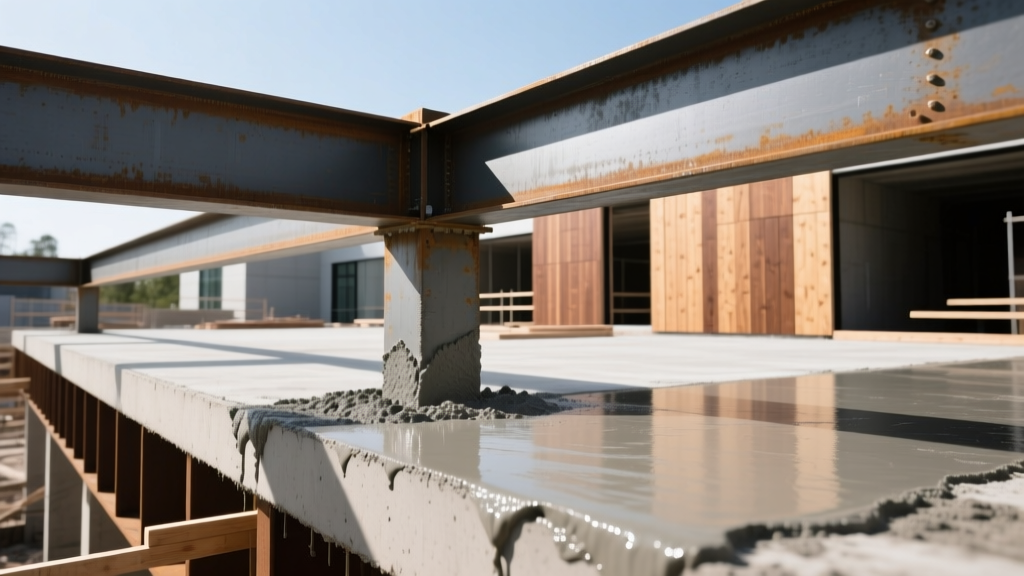
Head-to-Head: Concrete Types vs. Alternative Materials
To make an informed specification, we must compare these concrete variants against their direct market competitors: Structural Steel, Mass Timber, and Polymer-Modified Asphalt.
| Material | Primary Strength Metric | Approx. 2026 Cost | Embodied Carbon (kgCO2e/unit) | Ideal Application |
|---|---|---|---|---|
| Standard Ready-Mix | 4,000 psi (Compressive) | $135 - $165 / cu. yd. | ~350 per cubic meter | Foundations, retaining walls, standard slabs |
| UHPC | 21,000+ psi (Compressive) | $1,800 - $2,400 / cu. yd. | ~800 per cubic meter | Bridge decks, blast-resistant facades, thin shells |
| Pervious Concrete | 1,500 psi (Compressive) | $8.00 - $12.00 / sq. ft. | ~300 per cubic meter | Parking lots, pedestrian plazas, green infrastructure |
| Structural Steel (A992) | 50,000 psi (Yield Tensile) | $1,800 - $2,500 / ton | ~1.8 per kg | High-rise frames, long-span roofs, mezzanines |
| Mass Timber (CLT) | 4,300 psi (Bending) | $9.00 - $14.00 / sq. ft. | Negative (Carbon Sequestering) | Mid-rise floors, exposed architectural ceilings |
| Polymer Asphalt | N/A (Viscoelastic) | $3.50 - $5.50 / sq. ft. | ~0.4 per kg | Highway paving, heavy-duty logistics yards |
Deep Dive: When Alternatives Outperform Concrete
While the different types of concrete offer immense compressive capacity and thermal mass, alternative materials dominate in specific structural scenarios. The American Institute of Steel Construction (AISC) notes that structural steel remains unbeatable for speed of erection in high-rise construction. A steel frame can be topped out in weeks, whereas cast-in-place concrete requires sequential curing cycles (typically 7 days per floor) unless accelerated with costly steam curing or early-strength admixtures.
The Mass Timber Advantage for Mid-Rise
For structures between 5 and 12 stories, Cross-Laminated Timber (CLT) is increasingly displacing standard reinforced concrete slabs. According to data from WoodWorks, CLT panels act as both the structural floor deck and the architectural ceiling, eliminating the need for dropped ceilings, drywall, and fireproofing spray. While the upfront material cost of CLT ($9-$14/sq. ft.) is higher than a standard 6-inch concrete slab ($5-$7/sq. ft. installed), the reduction in crane time, shoring, and interior finishing often results in a 10% to 15% net savings on the total project schedule.
Pervious Concrete vs. Asphalt for Stormwater
In municipal and commercial paving, polymer-modified asphalt is cheaper upfront ($3.50/sq. ft.) than pervious concrete ($8.00/sq. ft.). However, asphalt is entirely impermeable. Specifying pervious concrete eliminates the need for underground stormwater detention vaults, which can cost upwards of $40 per cubic foot of storage capacity. When factoring in the elimination of subsurface drainage infrastructure, pervious concrete frequently achieves a lower total site-development cost.
Critical Failure Modes and Edge Cases
Material selection must account for how systems fail in the real world. Each material category possesses distinct vulnerabilities that engineers must mitigate during the design phase.
- Standard Concrete - Chloride Ingress: In marine environments or where de-icing salts are used, chlorides penetrate the capillary pores of standard concrete, corroding the internal rebar. Mitigation: Specify a maximum water-cement ratio of 0.40 and apply a silane/siloxane penetrating sealer.
- UHPC - Thermal Micro-Cracking: Because UHPC generates immense heat during hydration due to its high cementitious content, thick pours can experience thermal shock and micro-cracking if the ambient temperature drops below 50°F. Mitigation: Use internal curing agents (pre-wetted lightweight fine aggregates) and thermal blankets during winter pours.
- Structural Steel - Intumescent Coating Failure: Steel loses 50% of its yield strength at 1,100°F. In commercial buildings, steel requires intumescent paint for fire resistance. Edge Case: If the coating is applied in high humidity or over improperly blasted mill scale, it will delaminate during a fire event, leading to catastrophic collapse.
- Mass Timber - Envelope Moisture Trapping: CLT is highly susceptible to rot if exposed to weather during construction delays. Mitigation: Mandate the use of factory-applied, vapor-permeable weather barriers (like Intello) on all CLT panels before they leave the manufacturing facility.
Expert Warning: Never substitute standard ready-mix for UHPC in thin-shell applications without a complete structural redesign. UHPC relies on its steel fiber matrix for tensile ductility; standard concrete will experience brittle, catastrophic failure under the same bending moments.
Expert Verdict: Specifying the Right Matrix
The choice between the different types of concrete and alternative building materials is rarely about which material is universally 'better,' but rather which material aligns with the project's specific constraints regarding span, schedule, and environmental impact.
Specify Standard Ready-Mix for subterranean foundations and mass retaining walls where thermal mass and low cost are paramount. Upgrade to UHPC exclusively for architectural facades, bridge connections, or blast-resistant zones where reducing cross-sectional thickness justifies the 10x cost premium. For mid-rise floor decks where schedule and embodied carbon are the primary drivers, pivot to Mass Timber (CLT). Finally, for commercial paving where municipal stormwater fees are punitive, Pervious Concrete offers a superior lifecycle ROI compared to traditional asphalt and detention basins.
Written by
David NakamuraDavid Nakamura is a licensed architect (AIA) and construction technology writer focused on sustainable building methods, mass timber engineering, and high-performance building envelopes. He holds a Master of Architecture from the University of Washington and is a certified Passive House Consultant (CPHC). David spent eight years at the Seattle firm Mithun, where he led the design of three LEED Platinum projects, before founding his own practice specializing in net-zero residential design. He serves on the editorial advisory board of GreenBuilder Magazine and has authored peer-reviewed papers on cross-laminated timber (CLT) connections for the Journal of Structural Engineering. In his spare time, David teaches woodworking at Pratt Fine Arts Center and kayaks the Puget Sound.
More from David Nakamura
View all
Construction Cost
Labor Cost to Build a Deck Per Sq Ft: 2026 Installation Guide
Discover the exact labor cost to build a deck per sq ft in 2026. This installation guide breaks down contractor rates, complexity factors, and hidden fees.
Aug 4, 2026

Construction Cost
How Much Does It Cost to Build a 3 Bedroom House? Financing Guide
Learn exactly how much it costs to build a 3 bedroom house and explore 2026 financing options, construction loan types, and budget frameworks for your build.
Aug 4, 2026

Construction Cost
Cost to Build a Tennis Court: 2026 Guide
How much does it cost to build a tennis court in 2026? Breakdowns for asphalt, concrete, and synthetic surfaces plus fencing and lighting.
Jul 30, 2026