Stamped Concrete vs Regular: 2026 Cost Breakdown Analysis
Compare stamped concrete vs regular concrete costs in 2026. Detailed line-item pricing, labor multipliers, and lifecycle maintenance analysis.

The True Cost of Stamped Concrete vs Regular Concrete
When evaluating exterior paving options, the choice between stamped concrete and regular (plain broom-finished) concrete fundamentally comes down to a trade-off between aesthetic premium and budget constraints. While both utilize the same structural foundation—a 4,000 PSI ready-mix slab reinforced with fiber mesh or rebar—the surface treatment, labor intensity, and long-term maintenance profiles diverge significantly. In 2026, material inflation and specialized labor shortages have widened the price gap between these two finishes. According to the American Concrete Institute (ACI), decorative concrete applications require strict adherence to mix design and timing protocols that inherently drive up installation costs.
2026 National Average Cost Snapshot
Regular Concrete (Broom Finish): $8.50 – $12.50 per square foot installed.
Stamped Concrete (Single Pattern, One Color): $16.00 – $24.00 per square foot installed.
Stamped Concrete (Custom Multi-Color, Borders): $25.00 – $35.00+ per square foot installed.
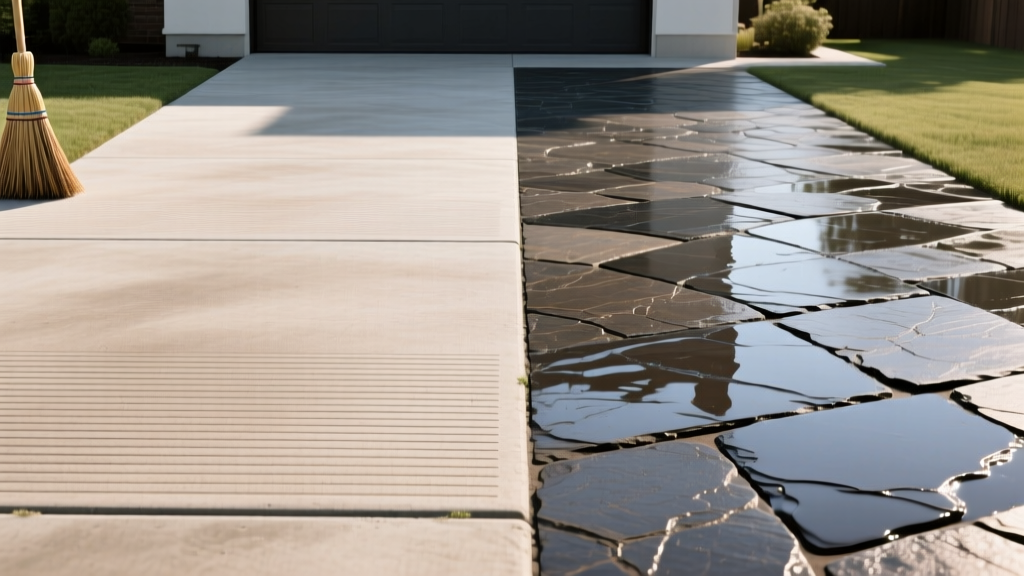
Line-Item Cost Breakdown: Where the Money Goes
To understand the financial delta between stamped concrete vs regular concrete, we must analyze a standard 1,000-square-foot residential patio project. The following table isolates the specific cost drivers for a 4-inch thick slab in a moderate climate zone.
| Project Phase | Regular Concrete Cost | Stamped Concrete Cost | Variance / Notes |
|---|---|---|---|
| Site Prep & Excavation | $1,500 | $1,800 | Stamped requires finer subgrade leveling to prevent mat rocking. |
| Forming & Base Material | $1,400 | $1,600 | Stiffer forms needed to hold heavier stamping crew equipment. |
| Ready-Mix Concrete (4000 PSI) | $7,500 | $8,200 | Stamped mix includes synthetic fiber mesh and slump retarders. |
| Color & Release Agents | $0 | $2,400 | Shake-on color hardener and antique release powder. |
| Finishing & Labor | $2,200 | $5,800 | Larger crew (4-6) required for time-sensitive stamping window. |
| Sealing & Curing | $0 | $1,400 | Two coats of solvent-based acrylic sealer required. |
| Total Project Cost (1,000 sq ft) | $12,600 ($12.60/sq ft) | $21,200 ($21.20/sq ft) | Stamped carries a ~68% premium over regular concrete. |
Material Specifications and Pricing Deep Dive
The structural integrity of both surfaces relies on the same National Ready Mixed Concrete Association standards for compressive strength. However, the surface materials dictate the visual outcome and the final price tag.
Ready-Mix and Reinforcement
Regular concrete driveways and patios typically utilize a standard 4,000 PSI mix with welded wire mesh (WWM) or #3 rebar on 24-inch centers. Stamped concrete demands a more engineered mix. Contractors typically specify a 4,000 to 4,500 PSI mix with a lower water-to-cement ratio (0.45 or below) and synthetic macro-fibers (like Fibermesh) to minimize plastic shrinkage cracking. Because stamped patterns cannot easily hide structural cracks the way a plain broom finish can, the mix often includes retarders to slow the curing process, buying the stamping crew extra working time. This specialized mix design adds roughly $15 to $25 per cubic yard compared to standard gray mix.
Color Systems and Release Agents
The most significant material divergence is the coloring system. While regular concrete is left in its natural gray state, stamped concrete utilizes one of two primary coloring methods:
- Integral Color: Liquid or powder pigment added directly to the ready-mix truck at the batch plant. Costs approximately $0.40 to $0.80 per square foot. It colors the entire slab, meaning surface chips won't reveal gray concrete underneath.
- Shake-On Color Hardener: Broadcast onto the surface of wet concrete and troweled in. Products like Butterfield Color PermaColor or Solomon Colors cost between $0.80 and $1.50 per square foot. This method creates a denser, more abrasion-resistant surface than integral color but requires higher skilled labor to apply evenly.
Additionally, stamping requires an antique release agent—a colored powder applied to the surface and the stamping mats to prevent the polyurethane tools from sticking to the concrete. This agent also settles into the grout lines of the stamp pattern, providing a secondary, contrasting color that mimics natural stone or brick.
Labor Multipliers: Why Stamping Demands a Premium
Labor is where the cost of stamped concrete vs regular concrete truly separates. A standard broom-finish slab can be poured, struck off, floated, and broomed by a skilled 3-person crew over a relaxed 6-hour window. The Portland Cement Association (PCA) notes that standard finishing tolerates minor delays and temperature fluctuations.
Stamping concrete is an aggressive, time-critical operation. Once the concrete reaches the exact window of plasticity—often a narrow 90-minute to 2-hour window depending on ambient temperature, humidity, and wind—the entire crew must mobilize. A standard stamping crew consists of 4 to 6 workers:
- The Applicator: Broadcasts the color hardener and release agent.
- The Floaters: Work the color into the surface with bull floats and darby hand tools.
- The Stampers: Physically press the polyurethane mats (which cost contractors upwards of $4,000 for a full set of professional tools) into the concrete, aligning patterns perfectly.
- The Detailer: Uses hand chisels and texture skins to fix edges and areas where the large mats cannot reach.
If the wind picks up and accelerates the curing process, the crew risks 'blowing' the pour, resulting in shallow stamp impressions or torn concrete. This high-stress environment and the need for specialized, experienced artisans command a labor premium of 150% to 200% over standard flatwork finishing.
Long-Term Maintenance and Lifecycle Costs
The initial installation is only half of the financial equation. The lifecycle maintenance of stamped concrete requires a continuous budget that regular concrete does not.
Warning: The Sealing Trap
Stamped concrete must be sealed to protect the color hardener and release agent from UV degradation and water infiltration. Homeowners must budget for resealing every 2 to 4 years using a high-quality solvent-based acrylic sealer (such as SuperSeal 25 or Cryli-Tek 5505). Resealing costs $1.50 to $2.50 per square foot. If the sealer is applied while moisture is still trapped in the slab, or if a non-breathable sealer is used, the surface will develop white, cloudy efflorescence blisters that require expensive chemical stripping to fix.
Conversely, regular broom-finished concrete is virtually maintenance-free. It does not require sealing (and sealing a standard driveway can actually make it dangerously slippery). While regular concrete may develop minor surface scaling over decades if exposed to harsh de-icing salts, it does not suffer from the aesthetic delamination or color fading inherent to poorly maintained stamped surfaces.
Traction and Safety Considerations
Regular concrete features a broom finish that provides excellent slip resistance, making it the mandatory choice for steep driveways, municipal sidewalks, and pool decks. Stamped concrete, once sealed with an acrylic topcoat, becomes remarkably slick when wet. To mitigate this liability, contractors must broadcast an anti-slip additive (like SureCrete SureGrip or SharkGrip) into the sealer during the final coat. This adds roughly $0.15 per square foot to the material cost but is non-negotiable for safety compliance in wet environments.
Decision Matrix: Project Scenarios and ROI
Choosing between stamped concrete vs regular concrete should be dictated by the specific functional requirements of the space and the property's overall value ceiling.
- Scenario A: The Primary Driveway (Heavy Vehicles, Snow Plows, De-icing Salts)
Recommendation: Regular Concrete. Stamped concrete is highly susceptible to surface scratching from snowplow blades, and the repeated use of magnesium chloride de-icers will rapidly degrade the acrylic sealer and bleach the antique release agent. A thick, 5-inch broom-finished slab with saw-cut control joints offers maximum durability and lowest lifecycle cost. - Scenario B: The Backyard Patio and Entertainment Area
Recommendation: Stamped Concrete. In outdoor living spaces where aesthetics directly correlate to property value and personal enjoyment, the 68% cost premium of stamping is justified. A slate or ashlar stone pattern mimics natural masonry at a fraction of the cost of hand-laid flagstone, offering an excellent return on investment for mid-to-high-tier residential properties. - Scenario C: The Budget-Constrained Walkway
Recommendation: Regular Concrete with Saw-Cut Scoring. If the budget cannot accommodate stamping but plain gray feels too industrial, opt for regular concrete with decorative saw-cut scoring (creating large 3x3 foot geometric grids) and a light integral color. This bridges the gap, adding architectural interest for less than $1.00 extra per square foot without the maintenance burden of stamped sealers.
Ultimately, regular concrete remains the undisputed champion of structural utility and low-maintenance economics. Stamped concrete is a specialized decorative overlay that demands a premium not just for the materials, but for the high-stakes, time-sensitive artistry required to execute it flawlessly. Align your choice with your long-term maintenance tolerance and the specific environmental stresses your project site will endure.
Written by
Elena RodriguezElena Rodriguez is a civil engineer and technical writer specializing in concrete technology, masonry systems, and ASTM/ACI compliance. She earned her B.S. in Civil Engineering from Texas A&M University and spent a decade at a materials testing laboratory, performing over 2,000 concrete compressive strength tests and masonry prism evaluations. Elena is an ACI-certified Field Testing Technician (Grade I) and a member of ASTM Committee C12 on Natural Building Stone. She currently consults on forensic engineering cases involving concrete failures and moisture intrusion. Based in San Antonio, TX, Elena is a proud member of the Society of Women Engineers (SWE) and coaches her daughter's FIRST Robotics team.
More from Elena Rodriguez
View all
Walls & Panels
Cost Analysis: Light Gauge Steel Framing Advantages and Disadvantages
Evaluate light gauge steel framing advantages and disadvantages through a strict cost analysis lens, comparing material, labor, and lifecycle expenses.
Aug 4, 2026

Walls & Panels
Gypsum Board Types: Exact Specifications, Thickness & Dimensions
Compare standard, Type X, and moisture-resistant gypsum board types. Get exact specifications, thicknesses, dimensions, and ASTM standards for your project.
Aug 4, 2026

Fire Resistance
Best Fire-Resistant Outdoor Decking Materials: 2026 Buyer Guide
Discover the best fire-resistant outdoor decking materials for 2026. Compare Class A PVC, aluminum, and hardwood options for WUI compliance and safety.
Aug 4, 2026