GFRC Technical Specs: The Ultimate Replacement Deck Chair Material
Explore the technical specifications of GFRC and UHPC as a replacement deck chair material. Compare tensile strength, weight, and mix designs.

The Engineering Shift to Cementitious Composites
When landscape architects and high-end furniture manufacturers evaluate a replacement deck chair material for harsh exterior environments, traditional options present significant engineering compromises. High-density polyethylene (HDPE) suffers from thermal expansion and UV degradation, teak requires intensive maintenance, and cast aluminum transfers heat uncomfortably. In 2026, advanced cementitious composites—specifically Glass Fiber Reinforced Concrete (GFRC) and Ultra-High-Performance Concrete (UHPC)—have emerged as the superior technical solution for architectural outdoor seating.
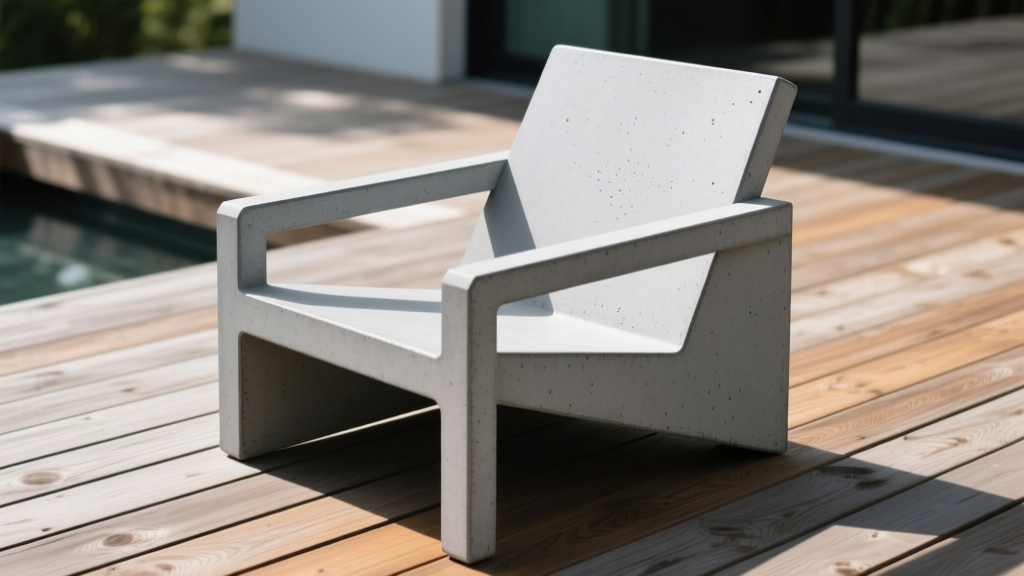
Unlike standard poured concrete, which is brittle and excessively heavy, GFRC and UHPC utilize discontinuous fiber reinforcement to achieve high flexural strength at minimal thicknesses. This allows for the casting of ergonomic, compound-curve deck chairs that weigh less than 60 pounds while offering absolute immunity to rot, UV fading, and biological degradation.
Formulation Specifications: GFRC vs. UHPC Mix Designs
The viability of concrete as a deck chair material relies entirely on the precision of the mix design. Standard concrete lacks the tensile capacity to withstand the dynamic point-loads of a seated user without catastrophic brittle failure. The following formulations represent the current industry standards for architectural furniture casting.
Glass Fiber Reinforced Concrete (GFRC) Matrix
GFRC is the most common choice for replacement deck chair material due to its optimal balance of cost, weight, and surface finish. The matrix relies on a high-cement, low-water formulation reinforced with alkali-resistant (AR) glass fibers.
- Cementitious Binder: 55-60% Type I/II Portland cement. White Portland cement is preferred for integral color consistency.
- Aggregate: 40-45% graded silica sand (50/70 mesh). Particle size distribution is critical to prevent nozzle clogging during spray-up applications.
- Reinforcement: 4.0-5.0% AR glass fibers by weight. The zirconia content must exceed 16% to prevent alkali-silica reaction (ASR) and long-term embrittlement.
- Water-to-Cement (w/c) Ratio: Strictly maintained between 0.30 and 0.34.
- Admixtures: Polycarboxylate ether (PCE) based superplasticizers to achieve a flowable consistency without increasing the w/c ratio, alongside a vinyl acetate ethylene (VAE) polymer modifier for improved bond strength and reduced permeability.
Ultra-High-Performance Concrete (UHPC) Matrix
For ultra-thin, cantilevered deck chair designs (such as continuous ribbon loungers), UHPC provides unparalleled structural capacity. UHPC eliminates coarse aggregate entirely, relying on optimized particle packing and micro-steel fibers.
- Compressive Strength: Exceeds 22,000 psi (150 MPa) at 28 days.
- Flexural Strength: 1,500 to 2,500 psi post-cracking residual strength.
- Reinforcement: 2.0% by volume micro-steel fibers (typically 13mm length, 0.2mm diameter).
- Density: Approximately 155 lbs/ft³, requiring thinner cross-sections to match the weight of thicker GFRC.
Never substitute standard E-glass fibers for AR (Alkali-Resistant) glass in GFRC furniture. The high pH of Portland cement (12.5-13.5) will dissolve standard glass fibers within 2 to 5 years, leading to sudden, catastrophic structural collapse of the deck chair under load. Always specify AR glass with a minimum 16% zirconia content, as verified by the manufacturer's mill test report.
Structural and Physical Performance Matrix
To understand why advanced cementitious composites are replacing legacy materials, we must compare their physical properties under standardized testing protocols. The table below contrasts GFRC and UHPC against traditional teak and recycled HDPE lumber.
| Material Property | GFRC (Spray-Up) | UHPC | Teak Wood | HDPE (Poly-Lumber) |
|---|---|---|---|---|
| Compressive Strength (ASTM C39) | 6,000 - 8,000 psi | > 22,000 psi | ~ 7,500 psi | N/A (Yields) |
| Flexural Strength (ASTM C78) | 2,000 - 3,000 psi | 3,500 - 5,000 psi | ~ 1,800 psi | ~ 4,500 psi |
| Modulus of Elasticity | 2.0 - 3.0 x 10^6 psi | 6.5 - 7.5 x 10^6 psi | 1.4 x 10^6 psi | 0.15 x 10^6 psi |
| Water Absorption (ASTM C642) | < 5.0% | < 1.5% | Varies (Swells) | 0.01% |
| Thermal Conductivity (W/m·K) | ~ 1.2 | ~ 1.5 | ~ 0.15 | ~ 0.45 |
Manufacturing Tolerances and Casting Techniques
Deck chairs require complex ergonomic geometries, including lumbar support curves and reclined backrest angles. The choice of casting methodology directly impacts the structural integrity of these compound curves.
Spray-Up vs. Premix Methodologies
For high-end replacement deck chair material applications, the spray-up method is vastly superior to the premix method. In spray-up, a chopper gun simultaneously deposits the cementitious slurry and cuts continuous AR glass fiber rovings into 1-inch lengths, propelling them onto the mold. This allows for randomized, 3D fiber orientation that perfectly conforms to the tight radii of an ergonomic backrest.
Premix GFRC, where fibers are blended into the mixer, suffers from fiber balling and uneven distribution in tight corners, creating localized weak points. Furthermore, premix limits fiber content to roughly 3%, whereas spray-up can achieve 5-6% fiber volume, significantly increasing the flexural capacity required for cantilevered armrests.
Minimum Thickness and Structural Ribbing
To maintain a manageable weight, GFRC deck chairs are cast as hollow shells. The minimum specified thickness for the primary load-bearing shell (seat pan and backrest) is 3/8 inch (9.5mm). To prevent deflection under a 300-pound dynamic load, the rear of the shell must be reinforced with structural ribs. These ribs are typically 1 inch wide by 2 inches deep, spaced at 8-inch centers, and cast integrally during the secondary build-up phase. According to the Precast/Prestressed Concrete Institute (PCI), proper ribbing allows GFRC panels to span significant distances while maintaining minimal cross-sectional thickness.
Weight Management and Core Engineering
A solid concrete deck chair would weigh upwards of 250 pounds, rendering it entirely impractical for residential or commercial decks. Advanced manufacturing utilizes lost-core techniques to manage weight.
- EPS Foam Cores: Expanded polystyrene is CNC-milled to the exact ergonomic contour of the chair. The GFRC is sprayed over the foam, creating a rigid composite structure. The foam remains inside, providing thermal insulation and reducing total weight to approximately 45-55 pounds.
- Hollow Rotational Casting: For UHPC, specialized molds allow for a hollow, double-walled construction. This requires precise control of the UHPC rheology to ensure the material coats the mold walls evenly before setting.
Environmental Degradation and Freeze-Thaw Dynamics
Outdoor furniture is subjected to severe environmental cycling. The primary failure mode for cementitious materials in cold climates is freeze-thaw spalling. Because GFRC and UHPC are cast with extremely low w/c ratios (below 0.35), their capillary pore structure is highly discontinuous. This drastically reduces water permeability.
When tested under ASTM C666 freeze-thaw protocols, properly formulated and cured GFRC exhibits a durability factor exceeding 90% after 300 cycles. To ensure long-term weathering resistance, integral water repellents (such as silane or siloxane admixtures) are added directly to the mix at a dosage of 1-2% by weight of cement. This provides bulk hydrophobicity, preventing water ingress even if the surface sealer is scratched or worn away over years of use.
Troubleshooting Edge Cases in Production
Manufacturing concrete furniture introduces unique production challenges that do not exist in wood or plastic fabrication.
Cause: Rapid moisture evaporation from the thin 3/8-inch GFRC shell before initial set, particularly in low-humidity manufacturing environments.
Solution: Apply a monomolecular evaporation retardant immediately after spraying. Maintain ambient curing room humidity above 85% and temperature at 70°F (21°C) for the first 24 hours. Never use standard burlap curing on complex ergonomic molds, as it will bridge over concave curves and fail to retain moisture against the concrete surface.
Cause: Glass fibers migrating to the surface during vibration or mold release, creating visible white streaks that ruin the architectural finish.
Solution: Apply a high-quality, semi-permanent mold release agent formulated specifically for GFRC. Utilize a fine-mist face coat (1/8 inch thick) containing no fibers, allowed to set for 15 minutes before applying the fiber-rich structural backup coat. This ensures a pristine, fiber-free aesthetic surface.
Conclusion on Material Selection
Specifying GFRC or UHPC as a replacement deck chair material requires a fundamental shift from traditional carpentry or plastics manufacturing to precision composite engineering. By strictly adhering to low w/c ratios, utilizing AR glass or micro-steel fibers, and employing spray-up casting over ergonomic EPS cores, manufacturers can produce outdoor seating that is structurally superior, thermally stable, and virtually immune to environmental degradation. For architectural projects demanding a 50-year service life with zero maintenance, advanced cementitious composites remain the undisputed technical choice.
Written by
Sarah WhitfieldSarah Whitfield is a chartered quantity surveyor (MRICS) and construction cost analyst with 15 years of experience in material pricing, procurement strategy, and project budgeting. She earned her degree in Construction Management from the University of Reading (UK) and has worked on projects ranging from $2M custom homes to $180M mixed-use developments across North America and Europe. Sarah currently leads cost estimating for BuildMat Insight, maintaining a proprietary database of 4,000+ material price points updated quarterly. She is a frequent contributor to RSMeans cost data panels and has presented at the International Cost Engineering Council (ICEC) congress. Based in Denver, CO, Sarah is an avid trail runner and volunteer mentor for Women in Construction.
More from Sarah Whitfield
View all
Wood & Lumber
What Are the Different Types of Wood? A Builder's Guide
Compare structural softwoods, finish hardwoods, and engineered lumber. Analyze Janka ratings, MOE values, and 2026 pricing for construction.
Aug 4, 2026

Walls & Panels
Steel Framing vs Wood Framing: Corrosion and Moisture Defense
Compare steel framing vs wood framing for moisture resistance. Learn about galvanized coatings, condensation risks, and corrosion protection strategies.
Jul 21, 2026

Stone & Masonry
How to Cut Stone Veneer: Wet Saw vs Grinder Comparison
Compare the best tools for cutting stone veneer. We review wet saws, angle grinders, and chop saws to help you achieve clean, chip-free cuts.
Jul 21, 2026