Fiberglass Pool Cost vs Concrete: 2026 Installation Guide
Compare the fiberglass pool cost vs concrete in 2026. This installation guide breaks down labor, materials, curing times, and hidden site risks.

The Installation Divide: Why Fiberglass Pool Cost vs Concrete Hinges on Labor
When homeowners and contractors evaluate the fiberglass pool cost vs concrete, the debate rarely centers on the raw materials alone. The true cost divergence lies in the installation methodology. A concrete (gunite or shotcrete) pool is built entirely from scratch on-site, requiring weeks of specialized labor, forming, steel tying, and pneumatic application. Conversely, a fiberglass pool is manufactured off-site in a controlled factory environment and dropped into an excavated hole via crane, compressing the structural installation phase into a single day. In 2026, with skilled masonry and steel-tying labor rates continuing to climb, understanding the granular installation steps of both methods is critical for accurate budgeting and project scheduling.
Concrete Pool Installation: The Gunite and Shotcrete Process
Concrete pools rely on a steel-reinforced shell that is pneumatically applied over a precisely excavated and formed dirt bowl. The installation process is highly sequential, meaning delays in one phase cascade through the entire project timeline.
Key Installation Steps and Material Specs
- Excavation and Forming: The site is dug to the exact profile of the pool, including deep ends and tanning ledges. Wooden or foam forms are built to define the coping line and bond beam.
- Steel Reinforcement: A continuous grid of #3 or #4 (3/8-inch to 1/2-inch) steel rebar is tied at 10-inch to 12-inch on-center intervals. This steel cage is elevated off the dirt using plastic or concrete "chairs" to ensure it sits in the middle of the eventual concrete shell.
- Plumbing Rough-In: PVC pressure and suction lines are trenched and glued before the shell is applied. Hydrostatic relief valves are installed in the main drain sump to prevent groundwater from pushing the empty shell upward.
- Pneumatic Application: According to guidelines referenced by the American Concrete Institute (ACI), shotcrete (wet-mix) or gunite (dry-mix) is applied to a thickness of 8 to 12 inches. The mix typically targets a compressive strength of 4,000 to 5,000 PSI at 28 days.
- Curing and Finishing: The shell requires a 28-day hydration period to reach full structural integrity. During this time, it must be kept moist to prevent shrinkage cracking before the interior plaster, pebble, or tile finish is applied.
Fiberglass Pool Installation: The Crane and Backfill Method
Fiberglass pools bypass the on-site structural building phase entirely. The shell is a pre-engineered composite of fiberglass mat, woven roving, and vinyl ester resin, typically finished with a 25-to-30-mil UV-stabilized gelcoat. The installation focuses heavily on earthworks, crane logistics, and precise backfilling.
Key Installation Steps and Material Specs
- Over-Excavation and Base Prep: The hole is dug 12 to 18 inches wider than the pool shell on all sides. The floor is leveled using a laser transit and topped with a 2-to-4-inch bed of clean, crushed angular gravel or washed masonry sand to create a perfectly flat, non-shifting base.
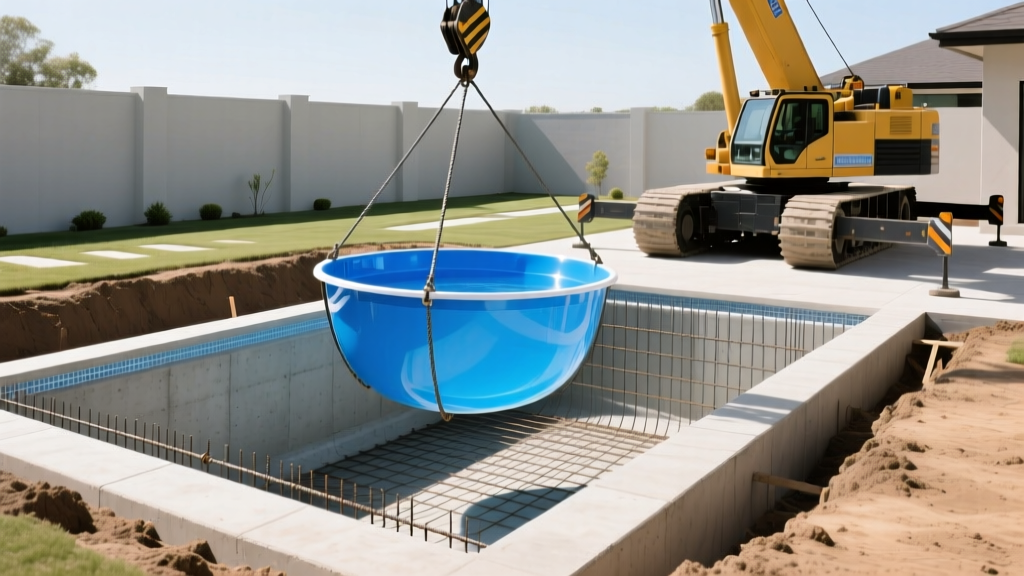
- Crane Placement and Setting: A mobile crane (typically 50 to 80 tons) lifts the shell using specialized nylon spreading straps to prevent gelcoat scratching. The shell is lowered into the excavation and leveled within a 1/4-inch tolerance.
- Simultaneous Fill and Backfill: This is the most critical installation step. As the pool is filled with water, the installer simultaneously backfills the exterior perimeter with clean, 3/8-inch angular crushed stone. The water weight inside pushes outward, while the gravel pushes inward, equalizing the hydrostatic pressure and preventing the fiberglass walls from bowing.
- Cantilever Coping and Decking: Because fiberglass shells flex slightly under load, the surrounding concrete deck must be isolated from the pool coping using a 1/2-inch expansion joint (mastic or closed-cell foam) to prevent the rigid deck from cracking the pool's bond beam.
2026 Cost Breakdown: Fiberglass Pool Cost vs Concrete
The following table illustrates the average installed costs for a standard 14' x 28' rectangular pool in 2026. Note that while the base fiberglass shell is cheaper, site access constraints (requiring larger cranes) and extensive gravel backfill can narrow the price gap.
| Cost Category | Concrete (Gunite/Shotcrete) | Fiberglass |
|---|---|---|
| Excavation & Dirt Hauling | $6,000 - $12,000 | $5,000 - $9,000 |
| Shell Materials & Steel | $18,000 - $25,000 | $22,000 - $35,000 (Factory Shell) |
| Specialized Labor (Setting/Forming) | $20,000 - $35,000 | $4,000 - $8,000 (Crane & Crew) |
| Backfill & Base Materials | $2,000 - $4,000 | $5,000 - $9,000 (Clean Gravel) |
| Plumbing, Equipment & Electric | $12,000 - $18,000 | $10,000 - $15,000 |
| Interior Finish (Plaster vs Gelcoat) | $8,000 - $15,000 | Included in Shell |
| Total Estimated Installed Cost | $85,000 - $130,000+ | $60,000 - $95,000 |
Hidden Installation Risks and Failure Modes
Beyond the initial invoice, poor installation practices lead to expensive remediation. The Pool & Hot Tub Alliance (PHTA) publishes strict ANSI/APSP standards for both concrete and fiberglass installations, yet contractor errors remain common.
Concrete: Rebound and Shrinkage Cracking
In shotcrete applications, "rebound" occurs when the aggregate bounces off the rebar and falls to the pool floor. If the nozzleman does not trim this weak, sandy material away before it sets, it creates a structural cold joint. Furthermore, if the concrete shell is not watered continuously during the 28-day cure, rapid moisture loss causes plastic shrinkage cracking, requiring expensive epoxy injections before the interior plaster can be applied.
Fiberglass: Groundwater Buoyancy and Wall Bowing
A fiberglass pool shell is essentially a massive, hollow boat. If installed in an area with a high water table and the pool is drained for winter maintenance without a functioning hydrostatic relief system, groundwater buoyancy can literally push the entire pool out of the ground, destroying the surrounding deck and plumbing. Additionally, failing to fill the pool with water simultaneously with the gravel backfill will cause the exterior earth pressure to crush the side walls inward, voiding the manufacturer's structural warranty.
The Site-Specific Decision Framework
Choosing between the two materials requires evaluating your specific site constraints against the installation realities of each method.
Choose Concrete If: You require a highly customized, non-standard shape or oversized dimensions (e.g., a 20' x 60' lap pool). You have tight overhead obstructions (power lines, mature trees) that prevent a mobile crane from swinging a 14,000-pound fiberglass shell. You are building an infinity edge or vanishing edge, which requires complex on-site forming that fiberglass cannot accommodate.
Choose Fiberglass If: You are on a strict timeline and need the pool operational within 4 to 6 weeks. Your site has wide, unobstructed access for a crane and dump trucks delivering 40 tons of clean gravel. You want a non-porous gelcoat surface that resists algae growth and requires significantly less chemical maintenance and acid washing over its lifespan.
Ultimately, the fiberglass pool cost vs concrete debate is settled by the site logistics. While fiberglass offers a lower baseline installation cost and a drastically compressed timeline, concrete remains the undisputed choice for architectural complexity and unlimited dimensional scaling. Assess your lot access, soil composition, and design requirements before committing to the excavation phase.
Written by
Elena RodriguezElena Rodriguez is a civil engineer and technical writer specializing in concrete technology, masonry systems, and ASTM/ACI compliance. She earned her B.S. in Civil Engineering from Texas A&M University and spent a decade at a materials testing laboratory, performing over 2,000 concrete compressive strength tests and masonry prism evaluations. Elena is an ACI-certified Field Testing Technician (Grade I) and a member of ASTM Committee C12 on Natural Building Stone. She currently consults on forensic engineering cases involving concrete failures and moisture intrusion. Based in San Antonio, TX, Elena is a proud member of the Society of Women Engineers (SWE) and coaches her daughter's FIRST Robotics team.
More from Elena Rodriguez
View all
Walls & Panels
Cost Analysis: Light Gauge Steel Framing Advantages and Disadvantages
Evaluate light gauge steel framing advantages and disadvantages through a strict cost analysis lens, comparing material, labor, and lifecycle expenses.
Aug 4, 2026

Walls & Panels
Gypsum Board Types: Exact Specifications, Thickness & Dimensions
Compare standard, Type X, and moisture-resistant gypsum board types. Get exact specifications, thicknesses, dimensions, and ASTM standards for your project.
Aug 4, 2026

Fire Resistance
Best Fire-Resistant Outdoor Decking Materials: 2026 Buyer Guide
Discover the best fire-resistant outdoor decking materials for 2026. Compare Class A PVC, aluminum, and hardwood options for WUI compliance and safety.
Aug 4, 2026