Types of Concrete Expansion Joints vs Control Joints Compared
Compare types of concrete expansion joints against control and isolation alternatives. Discover material costs, recovery rates, and spacing rules.

The Joint Hierarchy: Expansion vs. Control vs. Isolation
Concrete is a rigid, brittle material with a coefficient of thermal expansion of approximately 5.5 x 10^-6 per °F. When a 100-foot exterior slab experiences a 50°F temperature increase, it expands by roughly 0.33 inches. Without proper jointing, this thermal expansion generates immense internal compressive stress, leading to uncontrolled blowups, spalling, and structural failure. Understanding the specific types of concrete expansion joints—and knowing when to use alternative jointing systems—is the difference between a durable slab and a maintenance nightmare.
Before evaluating materials, it is critical to distinguish between the three primary joint categories in flatwork and paving:
- Expansion Joints: Designed with compressible filler materials to accommodate the physical expansion of concrete during temperature spikes. They completely separate adjacent pours.
- Control (Contraction) Joints: Saw-cut or tooled grooves that weaken the slab to force shrinkage cracking along a straight, hidden line. They do not accommodate expansion.
- Isolation Joints: Full-depth separations used where a slab abuts a fixed, immovable structure like a building foundation, column, or drainage inlet.
Comparing the Types of Concrete Expansion Joints
When an expansion joint is structurally required—typically at 20- to 30-foot intervals in exterior flatwork, or at rigid structural abutments—the choice of filler material dictates the joint's lifespan. As of 2026, closed-cell foams dominate commercial specifications, though legacy materials remain in use.
| Material Type | Recovery Rate | Water Absorption | Best Application | Est. Material Cost / LF |
|---|---|---|---|---|
| Closed-Cell Polyethylene Foam | > 95% | < 1% | Commercial flatwork, tilt-up panels, pool decks | $0.65 - $1.20 |
| Asphalt-Impregnated Fiberboard | ~ 70% | High (wicks moisture) | Residential driveways, light-duty sidewalks | $0.45 - $0.85 |
| Preformed Neoprene/Rubber Seals | 100% | 0% | Heavy-duty highway bridges, airport runways | $3.50 - $8.00+ |
| Cork / Cork-Rubber Blends | ~ 85% | Low | Architectural finishes, historical restoration | $2.00 - $4.50 |
Why Closed-Cell Foam is the Modern Standard
Traditional asphalt-impregnated fiberboard (often referred to generically by legacy brand names like Celotex) suffers from permanent deformation. When concrete expands and crushes the fiberboard, the material extrudes upward and fails to rebound when the concrete contracts in winter. This leaves a void that fills with incompressible debris (rocks, dirt), which then causes the slab edges to spall during the next thermal expansion cycle. Closed-cell polyethylene foam, such as Stego Wrap or Dow Corning joint fillers, features a cross-linked cellular structure that compresses and recovers its original shape almost perfectly, preventing debris infiltration and maintaining sealant integrity.
When to Choose Alternatives Over Expansion Joints
A common engineering error in residential and light-commercial construction is the overuse of expansion joints. Expansion joints are expensive to form, difficult to finish, and require ongoing sealant maintenance. In many scenarios, alternative jointing strategies are structurally superior and more cost-effective.
The Case for Saw-Cut Control Joints
According to guidelines published by the National Ready Mixed Concrete Association (NRMCA), the vast majority of cracking in slabs-on-grade is caused by volumetric shrinkage during the curing process, not thermal expansion. Control joints address this shrinkage by creating a plane of weakness. By saw-cutting joints to a depth of 25% of the slab thickness (e.g., a 1-inch cut on a 4-inch slab) within 4 to 12 hours of placement, contractors force the concrete to crack internally at the joint rather than randomly across the surface.
The Aggregate Interlock Advantage: Unlike expansion joints, which completely sever the slab and eliminate load transfer, saw-cut control joints maintain aggregate interlock. The fractured stone beneath the cut transfers shear loads across the joint, preventing differential settlement and faulting without the need for expensive steel dowel baskets.
Isolation Joints for Fixed Abutments
If a concrete patio is poured directly against a house foundation, an expansion joint is technically the wrong terminology; an isolation joint is required. Isolation joints utilize a thicker compressible material (typically 1/2-inch to 1-inch closed-cell foam) to absorb both the slab's expansion and any differential settlement between the new slab and the existing deep foundation.
Decision Framework: Which Joint Do You Actually Need?
- Scenario A: Slab is abutting a building, curb, or light pole.
Solution: Use a 1/2-inch closed-cell foam Isolation Joint. - Scenario B: Long exterior driveway or sidewalk exceeding 30 feet in length.
Solution: Use a 1/2-inch foam Expansion Joint every 30 feet, with Control Joints spaced every 10 feet in between. - Scenario C: Interior warehouse slab or standard residential garage.
Solution: Skip expansion joints entirely. Use a grid of saw-cut Control Joints spaced at 15-foot intervals (or L/W ratio of 1.5). - Scenario D: Highway paving or heavy industrial aprons subject to extreme heat.
Solution: Use doweled Expansion Joints with preformed neoprene compression seals.
Installation Tolerances and Sealant Failure Modes
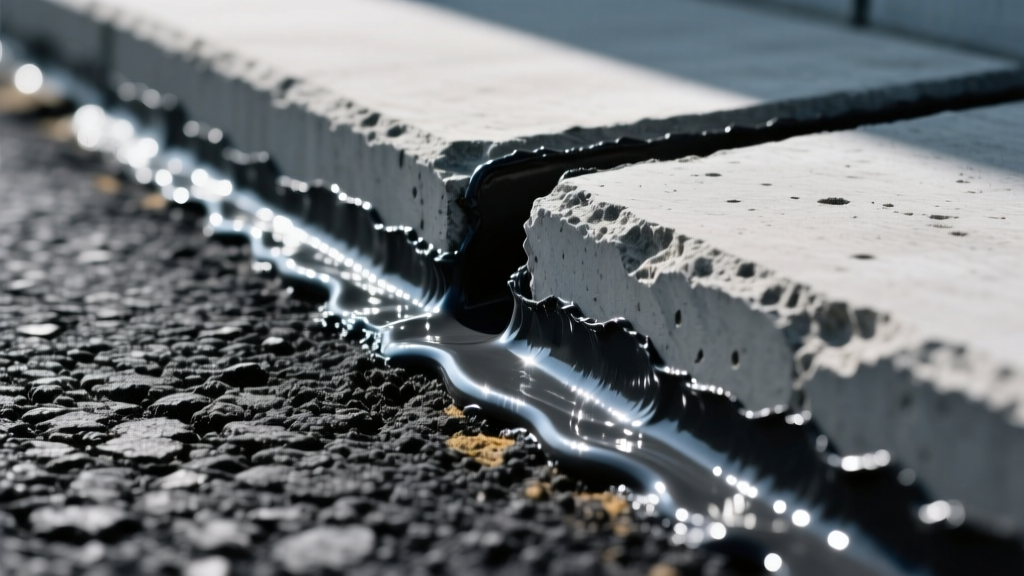
The best types of concrete expansion joints will fail prematurely if the sealant system is installed incorrectly. The sealant's job is to keep water and incompressibles out of the joint; the filler's job is to support the sealant.
The 3-Sided Bond Breaker Rule
Polyurethane and silicone joint sealants (such as Sika Sikaflex-1a or MasterSeal NP 1) must only adhere to the two vertical sides of the concrete joint. If the sealant bonds to the bottom of the joint or the filler material, it experiences three-sided adhesion. When the joint opens, the sealant will tear itself apart rather than stretching. Always install a closed-cell polyethylene backer rod that is 25% larger than the joint width to force it tightly against the sidewalls and act as a bond breaker at the base.
Depth-to-Width Ratios
Sealant geometry dictates its ability to stretch and compress without cohesive failure. The Federal Highway Administration (FHWA) and sealant manufacturers mandate strict shape factors:
- For joints 1/2 inch or narrower: The sealant depth must equal the width (1:1 ratio).
- For joints wider than 1/2 inch: The sealant depth must be half the width (1:2 ratio), with a maximum depth of 1/2 inch.
Applying sealant too deep wastes material and restricts the elastomer's movement capabilities, leading to adhesion failure at the concrete interface.
2026 Material and Labor Cost Breakdown
Budgeting for jointing systems requires factoring in both the raw materials and the specialized labor required for forming, finishing, and sealing. The costs below reflect national averages for commercial and high-end residential flatwork in 2026.
| Joint System | Material Cost (per LF) | Labor Cost (per LF) | Total Installed Cost (per LF) | Maintenance Cycle |
|---|---|---|---|---|
| Saw-Cut Control Joint (No Sealant) | $0.05 (Blade wear) | $0.80 - $1.20 | $0.85 - $1.25 | None |
| Fiberboard Expansion + Urethane Sealant | $1.50 - $2.00 | $3.50 - $5.00 | $5.00 - $7.00 | 5 - 8 Years |
| Closed-Cell Foam + Urethane Sealant | $1.80 - $2.50 | $3.50 - $5.00 | $5.30 - $7.50 | 10 - 15 Years |
| Preformed Neoprene Compression Seal | $4.00 - $7.00 | $8.00 - $12.00 | $12.00 - $19.00 | 20+ Years |
While saw-cut control joints are exponentially cheaper to install and maintain, they cannot replace expansion joints in environments where thermal expansion forces exceed the concrete's compressive strength. Attempting to save $6.00 per linear foot by substituting control joints for expansion joints on a large exterior apron routinely results in localized slab buckling, which costs upwards of $45.00 per square foot to demolish and replace.
Industry Standards and Sourcing
Proper joint detailing is governed by rigorous engineering standards. When drafting specifications or reviewing contractor submittals, ensure compliance with the following foundational documents:
- ACI 224.3R-95: The American Concrete Institute's definitive guide on Joints in Concrete Construction, detailing spacing limits, dowel bar requirements, and load-transfer mechanics.
- ASTM D1751: Standard Specification for Preformed Expansion Joint Fillers for Concrete Paving and Structural Construction (Nonextruding and Resilient Bituminous Types).
- ASTM D545: Standard Specification for Preformed Expansion Joint Fillers for Concrete Paving and Structural Construction (Cork and Cork-Rubber).
By matching the correct joint type to the specific structural and environmental demands of the slab, engineers and contractors can eliminate random cracking, preserve load-transfer efficiency, and drastically reduce long-term maintenance liabilities.
Written by
Priya KapoorPriya Kapoor is a real estate market analyst and construction economics researcher with expertise in housing affordability, development feasibility, and infrastructure investment. She holds a Master of Regional Planning from Cornell University and previously worked as a senior analyst at CBRE's Investment Properties group, where she modeled returns for $4B in mixed-use development pipelines. Priya now runs an independent research practice advising developers, municipalities, and REITs on construction cost forecasting and market timing. She publishes the quarterly "BuildMat Market Pulse" report tracking material price indices across 12 commodity categories. Based in Austin, TX, Priya serves on the board of Habitat for Humanity Austin and is a marathon runner.
More from Priya Kapoor
View all
Construction Cost
Cost to Build a 1600 Sq Ft Home in 2026: Full Breakdown
Accurate 2026 cost to build a 1600 sq ft home—material, labor, and regional pricing breakdowns included. Plan your budget with real-time estimates.
Aug 11, 2026

Wood & Lumber
Name the Types of Wood for Pressure Treatment and Preservation
Learn how to name the types of wood best suited for pressure treatment. Compare species treatability, chemical retention levels, and 2026 preservation costs.
Aug 4, 2026

Stone & Masonry
Stone Veneer Suppliers Lindenhurst: 2026 Cost Analysis
Analyze 2026 stone veneer costs in Lindenhurst, NY. Compare local supplier pricing, delivery fees, and Suffolk County installation labor rates.
Aug 4, 2026