Fibreglass Pool vs Concrete: 2026 Cost Breakdown Analysis
Compare the true 2026 costs of a fibreglass pool vs concrete. Detailed breakdown of installation, 10-year maintenance, and site-specific hidden expenses.

The True Cost of Ownership: Beyond the Initial Quote
When evaluating a fibreglass pool vs concrete (shotcrete or gunite) installation, the initial contractor quote only tells a fraction of the financial story. In 2026, stabilized supply chains have slightly eased the volatility of raw resin and steel prices, but specialized labor rates and site-preparation costs remain high. A comprehensive cost breakdown analysis must account for the material science of the shell, the thermodynamics of water heating, and the long-term chemical maintenance required by each substrate.
Concrete pools offer unlimited customization in shape and depth, utilizing a 4,000 PSI shotcrete mix reinforced with #4 (1/2-inch) steel rebar on a 10-inch grid. Fibreglass pools, conversely, are manufactured off-site using marine-grade isophthalic polyester resin and vinyl ester barrier coats to prevent osmotic blistering, limiting their maximum width to 16 feet due to Department of Transportation highway transport regulations. Understanding the financial divergence between these two structural approaches is critical for accurate budget forecasting.
Upfront Installation Cost Breakdown (2026 Data)
The baseline cost for a standard 14x28 foot pool varies significantly based on the shell material and the associated site work. Below is a comparative analysis of average line-item costs for a mid-to-high-end residential installation in 2026.
| Cost Category | Fibreglass Pool (14x28 ft) | Concrete Pool (14x28 ft) | Cost Variance Driver |
|---|---|---|---|
| Excavation & Soil Removal | $6,500 - $9,000 | $9,500 - $14,000 | Concrete requires wider overdig for formwork, plumbing trenches, and rougher grading. |
| Shell Material & Engineering | $22,000 - $38,000 | $28,000 - $45,000 | Concrete includes steel, shotcrete, and standard marcite plaster. Fibreglass includes the pre-molded shell. |
| Crane Rental & Rigging | $1,800 - $4,500 | $0 | Fibreglass requires a heavy-lift crane (often 100-ton) for precise placement. |
| Plumbing & Equipment Pad | $8,000 - $12,000 | $9,000 - $14,000 | Similar costs, though concrete often integrates more complex in-floor cleaning systems. |
| Coping & Basic Decking | $9,000 - $16,000 | $14,000 - $26,000 | Concrete pools typically utilize cantilever coping and require more extensive forming. |
| Total Estimated Baseline | $65,000 - $95,000 | $85,000 - $130,000+ | Concrete costs scale rapidly with custom depths, vanishing edges, and integrated spas. |
For a deeper understanding of manufacturer specifications and structural warranties, industry resources like Latham Pool Products provide detailed engineering comparisons between pre-engineered shells and site-built concrete structures.
Material Science: The "Alkalinity Tax" of Concrete
The most significant financial divergence between a fibreglass pool vs concrete occurs in years two through ten. This is driven by the chemical nature of the pool's interior finish.
Long-Term Surface Maintenance
- Concrete (Marcite Plaster): Lasts 7 to 12 years. Resurfacing costs $6,000 to $9,000. Must be acid-washed every 3-5 years ($400-$600 per service) to remove calcium scaling and algae embedded in the pores.
- Concrete (PebbleTec/Aggregate): Lasts 20+ years. Adds $8,000 to $12,000 to the initial installation cost. Highly resistant to staining but still requires regular brushing to prevent algae adhesion in the microscopic crevices between pebbles.
- Fibreglass: The 30-35 mil gelcoat surface lasts 20 to 30 years with zero resurfacing required. Algae cannot penetrate the glass-smooth surface, reducing brushing labor and chemical algaecide usage by up to 75%.
The 10-Year Financial Projection
To accurately compare the total cost of ownership (TCO), we must project operational expenses over a decade. According to consumer guidance from the Pool & Hot Tub Alliance (PHTA), operational efficiency is heavily dictated by the shell's thermal properties and surface friction.
Heating and Thermal Loss
Concrete possesses high thermal mass. It acts as a heat sink, absorbing thermal energy from the water and transferring it into the surrounding soil. A fibreglass pool, utilizing a resin matrix and often backfilled with insulating clean crushed stone, retains heat significantly better. If you are heating your pool with a 140,000 BTU heat pump or a gas heater, expect to spend 15% to 22% more on annual heating costs for a concrete pool compared to an identically sized fibreglass shell.
Chemical and Pumping Costs
Because fibreglass surfaces are frictionless, water flows more efficiently through the plumbing system, allowing homeowners to use smaller, variable-speed pumps (e.g., a 1.5 HP pump instead of a 2.0 HP pump) to achieve the same turnover rate. Furthermore, the non-porous nature of fibreglass reduces chlorine consumption by approximately 30%, as the chemical is not absorbed into the shell walls.
10-Year Maintenance Summary: Over a decade, a concrete pool with standard plaster will require roughly $4,500 more in chemicals, $3,000 more in heating, and will be approaching a $7,500 resurfacing mandate. A fibreglass pool will typically incur less than $2,000 in cumulative surface-related maintenance over the same period.
Site-Specific Hidden Costs and Edge Cases
Standard cost calculators often fail to account for site-specific variables that can drastically alter the final invoice. When deciding between a fibreglass pool vs concrete, evaluate your property against these hidden cost triggers.
1. Crane Access and Overhead Obstructions
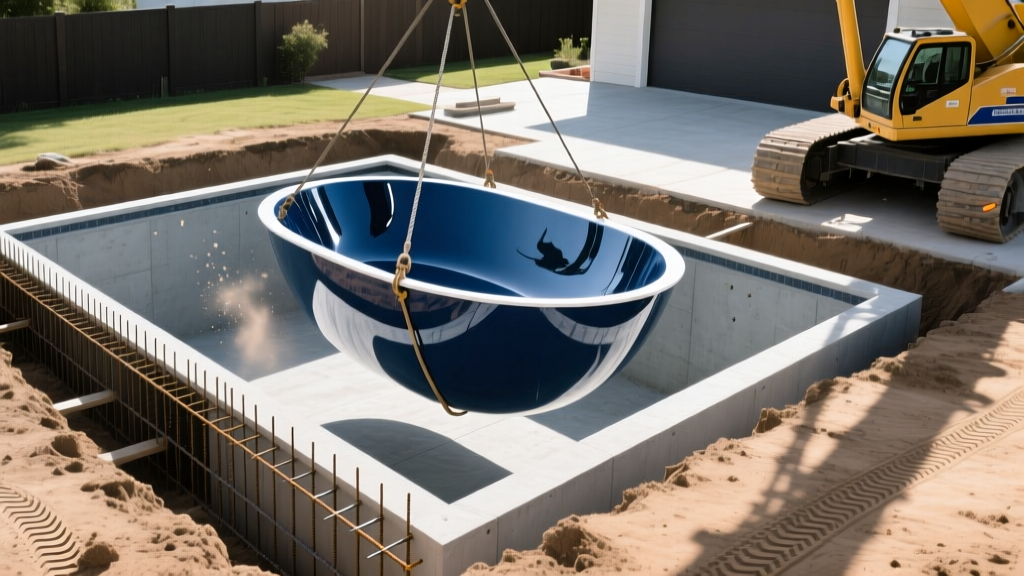
Fibreglass pools are delivered in a single piece and lowered into the excavation via crane. This requires a minimum 30-foot wide clearance path and zero overhead power lines or mature tree canopies. If a standard mobile crane cannot access your backyard, you may require a specialized articulated crane or a helicopter lift, which can add $5,000 to $15,000 to the project. Concrete pools are built in-situ, making them the only viable option for properties with severe access restrictions.
2. High Water Tables and Hydrostatic Pressure
In coastal regions or areas with heavy clay soil, the groundwater table can rise above the pool floor during rainy seasons. While both pool types require hydrostatic relief valves in the sump, an empty fibreglass pool is essentially a massive, lightweight boat. If the groundwater rises, the shell can "pop" out of the ground, destroying the plumbing and decking. To mitigate this in high water table zones, contractors must engineer a concrete "collar" around the fibreglass shell or install a permanent automated sump pump system, adding $3,500 to $6,000 to the excavation phase.
3. Backfill Material Specifications
Fibreglass pools require a very specific backfill material: 3/8-inch clean crushed stone (often called "pea gravel" or "clean stone"). This material flows like liquid around the structural ribs of the shell and locks into place without retaining water. Using native soil or sharp gravel can cause point-loading, leading to structural bulging or cracking of the gelcoat. Clean crushed stone is more expensive than standard fill dirt, adding roughly $1,200 to $2,000 to the material costs.
Decision Framework: Which Material Fits Your Scenario?
Use this matrix to determine the most cost-effective material for your specific project parameters. Comprehensive guides from networks like HGTV's Pool Material Resources echo the necessity of matching the shell type to the homeowner's lifestyle and property constraints.
Choose Fibreglass If:
- You want the lowest 10-year total cost of ownership.
- You prefer a smooth, non-abrasive surface for children and pets.
- Your backyard has wide, unobstructed access for a crane.
- You are satisfied with standard geometric or freeform shapes (up to 16ft wide).
- You want to minimize weekly brushing and chemical balancing.
Choose Concrete If:
- You require a custom shape, extreme depth (e.g., diving wells), or a vanishing edge.
- Your property has narrow access alleys or dense overhead tree canopies.
- You want to integrate complex hardscaping, such as sun shelves with custom tile mosaics or integrated concrete spas.
- You are building a commercial or high-use community pool where surface abrasion is a secondary concern to structural mass.
Final ROI and Resale Considerations
From a real estate perspective, both pool types add comparable value to a home, provided they are well-maintained. However, a 15-year-old concrete pool with aging, stained plaster will often trigger a $10,000 resurfacing negotiation during a home inspection, effectively reducing the home's net sale price. A 15-year-old fibreglass pool, assuming the gelcoat has not been subjected to extreme chemical abuse, will typically show minimal wear and require no immediate capital expenditure from the buyer. When calculating your budget, factor in not just the cost to build, but the cost to maintain the asset's liquidity over time.
Written by
David NakamuraDavid Nakamura is a licensed architect (AIA) and construction technology writer focused on sustainable building methods, mass timber engineering, and high-performance building envelopes. He holds a Master of Architecture from the University of Washington and is a certified Passive House Consultant (CPHC). David spent eight years at the Seattle firm Mithun, where he led the design of three LEED Platinum projects, before founding his own practice specializing in net-zero residential design. He serves on the editorial advisory board of GreenBuilder Magazine and has authored peer-reviewed papers on cross-laminated timber (CLT) connections for the Journal of Structural Engineering. In his spare time, David teaches woodworking at Pratt Fine Arts Center and kayaks the Puget Sound.
More from David Nakamura
View all
Construction Cost
Labor Cost to Build a Deck Per Sq Ft: 2026 Installation Guide
Discover the exact labor cost to build a deck per sq ft in 2026. This installation guide breaks down contractor rates, complexity factors, and hidden fees.
Aug 4, 2026

Construction Cost
How Much Does It Cost to Build a 3 Bedroom House? Financing Guide
Learn exactly how much it costs to build a 3 bedroom house and explore 2026 financing options, construction loan types, and budget frameworks for your build.
Aug 4, 2026

Construction Cost
Cost to Build a Tennis Court: 2026 Guide
How much does it cost to build a tennis court in 2026? Breakdowns for asphalt, concrete, and synthetic surfaces plus fencing and lighting.
Jul 30, 2026