Freddy's Menu Concrete vs Sundae Prep Flooring: 2026 Cost Breakdown
Compare 2026 build-out costs for Freddy's menu polished concrete vs sundae station epoxy flooring. Expert QSR construction breakdowns and material specs.

The QSR Flooring Divide: Aesthetic vs. Chemical Resistance
When executing a commercial build-out for a quick-service restaurant (QSR) franchise like Freddy's Frozen Custard & Steakburgers, general contractors face a distinct flooring bifurcation. The front-of-house dining and menu areas demand high-traffic durability and modern aesthetics, typically achieved through polished concrete. Conversely, the back-of-house sundae and frozen custard preparation stations require extreme chemical resistance to withstand dairy acids, sugar spills, and rigorous sanitation protocols. Treating these zones with a uniform flooring system is a critical error that leads to either premature floor failure in the kitchen or unnecessary capital expenditure in the dining room. This 2026 cost breakdown analyzes the material specifications, labor requirements, and long-term maintenance realities of Freddy's menu concrete versus sundae station specialty coatings.
Freddy's Menu & Dining Area: Polished Concrete Specs & Costs
The modern QSR aesthetic heavily favors exposed, polished concrete for dining and menu queue areas. It eliminates the need for secondary floor coverings like VCT or tile, reducing long-term maintenance costs associated with stripping and waxing. For a standard franchise footprint, the dining area typically spans 1,500 to 2,500 square feet.
Technical Specifications
To achieve the signature satin sheen seen in contemporary franchise designs, contractors must utilize a mechanical planetary grinder equipped with diamond-impregnated segments. The process involves grinding the concrete to a 400-grit or 800-grit finish. According to guidelines established by the American Concrete Institute (ACI), applying a lithium silicate densifier during the 200-grit stage is mandatory to harden the surface and prevent dusting. A final application of a penetrating stain guard is required to mitigate oil and soda spills in the menu area.
2026 Polished Concrete Cost Breakdown
| Line Item | Specification | Cost per Sq. Ft. |
|---|---|---|
| Surface Prep & Grinding | Metal bond diamonds (30/40 grit) | $1.25 - $1.75 |
| Densification | Lithium silicate liquid hardener | $0.40 - $0.60 |
| Honing & Polishing | Resin pads (100 to 800 grit) | $2.10 - $3.50 |
| Stain Protection | Fluoropolymer penetrating sealer | $0.50 - $0.85 |
| Total Installed Cost | Per Sq. Ft. (Dining/Menu Zone) | $4.25 - $6.70 |
The Sundae & Custard Station: Chemical-Resistant Systems
The sundae preparation area is a highly corrosive environment. Frozen custard, ice cream, and dairy toppings contain lactic acid. When dairy spills onto standard concrete, the acid reacts with the calcium carbonate and calcium hydroxide in the cement paste, causing etching, spalling, and eventual structural degradation of the slab surface. Standard epoxies will yellow and delaminate under these conditions. The sundae station requires a USDA-compliant, heavy-duty novolac epoxy or polyurethane mortar system.
Technical Specifications
For dairy-rich environments, a 100% solids novolac epoxy mortar applied at a minimum thickness of 1/8 inch (125 mils) is the baseline standard. This must be top-coated with an aliphatic polyurethane to provide UV stability and enhanced abrasion resistance. Furthermore, NSF International sanitation standards dictate that the flooring must integrate seamlessly with the walls to prevent bacterial harborage. This requires installing a 4-inch to 6-inch integral epoxy cove base, which adds significant labor and material complexity to the sundae station footprint.
2026 Sundae Station Flooring Cost Breakdown
- Substrate Preparation: Closed-loop shot blasting to achieve a CSP-3 profile ($1.50 - $2.00/sq. ft.)
- Moisture Mitigation: Epoxy moisture vapor barrier (required if MVER exceeds 3 lbs/1000 sq. ft./24hrs per ASTM International F1869 testing) ($2.50 - $4.00/sq. ft.)
- Novolac Epoxy Mortar: Trowel-applied, 1/8 inch thickness ($6.00 - $8.50/sq. ft.)
- Polyurethane Topcoat: Aliphatic, chemical-resistant finish ($1.50 - $2.25/sq. ft.)
- Integral Cove Base: 4-inch radius cove, priced per linear foot but amortized to approx. ($2.50/sq. ft. of floor area)
- Total Installed Cost: $14.00 - $19.25 per Sq. Ft.
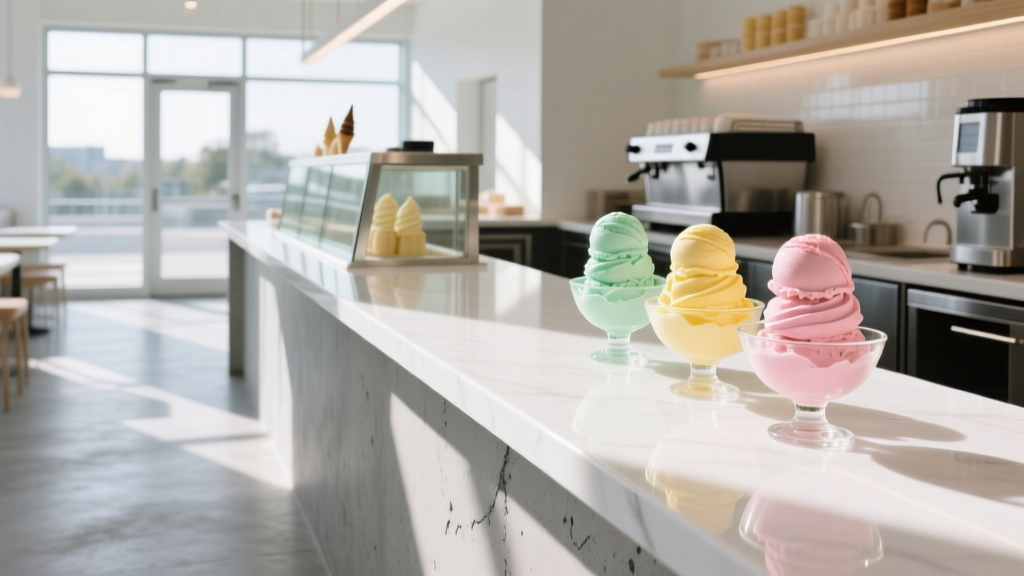
Direct Comparison: Menu Concrete vs Sundae Station Flooring
Understanding the performance delta between these two systems is critical for value engineering a QSR build-out without compromising health codes or structural longevity.
| Performance Metric | Menu Area (Polished Concrete) | Sundae Station (Novolac Epoxy) |
|---|---|---|
| Installed Cost (2026) | $4.25 - $6.70 / sq. ft. | $14.00 - $19.25 / sq. ft. |
| Lactic Acid Resistance | Poor (Requires immediate cleanup) | Excellent (Impervious to dairy acids) |
| Thermal Shock Tolerance | Moderate | High (Withstands hot washdowns) |
| Slip Resistance (Wet) | Low (Requires anti-slip additives) | High (Aggregate broadcast available) |
| Installation Timeline | 4 - 7 Days | 3 - 5 Days (Rapid cure options) |
Hidden Costs: Moisture Mitigation and Curing Delays
The most frequent budget overruns in QSR flooring occur due to ignored substrate conditions. Polished concrete in the menu area is highly susceptible to moisture vapor transmission. If the concrete slab was poured without a proper vapor retarder (a common issue in strip-mall tenant improvements), the polishing process can expose pinholes and cause the densifier to fail, resulting in a hazy, uneven finish. Testing via ASTM F2170 (relative humidity probes) is mandatory before mobilizing polishing equipment.
Novolac epoxy systems in the sundae station require strict temperature and humidity controls to cure properly. If the HVAC system is not fully commissioned and maintaining 70°F with <50% relative humidity, the epoxy can blush or remain tacky. A failed cure in the custard prep area will require a complete tear-out and re-pour, potentially delaying the franchise health inspection and grand opening by 10 to 14 days.
Expert Verdict for Franchise Build-Outs
Attempting to value-engineer a Freddy's build-out by extending the polished concrete from the menu area into the sundae prep station is a catastrophic financial decision. The cost to repair acid-etched concrete and replace failing sealers in a dairy environment will eclipse the initial savings of skipping the novolac epoxy within the first 18 months of operation. Conversely, installing heavy-duty polyurethane mortar throughout the entire dining and menu area is an unjustifiable capital expense, adding upwards of $25,000 to a standard 3,000-square-foot footprint. By strictly zoning the flooring—utilizing 800-grit polished concrete for the front-of-house and 1/8-inch novolac epoxy with integral cove base for the sundae station—contractors deliver a space that meets both the brand's aesthetic standards and rigorous health department sanitation codes.
Written by
James ThorntonJames Thornton is a construction industry veteran with 25 years of hands-on experience in wood framing, lumber grading, and residential building codes. He started as a framing carpenter in rural Oregon, earned his ICC Residential Building Inspector certification, and eventually became a senior plan reviewer for the City of Portland Bureau of Development Services. James holds a B.S. in Wood Science & Technology from Oregon State University and is a certified lumber grader through the West Coast Lumber Inspection Bureau (WCLIB). He has inspected over 3,000 residential construction sites and authored the city's internal guide on advanced framing techniques (2x6 at 24" O.C.). James lives in Bend, OR, where he builds custom timber-frame cabins and competes in lumberjack sports.
More from James Thornton
View all
Insulation
Best Home Insulation Materials: Complete 2026 Guide
Compare top home insulation materials for 2026. Find R-values, installed costs per square foot, and best uses for fiberglass, spray foam, and mineral wool.
Aug 4, 2026

Sustainable Building
Certify Your Green Building Material for LEED and WELL
Step-by-step guide to certifying a green building material for LEED v5 and WELL v2. Master EPDs, HPDs, and VOC limits for 2026 project specifications.
Aug 4, 2026

Stone & Masonry
Veneer Stacked Stone Panels: Interior Design & Style Showcase
Discover how veneer stacked stone panels transform interiors. Explore modern design profiles, material pairings, and technical installation specs.
Aug 4, 2026