Concrete Tile Roof vs Asphalt Shingles: Application & Cost Guide
Compare concrete tile roof vs asphalt shingles. Explore structural weight limits, installation costs, lifespan, and climate performance for your next build.
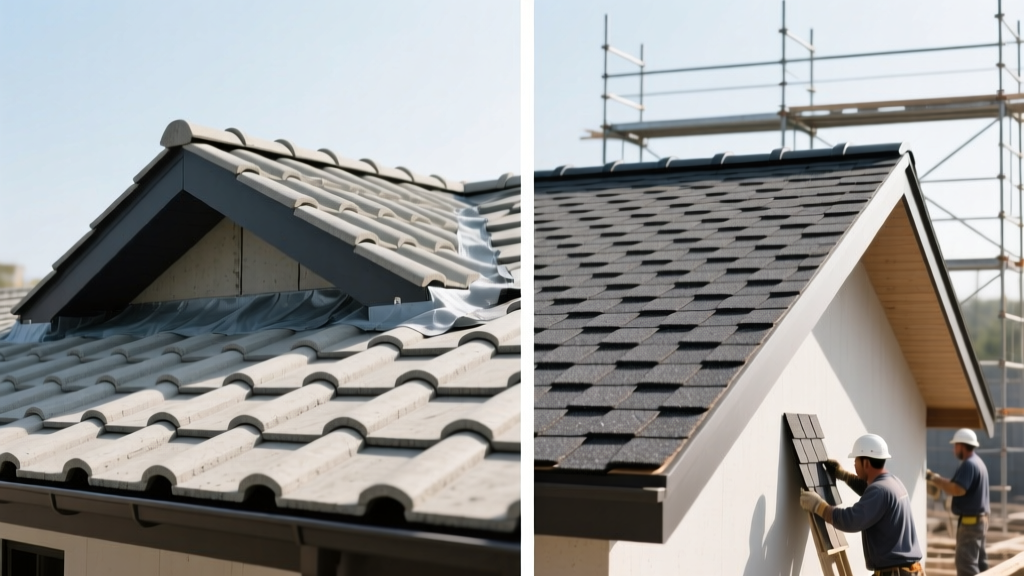
The Structural Reality: Weight and Framing Requirements
When evaluating a concrete tile roof vs asphalt shingles, the immediate visual difference masks a massive divergence in structural engineering and installation physics. In 2026, material science has improved both options—synthetic underlayments have extended tile system lifespans, while polymer-modified asphalt shingles offer enhanced impact resistance. However, selecting between them requires a rigorous assessment of your building’s load-bearing capacity.
Concrete tiles are exceptionally dense. A standard concrete profile (such as a flat or barrel tile) weighs between 600 and 1,100 pounds per square (100 square feet). In stark contrast, premium architectural asphalt shingles weigh just 200 to 250 pounds per square. This 4x weight differential dictates the roof framing design.
A standard residential roof truss designed for asphalt (often utilizing 2x4 top chords at 24 inches on center) will likely deflect or fail under the dead load of concrete tiles. Upgrading to 2x6 or 2x8 top chords, reducing spacing to 16 inches O.C., and adding structural hurricane tie-downs is mandatory for tile. This structural reinforcement typically adds $1.50 to $3.00 per square foot to the initial framing budget.
Application Showcase: Climate and Environmental Performance
The application environment heavily influences which material will outperform the other. According to the Tile Roofing Institute Alliance (TIA), concrete tiles excel in high-wind and coastal environments due to their interlocking profiles and mechanical fastening, while the Asphalt Roofing Manufacturers Association (ARMA) notes that modern polymer-modified shingles have drastically closed the gap in impact resistance.
| Performance Metric | Concrete Tile System | Premium Architectural Asphalt |
|---|---|---|
| Dead Load Weight | 600 - 1,100 lbs / sq | 200 - 250 lbs / sq |
| Wind Uplift Rating | Up to 150+ mph (with mechanical clips) | 110 - 130 mph (ASTM D3161 Class F/H) |
| Fire Resistance | Inherent Class A (non-combustible) | Class A (via fiberglass/granules) |
| Impact Resistance | High (Class 3/4 depending on profile) | Class 3 or 4 (UL 2218 polymer-modified) |
| Thermal Emittance | High (air gap creates thermal break) | Low to Medium (unless cool-roof coated) |
For homes in wildfire-prone zones (WUI - Wildland-Urban Interface), concrete is the superior application. While both carry a Class A fire rating, asphalt shingles can melt or become compromised by airborne embers lodging in the granule matrix, whereas concrete is entirely non-combustible and sheds embers effectively.
Financial Breakdown: Material, Labor, and Hidden Costs
Pricing a roof requires looking beyond the material cost per square. The total installed cost involves tear-off, decking prep, underlayment, and the roofing material itself.
2026 Cost per Square (100 sq ft) Estimates
- Premium Architectural Asphalt Shingles: Material costs range from $130 to $190 per square. Fully installed (including synthetic underlayment and ice/water shield at the eaves), expect to pay $450 to $750 per square.
- Standard Concrete Tile (Flat or Barrel): Material costs range from $250 to $450 per square. Fully installed (including specialized tile underlayment, battens, and mechanical clips), expect to pay $950 to $1,600 per square.
- Structural Reinforcement (Concrete Only): If the existing or planned trusses require upgrading to handle the 900+ lb/sq dead load, add a one-time structural engineering and lumber cost of $3,500 to $8,500 for an average 2,500 sq ft home.
Pro Tip for Retrofit Applications: If you are replacing an existing asphalt roof with concrete tile on an older home, a structural engineer must evaluate the load-bearing walls and foundation. The Federal Emergency Management Agency (FEMA) frequently notes in wind mitigation reports that unverified roof material upgrades on aging structures can lead to catastrophic truss failure during seismic or heavy snow events.
Installation Nuances and Long-Term Failure Modes
Every roofing material has a specific failure profile. Understanding these edge cases is critical for long-term maintenance planning.
Concrete Tile Failure Modes
- Efflorescence: New concrete tiles often leach calcium hydroxide, which reacts with atmospheric carbon dioxide to form a white, powdery residue (calcium carbonate) on the surface. While structurally harmless and typically washed away by rain within 12 to 18 months, it is a common aesthetic complaint from homeowners.
- Underlayment Degradation: Concrete tiles easily last 50 to 75 years. However, the waterproofing layer beneath them does not. Even premium synthetic tile underlayments have a functional life of 30 to 40 years. When the underlayment fails, the roof must undergo a 'lift and relay'—removing the tiles, replacing the underlayment, and reinstalling the tiles. This process costs $500 to $800 per square.
- Pedestrian Damage: Walking on a concrete tile roof without specialized foam crawling boards will inevitably crack the tiles. HVAC servicing or chimney repairs require extreme care.
Asphalt Shingle Failure Modes
- Thermal Splitting and Curling: In climates with extreme diurnal temperature swings, asphalt shingles expand and contract. Over 20 to 30 years, this causes the fiberglass mat to fatigue, leading to thermal splitting or edge curling.
- Algae Streaking: In humid, shaded environments, Gloeocapsa magma (blue-green algae) feeds on the limestone filler in asphalt shingles, causing unsightly black streaks. While copper-zinc infused shingles mitigate this, they cost 15-20% more upfront.
- Cold-Weather Sealant Failure: Asphalt shingles rely on heat-activated adhesive strips to bond. If installed in temperatures below 45°F without manual hand-sealing, wind uplift can easily tear the shingles off during the first winter storm.
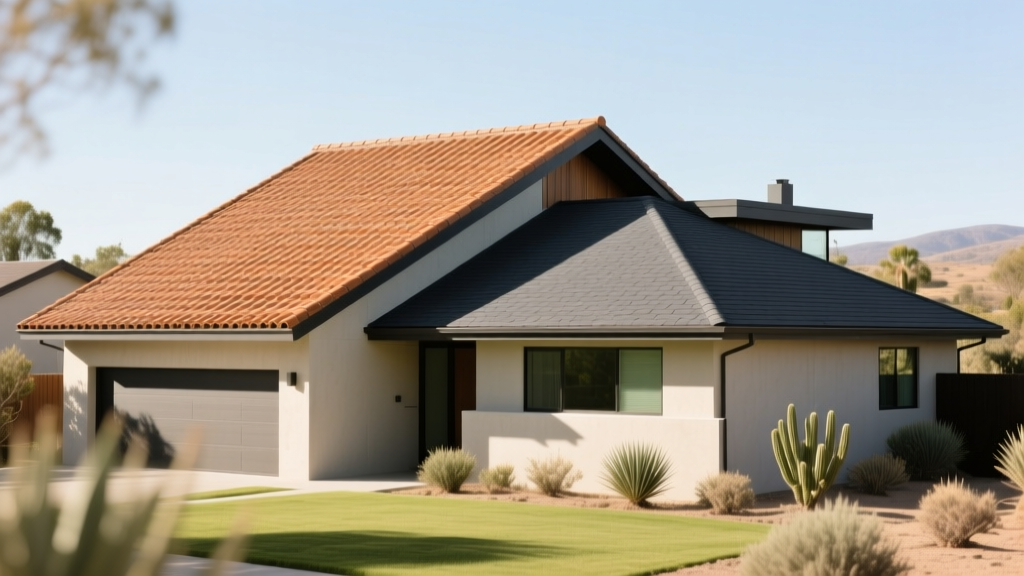
The Verdict: Which Application Fits Your Project?
Choose Concrete Tile If:
- Your home is in a coastal, hurricane-prone, or WUI wildfire zone.
- You are building a new home and can engineer the trusses for heavy dead loads from the start.
- You plan to stay in the home for 30+ years and want a lifetime exterior cladding.
- You prioritize high thermal emittance and energy efficiency via the natural air gap batten system.
Choose Asphalt Shingles If:
- You are re-roofing an existing structure not engineered for heavy loads.
- You need to minimize upfront capital expenditure and structural modification costs.
- Your roof features complex geometry, numerous valleys, and steep dormers where tile flashing is cost-prohibitive.
- You prefer a material that allows for easy, inexpensive localized repairs and HVAC roof access.
Ultimately, the decision between a concrete tile roof vs asphalt shingles hinges on your structural capacity and lifecycle budget. Asphalt remains the undisputed king of cost-effective, lightweight versatility, while concrete tile delivers unmatched longevity and severe-weather resilience for properly engineered structures.
Written by
Marcus ChenMarcus Chen is a licensed structural engineer (PE) and building materials analyst with over 12 years of experience across residential, commercial, and industrial construction. He holds a Master of Science in Civil Engineering from UC Berkeley and spent six years at Thornton Tomasetti before transitioning to independent consulting and technical writing. Marcus specializes in material selection for seismic-prone regions, concrete reinforcement strategies, and lifecycle cost analysis. His work has been cited by the American Concrete Institute (ACI) and the Structural Engineers Association of California (SEAOC). When he is not on a job site or at his desk, you will find him hiking the Sierra Nevada or restoring a 1920s craftsman bungalow in Oakland, CA.
More from Marcus Chen
View all
Construction Cost
How Much Did the Eiffel Tower Cost to Build?
How much did the Eiffel Tower cost to build in 1889? We adjust for inflation and compare its budget to modern skyscraper construction.
Aug 4, 2026

Fire Resistance
What Is a Fire Resistant Material? Testing & Certification Guide
Discover what is a fire resistant material through ASTM and UL testing. Learn how fire ratings, certifications, and assemblies work in construction.
Aug 4, 2026

Construction Cost
How Much Did the Burj Khalifa Cost to Build?
How much did the Burj Khalifa cost to build? We break down the $1.5B project and extract 5 money-saving strategies for your next build.
Jul 30, 2026