Glossy vs Matte Concrete Sealer: Performance & Mix Compatibility
Compare glossy vs matte concrete sealer performance. Learn how water-cement ratios, porosity, and film thickness dictate the right choice for your slab.
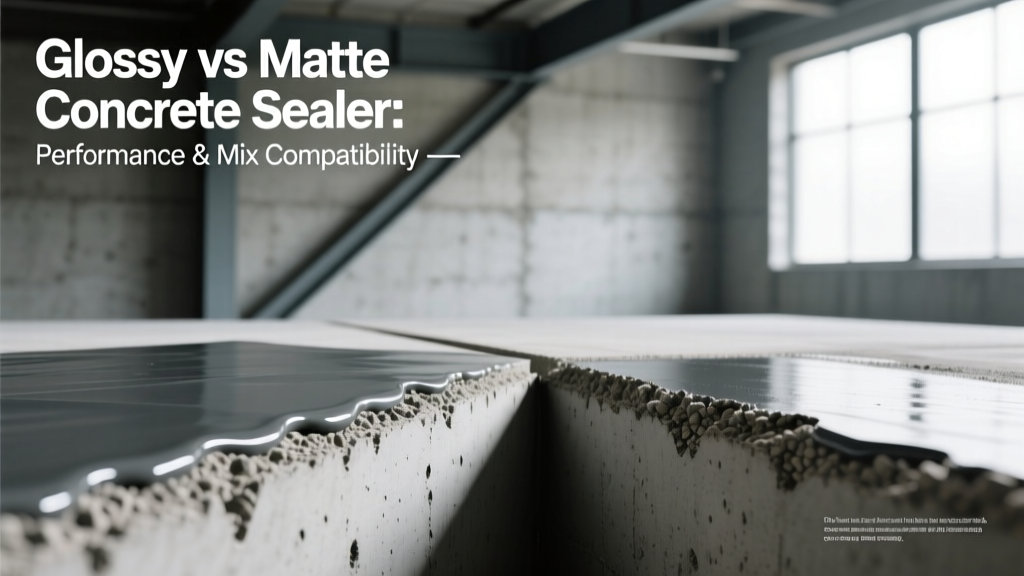
The Physics of Sheen: Film-Forming vs. Penetrating Matrices
The visual distinction between a glossy and matte concrete finish is not merely cosmetic; it is a direct result of the sealer’s chemical composition, solids content, and refractive index. When evaluating glossy vs matte concrete sealer options, contractors and engineers must look past the aesthetic and examine how these chemistries interact with the concrete’s capillary network.
According to the Concrete Network’s technical guidelines on sealer types, selecting the correct chemistry requires understanding the substrate's porosity, which is fundamentally dictated by the original mix design and finishing techniques.
How Concrete Mix Design Dictates Sealer Adhesion
The choice between a glossy film-former and a matte penetrant must be made during the mix design phase. The water-cement (w/c) ratio and the use of Supplementary Cementitious Materials (SCMs) directly control the surface profile and pore size distribution.
Water-Cement Ratio (w/c) and Capillary Porosity
A low w/c ratio (0.35 to 0.40) produces high-strength, low-permeability concrete. The capillary pores are incredibly fine and often discontinuous.
- Impact on Matte Penetrants: Silane and siloxane molecules struggle to penetrate dense, low w/c surfaces. If a penetrating matte sealer is applied to a 0.35 w/c slab that has been hard-troweled, the sealer will pool on the surface, leading to uneven curing, tackiness, and wasted material.
- Impact on Glossy Film-Formers: High-solids acrylics and polyurethanes thrive on dense surfaces. Because they do not rely on deep penetration for adhesion, they bond mechanically to the surface profile. However, they require a minimum Concrete Surface Profile (CSP 1 or 2) as defined by the International Concrete Repair Institute (ICRI) to prevent delamination under shear stress.
Supplementary Cementitious Materials (SCMs) and Alkalinity
Mixes utilizing high volumes of fly ash (Class F) or slag cement reduce the overall alkalinity (pH) of the concrete pore solution over time. Reactive penetrating matte sealers (like lithium or sodium silicates) require high alkalinity and free calcium hydroxide to trigger the pozzolanic reaction that forms calcium silicate hydrate (C-S-H) gels. If your mix design specifies 50% slag replacement, a silicate-based matte densifier will underperform. In such mixes, a non-reactive siloxane matte sealer or a glossy aliphatic polyurethane is required.
Glossy vs Matte Concrete Sealer: Technical Comparison Matrix
The following matrix breaks down the physical properties, application parameters, and mix compatibility for the most common sealer chemistries used in commercial and residential construction.
| Property | Glossy Acrylic (Solvent-Based) | Glossy Aliphatic Polyurethane | Matte Silane/Siloxane | Matte Silicate Densifier |
|---|---|---|---|---|
| Solids Content | 20% - 30% | 40% - 60% | 5% - 10% (Active) | 15% - 25% |
| Coverage Rate | 200 - 250 sq ft/gal | 300 - 400 sq ft/gal | 250 - 400 sq ft/gal | 400 - 600 sq ft/gal |
| Ideal w/c Ratio | 0.40 - 0.55 | Any (Requires CSP 2) | 0.45 - 0.60 (Porous) | 0.35 - 0.45 (Dense) |
| Wet DCOF (Slip Resistance) | Low (< 0.30) - Grit required | Low (< 0.35) - Grit required | High (> 0.50) - Unaltered | High (> 0.50) - Unaltered |
| UV Stability | Moderate (May yellow/amber) | Excellent (Non-yellowing) | Excellent (Sub-surface) | Excellent (Sub-surface) |
Real-World Failure Modes: When the Mix Rejects the Sealer
Applying the wrong sealer type to a specific concrete mix design results in predictable, often catastrophic, coating failures. Understanding these edge cases prevents costly remediation.
- Osmotic Blistering (Glossy on High w/c): If a high-solids glossy epoxy or polyurethane is applied to a porous, high w/c slab (0.55+) with an active vapor drive, moisture vapor becomes trapped beneath the impermeable film. The vapor pressure exceeds the tensile bond strength of the sealer, causing blisters. Fix: Use a breathable matte siloxane or a moisture-mitigating epoxy primer.
- Efflorescence Trapping (Glossy on Uncured Slabs): Film-forming glossy sealers applied before the concrete has fully hydrated and off-gassed will trap migrating calcium salts. This manifests as a white, cloudy haze beneath the glossy film that cannot be removed without stripping the sealer entirely via chemical strippers or media blasting.
- Powdering/Chalking (Matte Silicate on High SCM): As noted, silicate densifiers require free lime to react. On mixes with high metakaolin or slag content, the unreacted silicate dries on the surface as a white, powdery residue that ruins the matte aesthetic and requires aggressive scrubbing to remove.
Application Decision Framework
Use the following environmental and structural parameters to select the optimal sealer category for your project.
Exterior Flatwork & Driveways
Recommendation: Matte Silane/Siloxane or Low-Solids Matte Acrylic.
Why: Exterior surfaces are exposed to freeze-thaw cycles and UV radiation. High-build glossy sealers degrade rapidly under UV and create severe slip hazards when wet. Penetrating matte sealers lower the absorption coefficient (per FHWA pavement preservation guidelines), protecting the internal rebar from chloride ingress without altering surface friction.
Interior Retail & Showrooms
Recommendation: Glossy Aliphatic Polyurethane over a Silicate Densifier.
Why: Retail environments demand high abrasion resistance and a premium "wet look" that enhances decorative aggregates. The silicate densifier hardens the surface matrix, while the polyurethane provides a UV-stable, high-GU glossy film that withstands foot traffic and shopping cart shear forces.
Industrial & Warehouse Floors
Recommendation: Matte Silicate Densifier + Matte Guard.
Why: Forklift traffic will scratch and delaminate glossy film-formers within months. A reactive matte silicate densifier permanently alters the surface chemistry, increasing Mohs hardness to 6-7, while a matte guard provides stain resistance without the maintenance burden of waxing or recoating glossy films.
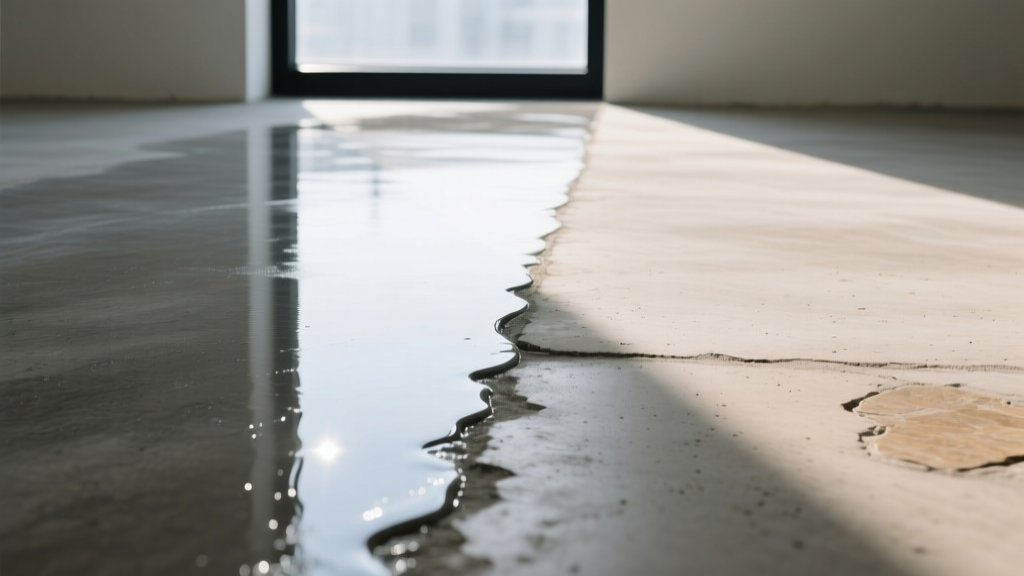
Lifecycle Costing and Maintenance Intervals
The initial material cost of a sealer is a fraction of its total lifecycle cost. Glossy sealers inherently require more maintenance due to their surface-exposed nature.
Glossy Acrylics: Initial cost is low ($0.15 - $0.25 per sq ft), but they degrade under UV and abrasion. Expect to apply a maintenance "sacrificial" wax coat quarterly and fully strip and recoat the acrylic every 12 to 18 months. Over a 5-year period, the maintenance labor often exceeds the initial installation cost by 300%.
Glossy Polyurethanes: Higher initial cost ($0.45 - $0.70 per sq ft) and strict application requirements (two-component mixing, strict recoat windows). However, they offer a 5 to 7-year lifecycle before requiring a screen-and-recoat, making them highly cost-effective for commercial interiors.
Matte Penetrants (Silane/Siloxane): Moderate initial cost ($0.20 - $0.35 per sq ft). Because they do not form a surface film, they do not scratch or wear away from foot traffic. They degrade only when the chemical bond hydrolyzes, typically yielding a 5 to 10-year service life with zero intermediate maintenance. The only indicator of failure is when water no longer beads on the surface, signaling it is time for a single, straightforward reapplication without the need for chemical stripping.
Written by
James ThorntonJames Thornton is a construction industry veteran with 25 years of hands-on experience in wood framing, lumber grading, and residential building codes. He started as a framing carpenter in rural Oregon, earned his ICC Residential Building Inspector certification, and eventually became a senior plan reviewer for the City of Portland Bureau of Development Services. James holds a B.S. in Wood Science & Technology from Oregon State University and is a certified lumber grader through the West Coast Lumber Inspection Bureau (WCLIB). He has inspected over 3,000 residential construction sites and authored the city's internal guide on advanced framing techniques (2x6 at 24" O.C.). James lives in Bend, OR, where he builds custom timber-frame cabins and competes in lumberjack sports.
More from James Thornton
View all
Insulation
Best Home Insulation Materials: Complete 2026 Guide
Compare top home insulation materials for 2026. Find R-values, installed costs per square foot, and best uses for fiberglass, spray foam, and mineral wool.
Aug 4, 2026

Sustainable Building
Certify Your Green Building Material for LEED and WELL
Step-by-step guide to certifying a green building material for LEED v5 and WELL v2. Master EPDs, HPDs, and VOC limits for 2026 project specifications.
Aug 4, 2026

Stone & Masonry
Veneer Stacked Stone Panels: Interior Design & Style Showcase
Discover how veneer stacked stone panels transform interiors. Explore modern design profiles, material pairings, and technical installation specs.
Aug 4, 2026