What Type of Gravel Under Concrete Ensures a Crack-Free Slab?
Discover what type of gravel under concrete prevents cracking. Learn exact aggregate sizes, compaction lifts, and base depths for durable slab installation.

The Fundamental Rule: Angular Crushed Stone vs. Rounded Gravel
When determining what type of gravel under concrete is required for a structural slab, the answer hinges entirely on particle geometry and compaction mechanics. The most common and catastrophic error in residential and light-commercial slab preparation is the use of rounded aggregate, such as pea gravel or river rock, as a base material. Rounded stones lack facial friction; under the hydrostatic pressure of wet concrete or the dynamic loads of vehicular traffic, they roll and shift, leading to differential settlement and immediate slab cracking.
The only acceptable material for a concrete sub-base is angular crushed stone. Mechanically crushed rock features jagged edges and fractured faces that mechanically interlock when compacted. This interlocking matrix creates a rigid, load-bearing platform that distributes the slab's weight evenly across the underlying soil subgrade, effectively neutralizing point-loads that cause tensile failure in concrete.
Selecting the Right Aggregate Size and Gradation
Not all crushed stone is identical. The ideal base material must contain a mix of larger structural stones and smaller 'fines' (stone dust) to fill the voids between the larger rocks, eliminating air pockets and preventing water migration. According to the ASTM D2940 standard for graded aggregate materials, a well-graded mix is essential for maximum density.
| Aggregate Type | Size Profile | Best Application | 2026 Avg. Cost (Per Ton) |
|---|---|---|---|
| #411 (Crusher Run / Road Stone) | 3/4' minus (with fines) | The gold standard for concrete slab bases. Fines lock the 3/4' stones together for a concrete-like sub-base. | $22 - $38 |
| #57 Stone (Clean) | 3/4' clean (no fines) | Poor base for slabs due to voids. Excellent for perimeter drainage or behind retaining walls. | $25 - $42 |
| #67 Stone | 3/4' minus (fewer fines) | Good for wet climates where #411 holds too much moisture, but requires heavier compaction equipment. | $24 - $40 |
| #304 (Crushed Limestone) | 1.5' minus (heavy fines) | Commercial driveways and heavy-load industrial slabs requiring extreme subgrade stabilization. | $20 - $35 |
For 90% of residential driveways, patios, and garage floors, #411 Crusher Run (also known as quarry process or dense-graded aggregate) is the mandatory choice. The inclusion of stone dust allows the material to compact into a nearly impermeable, solid mass that mimics the structural integrity of weak concrete.
Calculating Depth and Tonnage Requirements
The depth of your gravel base must scale with the anticipated load and the native soil's California Bearing Ratio (CBR). The Portland Cement Association outlines specific subbase thickness requirements based on structural demand.
- Foot Traffic & Patios (Unreinforced 4' slab): 4 inches of compacted #411 gravel.
- Passenger Vehicles (Driveways & Garages): 6 inches of compacted #411 gravel.
- Heavy Trucks & RVs (Commercial Pads): 8 to 12 inches of compacted #411 gravel, often stabilized with a geogrid.
Tonnage Formula: To calculate the required gravel, multiply the slab's Length (ft) × Width (ft) × Depth (ft), then divide by 27 to get cubic yards. Multiply the cubic yards by 1.4 (the standard weight conversion for compacted crushed stone) to determine the total tons needed. Always order 10% overage to account for subgrade irregularities and compaction settlement.
Step-by-Step Subgrade and Base Installation Protocol
A proper base installation requires strict adherence to lift thickness and moisture control. Dumping 8 inches of gravel and attempting to compact the top layer will result in a false compaction reading, leaving the bottom 4 inches loose and prone to future settlement.
- Subgrade Excavation and Proofrolling: Excavate to the required depth (slab thickness + gravel depth). Before adding gravel, 'proofroll' the bare dirt subgrade with a heavy vehicle or vibratory roller. Any area that deflects, pumps, or shows rutting must be excavated deeper and backfilled with compacted stone.
- Geotextile Separation (Conditional): If the native soil is highly expansive clay or organic silt, lay a non-woven geotextile fabric directly on the dirt. This prevents the clay from 'pumping' up into the gravel voids during freeze-thaw cycles, which destroys the base's drainage capacity.
- Spreading in Lifts: Spread the #411 gravel in maximum 4-inch loose lifts. A 4-inch loose lift will compact down to approximately 3 inches. If you need a 6-inch base, you must spread and compact two separate 3-inch layers.
- Moisture Conditioning: Crushed stone requires an Optimum Moisture Content (OMC) of roughly 5% to 8% to achieve maximum density. The dust must be damp enough to act as a binder, but not saturated.
Field Squeeze Test: Grab a handful of the #411 mix and squeeze it tightly. It should hold its shape like a snowball without water dripping through your fingers. If it crumbles, spray it with a hose. If it drips, let it cure in the sun.
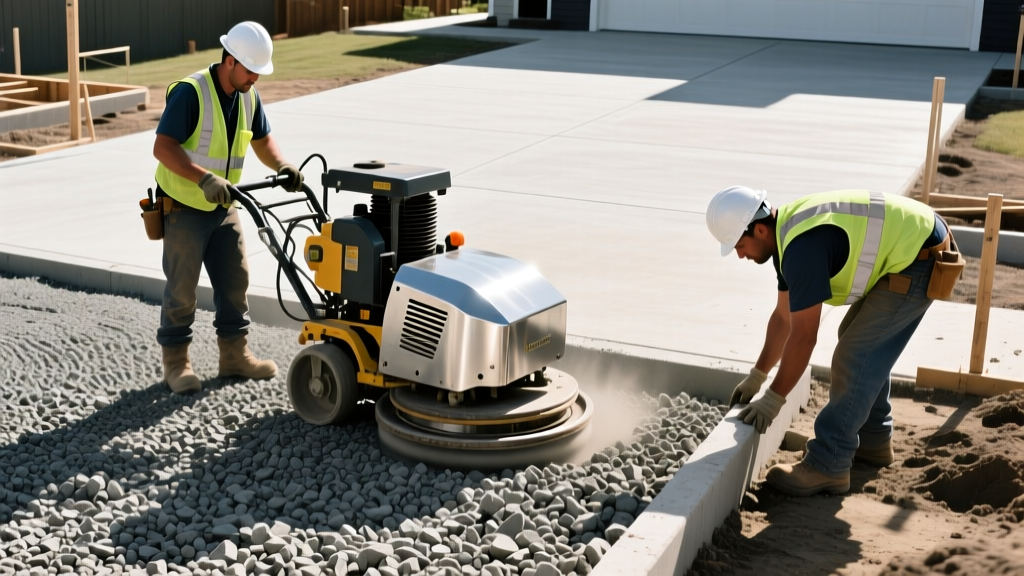
- Mechanical Compaction: Use a minimum 140-lb vibratory plate compactor for residential edges and a 1-to-2-ton double-drum vibratory roller for open areas. Make at least three overlapping passes per lift. The target is 95% Standard Proctor Density (ASTM D698). The surface should be so hard that a boot heel leaves no visible impression.
The Vapor Barrier Placement Dilemma
Once the gravel base is fully compacted and laser-screeded to grade, the placement of the polyethylene vapor retarder becomes the next critical decision. Industry practices have evolved significantly. According to Concrete Construction guidelines and modern ACI 302.1R recommendations, placing a 6-mil poly sheet directly on the gravel is an outdated and flawed practice.
The jagged edges of compacted #411 crusher run will easily puncture standard 6-mil or 10-mil polyethylene during the concrete pour and the subsequent vibration/screeding process, rendering the vapor barrier useless. Furthermore, placing a thin vapor barrier directly on the rock prevents the concrete bleed water from escaping downward, leading to severe surface scaling, delayed curing, and weakened surface paste.
The 2026 Premium Standard: Use a 15-mil cross-laminated polyolefin vapor retarder (such as Stego Wrap or Perm-A-Barrier) placed directly over the compacted gravel. The 15-mil thickness resists punctures from the angular #411 stone. If the slab will receive moisture-sensitive floor coverings (like epoxy, hardwood, or VCT tile), this 15-mil barrier is non-negotiable to prevent alkaline silica vapor transmission, which destroys flooring adhesives.
Troubleshooting Common Base Failures
Even with the correct gravel type, specific environmental and site conditions can compromise the slab if not addressed during installation.
- Frost Heave in Northern Climates: In regions with deep frost lines, the gravel base must extend below the local frost depth, or the slab must be thickened at the edges (a grade beam). Water trapped in the base freezes and expands, lifting the slab unevenly. Ensure the base has a minimum 2% slope to daylight for subsurface drainage.
- Clay Soil Pumping: If a slab cracks in a spiderweb pattern within the first year over clay soil, it is usually due to 'pumping'—where water pressure forces wet clay up into the gravel voids, turning the base into mud. The mandatory fix is excavating 2 extra inches of clay and replacing it with a non-woven geotextile fabric and a layer of clean, washed #57 stone for capillary drainage before placing the #411 base.
- Edge Slumping: Concrete edges often crack and drop because the gravel base was not contained. Always install rigid, braced formwork or compacted curb restraints that extend the full depth of the gravel base, preventing the lateral outward spread of the crushed stone under the weight of the wet concrete.
By strictly specifying angular #411 crusher run, adhering to 4-inch compaction lifts, and utilizing modern 15-mil puncture-resistant vapor retarders, you eliminate the primary mechanical causes of slab settlement and tensile cracking. The cost of the aggregate base represents less than 10% of the total concrete project budget, yet it dictates 100% of the slab's long-term structural viability.
Written by
Priya KapoorPriya Kapoor is a real estate market analyst and construction economics researcher with expertise in housing affordability, development feasibility, and infrastructure investment. She holds a Master of Regional Planning from Cornell University and previously worked as a senior analyst at CBRE's Investment Properties group, where she modeled returns for $4B in mixed-use development pipelines. Priya now runs an independent research practice advising developers, municipalities, and REITs on construction cost forecasting and market timing. She publishes the quarterly "BuildMat Market Pulse" report tracking material price indices across 12 commodity categories. Based in Austin, TX, Priya serves on the board of Habitat for Humanity Austin and is a marathon runner.
More from Priya Kapoor
View all
Construction Cost
Cost to Build a 1600 Sq Ft Home in 2026: Full Breakdown
Accurate 2026 cost to build a 1600 sq ft home—material, labor, and regional pricing breakdowns included. Plan your budget with real-time estimates.
Aug 11, 2026

Wood & Lumber
Name the Types of Wood for Pressure Treatment and Preservation
Learn how to name the types of wood best suited for pressure treatment. Compare species treatability, chemical retention levels, and 2026 preservation costs.
Aug 4, 2026

Stone & Masonry
Stone Veneer Suppliers Lindenhurst: 2026 Cost Analysis
Analyze 2026 stone veneer costs in Lindenhurst, NY. Compare local supplier pricing, delivery fees, and Suffolk County installation labor rates.
Aug 4, 2026