Asphalt vs Concrete Driveway: Costs, Lifespan, and Climate Guide
Compare asphalt vs concrete driveway costs, lifespans, and climate performance. Expert data on PSI, binder grades, and 30-year ROI.

The Core Dilemma: Bitumen vs. Portland Cement
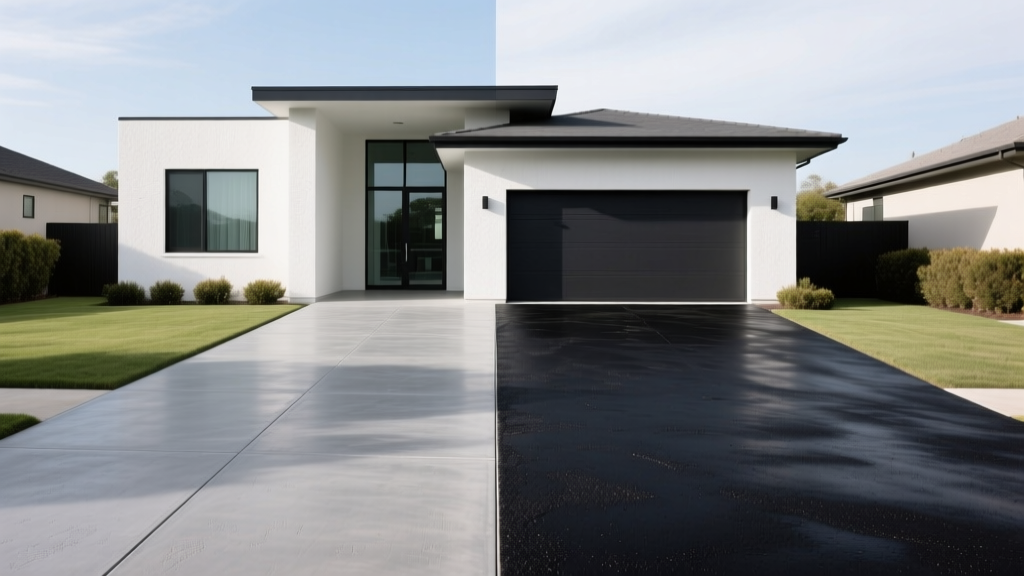
Choosing between an asphalt vs concrete driveway is fundamentally a choice between a viscoelastic, petroleum-based matrix and a rigid, hydrated crystalline structure. While both materials serve the primary function of supporting vehicular loads, their chemical compositions dictate entirely different performance profiles, maintenance schedules, and failure modes. Asphalt relies on a bitumen binder to hold aggregate together, allowing it to flex under heavy loads and temperature fluctuations. Concrete relies on Portland cement and water to create a chemical reaction (hydration) that locks aggregate into a rigid, high-compressive-strength slab. Understanding these material science differences is the only way to make an accurate 30-year paving decision.
Quick Decision Matrix
- Choose Asphalt If: Your upfront budget is strictly under $6 per square foot, you live in a region with severe freeze-thaw cycles and heavy road salt usage, or you need the driveway operational within 48 hours.
- Choose Concrete If: You are parking heavy RVs or commercial trucks (requiring 5,000 PSI mixes), you live in a high-heat/sunny climate where UV degradation destroys asphalt, or you prioritize a 30+ year lifespan with minimal structural maintenance.
Material Composition and Structural Integrity
The longevity of any driveway is determined by its subgrade preparation and material specification. A failure in either material is almost always a failure of the base, not the surface.
Concrete Specifications
A residential driveway requires a minimum compressive strength of 4,000 PSI (pounds per square inch). The mix should utilize a 3/4-inch crushed angular aggregate to ensure mechanical interlocking. In climates that experience freezing temperatures, the concrete must be air-entrained (containing 5% to 8% microscopic air bubbles). According to the Portland Cement Association, these microscopic voids provide expansion chambers for freezing water, preventing the internal hydraulic pressure that causes surface spalling and D-cracking.
- Thickness: 4 inches minimum for passenger vehicles; 6 inches for heavy trucks or RVs.
- Reinforcement: Welded wire mesh (6x6 W2.9xW2.9) or #4 rebar spaced at 24 inches on center.
- Jointing: Control joints must be cut or tooled every 10 feet to dictate where the concrete will inevitably crack as it shrinks during curing.
Asphalt Specifications
Hot Mix Asphalt (HMA) for driveways should utilize a Performance Graded (PG) binder appropriate for your local climate. For most of the United States, a PG 64-22 binder is standard, meaning it is engineered to resist rutting at pavement temperatures up to 64°C (147°F) and resist thermal cracking down to -22°C (-8°F). The Federal Highway Administration emphasizes that proper aggregate gradation and binder selection are critical to preventing premature fatigue cracking in flexible pavements.
- Surface Thickness: 2.5 to 3 inches of HMA, laid in two lifts (a 1.5-inch base course and a 1-inch surface course) for optimal compaction.
- Base Course: 4 to 8 inches of compacted crushed angular aggregate (typically 1.5-inch to 2-inch crushed stone).
- Compaction: Must achieve 92% to 96% of theoretical maximum specific gravity (Rice gravity) using a vibratory plate or small tandem roller.
True Cost Breakdown: Installation and 30-Year Lifecycle
Comparing the upfront cost of an asphalt vs concrete driveway without calculating the 30-year lifecycle cost leads to poor financial planning. Asphalt is significantly cheaper to install but requires continuous chemical maintenance. Concrete demands a higher initial capital outlay but features a drastically lower maintenance burden.
| Cost Factor | Asphalt Driveway | Concrete Driveway |
|---|---|---|
| Upfront Installation | $4.00 - $8.00 / sq. ft. | $8.00 - $15.00 / sq. ft. |
| Sealcoating / Sealing | $0.15 - $0.25 / sq. ft. (Every 3-5 yrs) | $0.20 - $0.30 / sq. ft. (Every 5-10 yrs, optional) |
| Joint / Crack Maintenance | Annual hot-pour crack filling required | Polyurethane joint caulking every 10 years |
| Expected Lifespan | 15 - 20 years (before major overlay) | 30 - 50 years |
| 30-Year Total Cost (per sq. ft.) | $9.50 - $16.00 (Includes 1 overlay & sealcoating) | $9.00 - $17.00 (Includes minor joint repair) |
Climate and Environmental Stressors
The geographic location of your property is the single most critical variable in the asphalt vs concrete driveway debate. Materials that perform flawlessly in Arizona will catastrophically fail in Minnesota.
Freeze-Thaw Cycles and De-icing Salts
Asphalt's viscoelastic nature allows it to expand and contract with extreme temperature swings without losing structural integrity. It is also highly resistant to the corrosive effects of sodium chloride and calcium chloride used for winter de-icing. Concrete, however, is highly vulnerable to salt. Chloride ions penetrate the capillary pore structure of concrete, accelerating freeze-thaw damage and causing surface scaling. If you live in a heavy snow-belt region and intend to use chemical de-icers, asphalt is the superior structural choice unless you are willing to invest in high-quality penetrating silane/siloxane concrete sealers annually.
UV Degradation and the Heat Island Effect
In hot, sunny climates, UV radiation oxidizes the bitumen binder in asphalt, causing it to become brittle, lose its black color, and eventually ravel (lose aggregate). Furthermore, asphalt has a very low solar reflectance (albedo of 0.05 to 0.10). According to the Environmental Protection Agency's Heat Island Effect data, dark asphalt surfaces can reach temperatures 20°F to 30°F hotter than the ambient air, radiating heat back into your home and increasing cooling costs. Concrete has a much higher albedo (0.20 to 0.40), reflecting solar radiation and maintaining structural rigidity regardless of UV exposure. In the Southwest and Deep South, concrete is the undisputed champion.
Maintenance Realities and Failure Modes
Every paving material eventually fails. Knowing how your driveway will fail allows you to spot early warning signs and intervene before the subgrade is compromised.
Asphalt Failure Modes
- Alligator Cracking: Interconnected fatigue cracks indicating a failed subgrade or insufficient asphalt thickness.
- Rutting: Permanent deformation in the wheel paths, caused by poor compaction during installation or a soft base.
- Oxidation/Raveling: The surface turns gray and aggregate stones loosen due to UV-degraded binder.
Concrete Failure Modes
- Spalling/Scaling: The top 1/4 inch of the surface flakes off, usually due to freeze-thaw cycles or finishing the slab while bleed water was still on the surface.
- Faulting: One side of a control joint drops lower than the other, caused by water infiltrating the joint and washing out the subgrade.
- Corner Breaks: Diagonal cracks at the corners of a slab panel, indicating heavy loads applied too close to the unsupported edge.
Resale Value and Aesthetic Versatility
From a real estate perspective, concrete generally yields a higher return on investment. Homebuyers perceive concrete as a premium, permanent fixture, whereas asphalt is often viewed as a utilitarian surface that will soon require their time and money to maintain.
"In mid-to-high-tier residential appraisals, a well-maintained concrete driveway—particularly stamped or exposed aggregate—can increase property valuation by 1% to 2% over an identical home with an asphalt driveway. Asphalt is generally considered 'standard' and does not trigger a positive adjustment in the sales comparison approach unless it is a newly installed replacement."
Aesthetically, concrete offers immense versatility. It can be integrally colored, stamped to mimic cobblestone or slate, or finished with a broom texture for slip resistance. Asphalt is limited to black or dark gray, though specialized colored asphalt coatings exist, they are prone to rapid wear and peeling under vehicular shear forces.
Final Verdict: Which Should You Pave With?
There is no universally superior material; there is only the correct material for your specific soil, climate, and financial parameters. If you are building in a northern climate with harsh winters, heavy salt usage, and a strict initial budget, pave with Hot Mix Asphalt over a thick, well-draining aggregate base. If you are building in a temperate or southern climate, plan to park heavy recreational vehicles, and want a low-maintenance surface that will outlive your mortgage, invest in air-entrained, 4,000 PSI concrete with properly spaced control joints. In both scenarios, the quality of the compacted subgrade will ultimately dictate the lifespan of the surface above it.
Written by
Elena RodriguezElena Rodriguez is a civil engineer and technical writer specializing in concrete technology, masonry systems, and ASTM/ACI compliance. She earned her B.S. in Civil Engineering from Texas A&M University and spent a decade at a materials testing laboratory, performing over 2,000 concrete compressive strength tests and masonry prism evaluations. Elena is an ACI-certified Field Testing Technician (Grade I) and a member of ASTM Committee C12 on Natural Building Stone. She currently consults on forensic engineering cases involving concrete failures and moisture intrusion. Based in San Antonio, TX, Elena is a proud member of the Society of Women Engineers (SWE) and coaches her daughter's FIRST Robotics team.
More from Elena Rodriguez
View all
Walls & Panels
Cost Analysis: Light Gauge Steel Framing Advantages and Disadvantages
Evaluate light gauge steel framing advantages and disadvantages through a strict cost analysis lens, comparing material, labor, and lifecycle expenses.
Aug 4, 2026

Walls & Panels
Gypsum Board Types: Exact Specifications, Thickness & Dimensions
Compare standard, Type X, and moisture-resistant gypsum board types. Get exact specifications, thicknesses, dimensions, and ASTM standards for your project.
Aug 4, 2026

Fire Resistance
Best Fire-Resistant Outdoor Decking Materials: 2026 Buyer Guide
Discover the best fire-resistant outdoor decking materials for 2026. Compare Class A PVC, aluminum, and hardwood options for WUI compliance and safety.
Aug 4, 2026