Technical Guide to Types of Concrete Stain: Acid vs. Water-Based
Compare technical specifications of acid and water-based concrete stains, including chemical composition, coverage rates, and substrate requirements.
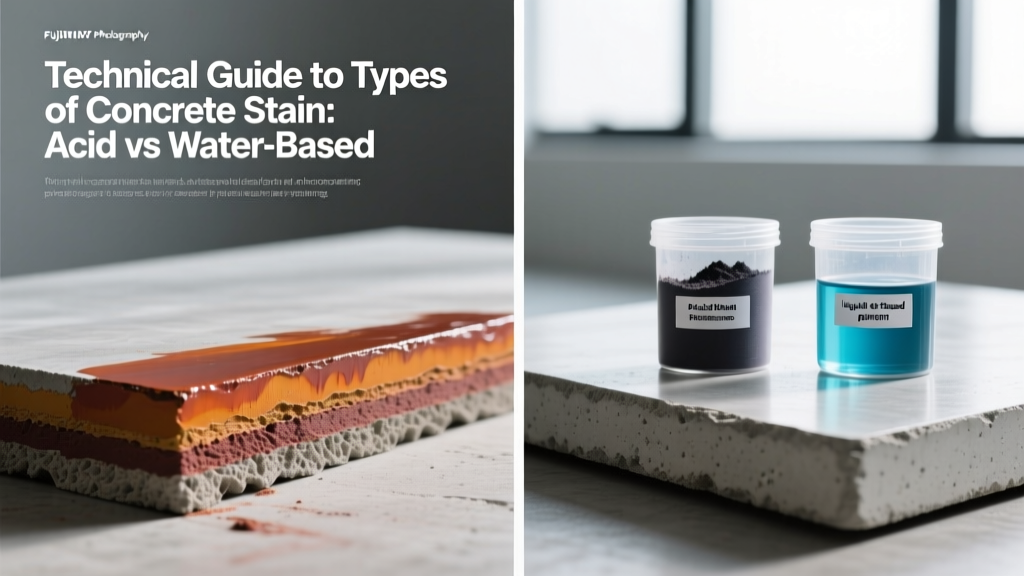
Substrate Chemistry and Stain Penetration Mechanics
Concrete staining is not a surface-level coating application; it is a subsurface penetration process governed by the porosity and chemical makeup of the cementitious substrate. When evaluating the different types of concrete stain, contractors and architects must look beyond color charts and analyze the molecular interaction between the stain carrier and the hydrated cement paste. The Portland Cement Association notes that the permeability of concrete is directly tied to its water-to-cement (w/c) ratio, which subsequently dictates the depth of stain penetration and the intensity of the final color reaction.
For a stain to be effective, the substrate must possess an open pore structure. Densifiers, curing compounds, and late-age troweling create a vitrified surface that blocks the capillary action required for both acid and water-based stains to penetrate. Before selecting a stain chemistry, the substrate must pass a water-drop absorption test or achieve a minimum Concrete Surface Profile (CSP) of 1 to 2 via mechanical abrasion.
Reactive Acid Stains: Metallic Salts and Hydrochloric Acid
Acid stains represent the traditional standard for variegated, translucent concrete coloring. The technical mechanism relies on a controlled chemical reaction rather than simple pigment deposition. The solution typically consists of water, hydrochloric acid (HCl), and acid-soluble metallic salts.
Chemical Reaction Mechanism
When applied to concrete, the hydrochloric acid mildly etches the surface, opening the pores and reacting with the free lime (calcium hydroxide) in the concrete. This localized reduction in pH allows the metallic salts to penetrate and react permanently with the hydrated cement minerals. The resulting metallic oxides become a permanent part of the concrete matrix, meaning they will not peel, flake, or fade from UV exposure.
Technical Specifications and Limitations
- pH Level: Highly acidic, typically between 1.0 and 2.5 prior to application.
- Color Palette: Limited to earth tones (browns, tans, terra cottas, soft blue-greens, and blacks). Bright reds, yellows, and whites are chemically impossible with standard metallic salts.
- Coverage Rate: 200 to 400 square feet per gallon, heavily dependent on surface porosity and the desired color intensity (multiple applications increase depth).
- Cure Time: Requires 2 to 8 hours for the chemical reaction to complete before neutralization.
- Neutralization Requirement: Mandatory. The surface must be neutralized with an alkaline solution (e.g., baking soda and water or a commercial ammonia-based neutralizer) to raise the pH above 7.0 before sealing. Failure to neutralize will cause the sealer to fail and the concrete to continue degrading.
Industry-standard products like Kemiko Stone Tone utilize this exact metallic salt formulation, requiring strict adherence to OSHA safety protocols regarding acid handling and vapor inhalation during application.
Water-Based Acrylic Stains: Polymer Dispersions and Pigment Carriers
As environmental regulations regarding volatile organic compounds (VOCs) and acid runoff have tightened, water-based stains have evolved from simple diluted paints to sophisticated penetrating polymer systems. Unlike acid stains, water-based stains do not chemically alter the concrete. Instead, they utilize a combination of penetrating acrylic polymers and ultra-fine micronized pigments.
The technical advantage of water-based systems lies in their pigment suspension. Because they do not rely on a chemical reaction with calcium hydroxide, manufacturers can incorporate a vastly broader spectrum of inorganic and organic pigments. According to guidelines published by the American Concrete Institute (ACI), non-reactive stains must achieve sufficient mechanical interlock within the concrete's capillary network to resist delamination under traffic loads.
Technical Specifications and Limitations
- pH Level: Neutral to slightly alkaline (7.0 to 9.0).
- Color Palette: Unlimited. Can achieve vibrant reds, blues, yellows, and stark whites, as well as metallic and pearlescent effects.
- Coverage Rate: 250 to 500 square feet per gallon. Because they do not etch the surface, they often require less product to achieve uniform opacity.
- Cure Time: Rapid drying, typically 1 to 4 hours depending on ambient humidity and temperature.
- Neutralization Requirement: None. The surface simply needs to be cleaned of residue and allowed to dry before sealing.
Products such as L.M. Scofield Lithochrome Antiquing Stain utilize advanced acrylic copolymers that carry pigments deep into the substrate while leaving the surface breathable, preventing the vapor transmission issues common with topical film-forming coatings.
Comparative Engineering Matrix
Selecting between reactive and non-reactive types of concrete stain requires evaluating the project's structural and aesthetic parameters. The following matrix outlines the critical engineering differences.
| Specification Metric | Reactive Acid Stain | Water-Based Penetrating Stain |
|---|---|---|
| Bonding Mechanism | Chemical reaction (metallic oxide formation) | Mechanical interlock (polymer/pigment deposition) |
| VOC Content | Low to Moderate (acid fumes present) | Ultra-Low (compliant with strict SCAQMD limits) |
| UV Stability | 100% UV Stable (inorganic oxides) | Variable (requires UV-stable acrylics and inorganic pigments) |
| Application Complexity | High (requires neutralization, unpredictable variegation) | Low (predictable coverage, no neutralization) |
| Substrate Dependency | Extreme (requires high free lime content; fails on fly-ash heavy mixes) | Moderate (requires open pores, but independent of lime content) |
| Color Consistency | Low (highly variegated, mottled, natural stone look) | High (can achieve uniform, consistent, or layered tones) |
Substrate Compatibility and Edge Cases
The most frequent cause of stain failure is a mismatch between the stain chemistry and the concrete mix design. Modern concrete mixtures frequently incorporate supplementary cementitious materials (SCMs) like fly ash, slag cement, or silica fume to increase compressive strength and reduce carbon footprints. However, these SCMs consume the free lime (calcium hydroxide) during the secondary pozzolanic reaction.
Warning: High Fly-Ash and Slag Mixes
If a concrete slab is poured with a mix design containing more than 15% fly ash or 30% slag cement, the free lime required for an acid stain reaction will be severely depleted. Applying an acid stain to this substrate will result in a pale, washed-out appearance that lacks depth. In these edge cases, water-based penetrating stains are the mandatory technical specification, as their pigment carriers do not rely on calcium hydroxide to develop color.
Similarly, exterior applications subject to freeze-thaw cycling demand specific stain and sealer pairings. While both stain types penetrate the surface, the subsequent sealer must be a breathable, penetrating silane/siloxane water repellent rather than a topical acrylic. Trapping moisture beneath a topical sealer after staining will lead to spalling during freeze-thaw cycles, destroying both the concrete surface and the stain.
Specification Decision Framework
To finalize the material specification for your project, apply the following logical framework based on site conditions and design intent:
- Analyze the Mix Design: Request the batch ticket from the ready-mix supplier. If SCM replacement levels exceed 15% fly ash or 30% slag, immediately eliminate acid stains from consideration.
- Evaluate the Design Intent: If the architectural rendering demands uniform, vibrant, or non-earth-tone colors (e.g., a corporate logo embedded in the floor), specify a high-quality water-based acrylic stain.
- Assess Site Logistics: For occupied commercial renovations or interior residential spaces where acid vapor mitigation and wet-neutralization runoff are logistically prohibitive, water-based stains offer a massive advantage in indoor air quality and site cleanup.
- Determine the Wear Environment: For heavy industrial traffic, ensure that whichever stain is selected is paired with a high-solids polyaspartic or epoxy sealer. Note that acid stains generally provide a slightly better micro-profile for epoxy adhesion due to the mild etching effect of the hydrochloric acid, whereas water-based stains may require a light mechanical scuff before applying heavy-duty topical sealers.
By prioritizing the chemical realities of the substrate over superficial color charts, specifiers can ensure the selected concrete stain delivers both the intended aesthetic and long-term structural durability.
Written by
Elena RodriguezElena Rodriguez is a civil engineer and technical writer specializing in concrete technology, masonry systems, and ASTM/ACI compliance. She earned her B.S. in Civil Engineering from Texas A&M University and spent a decade at a materials testing laboratory, performing over 2,000 concrete compressive strength tests and masonry prism evaluations. Elena is an ACI-certified Field Testing Technician (Grade I) and a member of ASTM Committee C12 on Natural Building Stone. She currently consults on forensic engineering cases involving concrete failures and moisture intrusion. Based in San Antonio, TX, Elena is a proud member of the Society of Women Engineers (SWE) and coaches her daughter's FIRST Robotics team.
More from Elena Rodriguez
View all
Walls & Panels
Cost Analysis: Light Gauge Steel Framing Advantages and Disadvantages
Evaluate light gauge steel framing advantages and disadvantages through a strict cost analysis lens, comparing material, labor, and lifecycle expenses.
Aug 4, 2026

Walls & Panels
Gypsum Board Types: Exact Specifications, Thickness & Dimensions
Compare standard, Type X, and moisture-resistant gypsum board types. Get exact specifications, thicknesses, dimensions, and ASTM standards for your project.
Aug 4, 2026

Fire Resistance
Best Fire-Resistant Outdoor Decking Materials: 2026 Buyer Guide
Discover the best fire-resistant outdoor decking materials for 2026. Compare Class A PVC, aluminum, and hardwood options for WUI compliance and safety.
Aug 4, 2026