Concrete vs Mortar: Mix Design, Ratios & Strength
Compare concrete vs mortar mix designs, cement ratios, and compressive strength. Learn when to use 3000 psi concrete or Type S mortar for masonry.
The Core Divergence: Aggregate Grading and Structural Intent
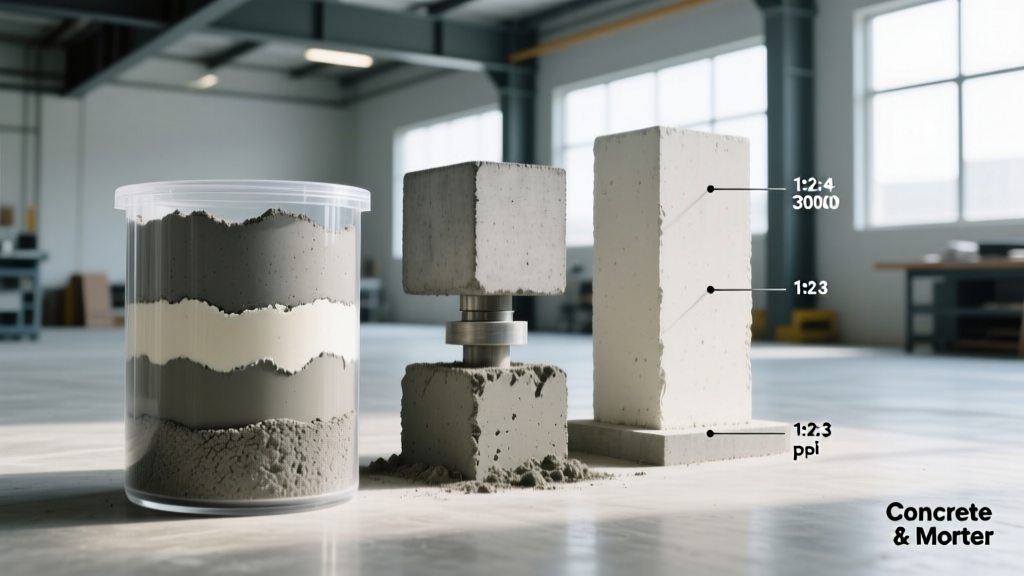
While both materials rely on Portland cement as a primary binder, evaluating concrete vs mortar requires looking past the cement silo to the aggregate sieve. The fundamental distinction lies in particle size distribution and the resulting water-cement (w/c) ratio. Concrete is engineered for compressive load-bearing capacity, utilizing coarse aggregates (gravel or crushed stone) up to 1.5 inches in diameter. Mortar is engineered for adhesion, workability, and moisture retention, utilizing only fine aggregates (masonry sand) where 100% of the particles pass through a No. 4 (4.75mm) sieve.
Concrete Mix Design: Ratios, PSI, and Abrams' Law
Structural concrete mix design is governed by Abrams' Law, which states that the compressive strength of concrete is inversely proportional to the water-cement ratio. A lower w/c ratio yields higher strength but reduces workability, necessitating chemical admixtures rather than excess water.
Standard Proportioning (The 1:2:3 Rule)
For general-purpose flatwork, footings, and non-post-tensioned slabs, a standard volumetric ratio of 1 part Portland cement, 2 parts fine aggregate (sand), and 3 parts coarse aggregate (gravel) is utilized. However, modern ready-mix batching relies on absolute volume and weight rather than simple volumetric shoveling.
- 3,000 PSI Mix: Targets a w/c ratio of approximately 0.50. Ideal for residential sidewalks, patios, and interior slabs-on-grade. Costs roughly $125 to $145 per cubic yard in 2026.
- 4,000 PSI Mix: Targets a w/c ratio of 0.40 to 0.45. Required for structural columns, suspended decks, and driveways subject to heavy vehicular loads.
- 5,000+ PSI Mix: Targets a w/c ratio below 0.35. Utilizes supplementary cementitious materials (SCMs) like fly ash or slag cement, alongside high-range water reducers (superplasticizers).
For exterior applications in freeze-thaw climates, air-entraining admixtures (compliant with ASTM C260) are mandatory. These introduce microscopic, disconnected air bubbles (typically 5% to 8% of total volume) that provide expansion chambers for freezing water, preventing surface spalling and internal micro-cracking.
Mortar Mix Design: ASTM C270 and the Role of Hydrated Lime
Unlike concrete, mortar must remain plastic, adhere to vertical masonry units, and retain water long enough to prevent the porous bricks or blocks from rapidly sucking moisture out of the mix (which halts hydration). According to the ASTM C270 standard, mortar is classified by its compressive strength, which is manipulated by adjusting the ratio of Portland cement to hydrated lime.
The Four Primary Mortar Types
| Mortar Type | Cement : Lime : Sand (Volume) | Min. Compressive Strength | Primary Application |
|---|---|---|---|
| Type M | 1 : 1/4 : 3 | 2,500 PSI | Below-grade masonry, retaining walls, heavy load-bearing |
| Type S | 1 : 1/2 : 4.5 | 1,800 PSI | At-grade exterior walls, brick veneer, high lateral loads |
| Type N | 1 : 1 : 6 | 750 PSI | General-purpose above-grade, interior, non-load-bearing |
| Type O | 1 : 2 : 9 | 350 PSI | Historic masonry restoration, soft brick, interior repointing |
Hydrated lime (ASTM C206 or C207) is the critical differentiator in mortar design. It acts as a plasticizer, increasing water retention and workability without the need for synthetic chemicals. Furthermore, lime enables autogenous healing; when micro-cracks form in the mortar joint, unhydrated lime particles react with atmospheric carbon dioxide to precipitate calcium carbonate, naturally sealing the crack over time.
Admixtures and Hydration Chemistry Differences
The chemical approach to modifying workability differs vastly between the two materials. In concrete, adding water to increase slump destroys the structural matrix. Therefore, polycarboxylate-based high-range water reducers (HRWR) are used to disperse cement flocculates, allowing high flowability at a low w/c ratio.
In mortar, the goal is stickiness and board life. Mortar plasticizers (often based on lignosulfonates or synthetic polymers) are used to entrain a controlled amount of microscopic air (12% to 19% per ASTM C91) which acts as a ball-bearing system between sand particles. However, excessive air entrainment in mortar severely reduces its bond strength to the masonry unit, a common failure point when masons improperly overdose liquid plasticizers in the mixer.
Application Failures: What Happens When You Swap Them
Using the wrong cementitious mix is a primary cause of structural remediation claims. Understanding the failure mechanics of concrete vs mortar substitutions is critical for site supervisors and DIY builders.
Failure Mode 1: Using Mortar for Footings
If a builder attempts to pour a structural footing using Type S mortar, the lack of coarse aggregate means the mix will experience massive volumetric shrinkage as it cures. More importantly, the 1,800 PSI compressive strength is insufficient for concentrated column loads, leading to immediate crushing and differential settlement of the structure above.
Failure Mode 2: Using Concrete for Repointing Historic Brick
Historic bricks (pre-1930s) are often soft and highly porous. Repointing them with a high-strength concrete or Type M mortar traps moisture inside the brick. During freeze-thaw cycles, the moisture expands, and because the mortar joint is harder than the brick itself, the brick face spalls and shatters rather than the sacrificial mortar joint cracking.
Sourcing: Pre-Bagged vs. Ready-Mix Batching
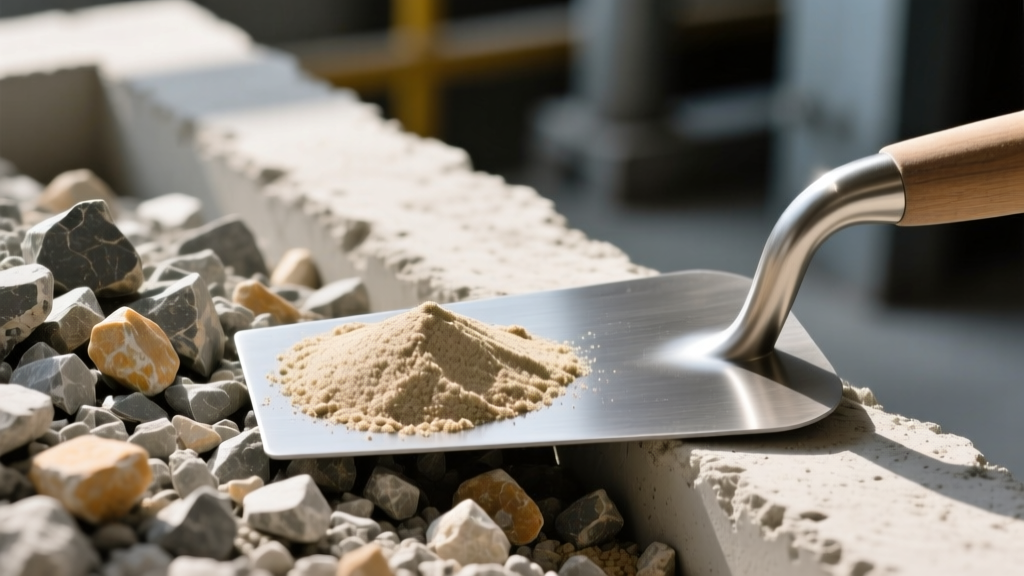
Material procurement strategies shift based on project scale. For concrete, any pour exceeding 2 cubic yards should be sourced from a ready-mix batch plant. Batch plants utilize computerized moisture sensors to adjust the water added at the drum in real-time, accounting for the ambient moisture in the sand and gravel stockpiles. This ensures the exact w/c ratio specified by the structural engineer is maintained.
For mortar, pre-bagged blends (e.g., 80 lb. bags of Type S or N masonry cement) are standard for projects under 5,000 square feet of wall area. These bags contain the exact proportions of Portland cement, plasticizers, and air-entraining agents, requiring only the addition of job-site sand and water. As of 2026, an 80 lb. bag of premium masonry cement costs between $7.50 and $9.00, yielding approximately 0.6 cubic feet of mortar when mixed with the appropriate volume of damp, loose masonry sand.
For large-scale commercial masonry, silo-delivered bulk mortar cement is mixed in continuous-mix drum mixers, ensuring batch-to-batch consistency that manual bag-mixing cannot achieve. Regardless of the sourcing method, adhering strictly to the Portland Cement Association guidelines for curing times and temperature limits (avoiding placement below 40°F without thermal blankets) remains non-negotiable for long-term durability.
Written by
Sarah WhitfieldSarah Whitfield is a chartered quantity surveyor (MRICS) and construction cost analyst with 15 years of experience in material pricing, procurement strategy, and project budgeting. She earned her degree in Construction Management from the University of Reading (UK) and has worked on projects ranging from $2M custom homes to $180M mixed-use developments across North America and Europe. Sarah currently leads cost estimating for BuildMat Insight, maintaining a proprietary database of 4,000+ material price points updated quarterly. She is a frequent contributor to RSMeans cost data panels and has presented at the International Cost Engineering Council (ICEC) congress. Based in Denver, CO, Sarah is an avid trail runner and volunteer mentor for Women in Construction.
More from Sarah Whitfield
View all
Wood & Lumber
What Are the Different Types of Wood? A Builder's Guide
Compare structural softwoods, finish hardwoods, and engineered lumber. Analyze Janka ratings, MOE values, and 2026 pricing for construction.
Aug 4, 2026

Walls & Panels
Steel Framing vs Wood Framing: Corrosion and Moisture Defense
Compare steel framing vs wood framing for moisture resistance. Learn about galvanized coatings, condensation risks, and corrosion protection strategies.
Jul 21, 2026

Stone & Masonry
How to Cut Stone Veneer: Wet Saw vs Grinder Comparison
Compare the best tools for cutting stone veneer. We review wet saws, angle grinders, and chop saws to help you achieve clean, chip-free cuts.
Jul 21, 2026