What Type of Concrete Is Used for Sidewalks? The Complete Mix Guide
Discover exactly what type of concrete is used for sidewalks, including PSI requirements, air-entrainment specs, aggregate sizes, and 2026 cost data.

The Exact Concrete Mix Design for Sidewalks
When determining what type of concrete is used for sidewalks, structural engineers and contractors rely on a specific balance of compressive strength, workability, and environmental durability. The industry standard for residential and light-commercial sidewalks is a 3,000 to 4,000 PSI (pounds per square inch) concrete mix with a maximum aggregate size of 3/4-inch and a slump of 4 to 5 inches.
Unlike structural foundations that require high-early strength, sidewalk concrete prioritizes surface durability and freeze-thaw resistance. A standard 5-sack or 6-sack mix (approximately 470 to 564 pounds of Portland cement per cubic yard) provides the necessary paste volume to encapsulate the aggregate while maintaining a low water-to-cement (w/c) ratio. Keeping the w/c ratio below 0.45 is critical; excess water increases workability but drastically reduces surface abrasion resistance and increases the likelihood of plastic shrinkage cracking.
Residential vs. Commercial Sidewalk Specifications
Municipal codes and commercial property managers mandate stricter tolerances for public right-of-ways compared to private residential paths. Below is the comparative matrix for standard sidewalk applications.
| Specification | Residential Sidewalks | Commercial / Municipal Sidewalks |
|---|---|---|
| Compressive Strength | 3,000 PSI (28-day) | 4,000 PSI (28-day) |
| Minimum Thickness | 4 inches | 4 to 6 inches (depending on maintenance vehicle access) |
| Maximum Aggregate Size | 3/4-inch crushed stone | 3/4-inch to 1-inch crushed stone |
| Air Entrainment | 4% to 6% (in freeze-thaw climates) | 5% to 7% (strictly enforced via ASTM C260) |
| Control Joint Spacing | Every 4 to 5 feet (to create square panels) | Every 4 to 5 feet, saw-cut within 12 hours of placement |
| Surface Finish | Light broom finish for slip resistance | Heavy transverse broom finish (ADA compliant) |
The Freeze-Thaw Factor: Why Air Entrainment is Non-Negotiable
If you live in a climate where temperatures drop below freezing, the single most important component in your sidewalk mix is air-entraining admixture (AEA). According to the Portland Cement Association, unentrained concrete will rapidly deteriorate when subjected to cyclic freezing and thawing in the presence of moisture.
AEA introduces billions of microscopic, disconnected air bubbles (typically 4% to 7% of the total concrete volume) into the cement paste. When water inside the concrete freezes and expands by 9%, these microscopic voids act as pressure-relief chambers. Without them, the internal hydraulic pressure exceeds the tensile strength of the concrete, causing the surface to pop off—a failure mode known as scaling.
Critical Warning: Never use deicing salts (like calcium chloride or rock salt) on non-air-entrained concrete during its first winter. The combination of osmotic pressure from the salts and the expansion of freezing water will guarantee severe surface spalling within a single season.
Reinforcement Strategies: Wire Mesh vs. Synthetic Fibers
Sidewalks are considered "unreinforced" or "lightly reinforced" structural elements because they are designed to rest on a continuous subgrade rather than span voids. However, secondary reinforcement is used to control temperature and shrinkage cracking.
- Welded Wire Mesh (WWM): Typically 6x6 W1.4xW1.4 wire mesh. It must be physically pulled up into the upper third of the slab during the pour. If it ends up resting on the subgrade, it provides zero structural or crack-control value.
- Macrosynthetic Fibers: Products like W.R. Meadows FIBERMESH or Grace Concrete micro-synthetic fibers are dosed directly into the ready-mix truck (usually 3 to 5 lbs per cubic yard). These fibers create a three-dimensional matrix that intercepts micro-cracks before they propagate to the surface. For most modern sidewalk pours, synthetic fibers have entirely replaced wire mesh due to lower labor costs and superior early-age plastic shrinkage control.
2026 Sidewalk Concrete Cost Breakdown
Accurate budgeting requires understanding both material costs and the logistical premiums associated with ready-mix delivery. The pricing below reflects national averages for 2026.
| Cost Category | Estimated Price Range | Notes |
|---|---|---|
| Ready-Mix Concrete (3,000 - 4,000 PSI) | $145 - $185 per cubic yard | Includes standard 3/4" aggregate and air-entrainment. |
| Short-Load Fee | $75 - $150 flat fee | Applied to orders under 3 to 4 cubic yards. |
| Synthetic Fiber Reinforcement | $12 - $18 per cubic yard | Dosed at the batch plant; eliminates wire mesh labor. |
| Concrete Pump Truck (Line Pump) | $800 - $1,200 per day | Required if the truck cannot back directly up to the forms. |
| Subgrade Preparation (Labor/Material) | $2.50 - $4.00 per sq. ft. | Includes excavation, 4-inch compacted gravel base, and forming. |
Critical Placement and Curing Protocols
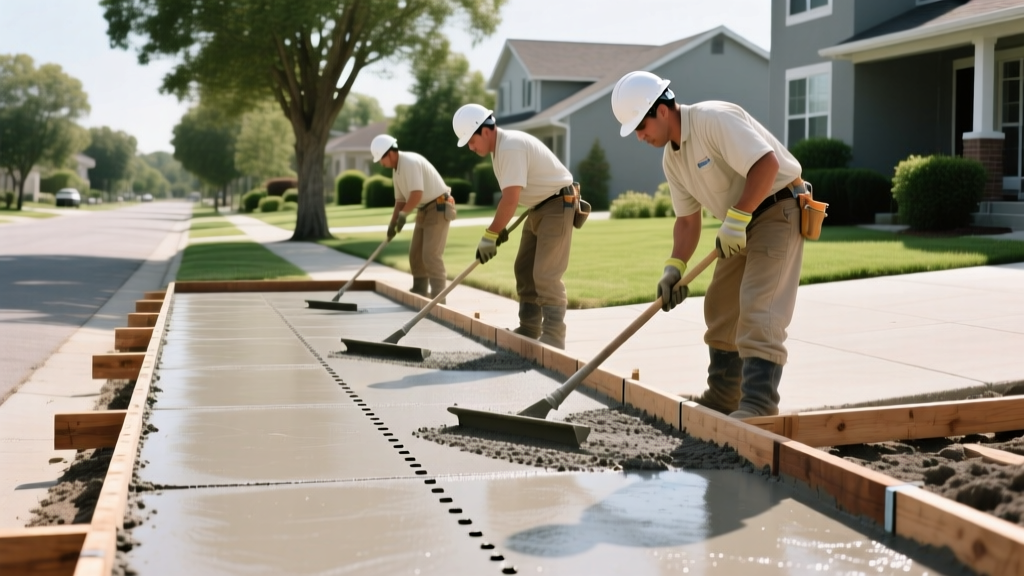
Even a perfectly designed 4,000 PSI mix will fail if placed and cured incorrectly. The American Concrete Institute (ACI) outlines strict protocols for flatwork placement that directly impact the lifespan of a sidewalk.
Control Joint Depth and Timing
Concrete will crack; the goal is to force it to crack in a straight, hidden line. Control joints must be cut to a depth of exactly 25% of the slab thickness. For a standard 4-inch sidewalk, joints must be 1 inch deep. If using a hand groover, do it when the concrete can support your weight but is still plastic. If using an early-entry saw (like a Soff-Cut), cut within 1 to 4 hours of finishing, before thermal contraction stresses build up overnight.
Proper Curing Methods
Sidewalks have a high surface-area-to-volume ratio, making them highly susceptible to rapid moisture evaporation. As soon as the final broom finish is applied and the surface sheen disappears, the concrete must be cured.
- Wet Curing: Covering with wet burlap and 4-mil polyethylene sheeting for 5 to 7 days. This is the gold standard for preventing plastic shrinkage cracks.
- Membrane Curing: Spraying a wax-based or acrylic curing compound (such as Dayton Superior Resin 7) immediately after finishing. This seals the moisture inside the slab to allow proper hydration of the cement particles.
Troubleshooting Common Sidewalk Failures
Understanding why existing sidewalks fail helps in specifying the correct mix for new projects.
- Frost Heave: Caused by poor subgrade drainage. When the soil beneath the slab freezes, it expands and lifts the concrete. Fix: Ensure a minimum 4-inch base of compacted, free-draining crushed stone (ASTM D2940) and install French drains if the water table is high.
- Map Cracking (Craze Cracking): A network of fine, shallow surface cracks. This is almost always caused by finishing the concrete while bleed water is still on the surface, which traps water under a dense, weak layer of cement paste. Fix: Never trowel bleed water back into the surface; wait for it to evaporate.
- Joint Spalling: The edges of control joints chip and break away. This occurs when joints are cut too late (after the concrete has gained too much tensile strength) or when the joint edges are not sealed, allowing incompressible debris (gravel, dirt) to enter. When the slab expands in summer heat, the debris prevents closure, crushing the concrete edges.
By specifying a 4,000 PSI air-entrained mix with a 0.45 w/c ratio, utilizing synthetic fibers, and enforcing strict jointing and curing protocols, you ensure a sidewalk that will easily exceed its 30-year design life with minimal maintenance.
Written by
Marcus ChenMarcus Chen is a licensed structural engineer (PE) and building materials analyst with over 12 years of experience across residential, commercial, and industrial construction. He holds a Master of Science in Civil Engineering from UC Berkeley and spent six years at Thornton Tomasetti before transitioning to independent consulting and technical writing. Marcus specializes in material selection for seismic-prone regions, concrete reinforcement strategies, and lifecycle cost analysis. His work has been cited by the American Concrete Institute (ACI) and the Structural Engineers Association of California (SEAOC). When he is not on a job site or at his desk, you will find him hiking the Sierra Nevada or restoring a 1920s craftsman bungalow in Oakland, CA.
More from Marcus Chen
View all
Construction Cost
How Much Did the Eiffel Tower Cost to Build?
How much did the Eiffel Tower cost to build in 1889? We adjust for inflation and compare its budget to modern skyscraper construction.
Aug 4, 2026

Fire Resistance
What Is a Fire Resistant Material? Testing & Certification Guide
Discover what is a fire resistant material through ASTM and UL testing. Learn how fire ratings, certifications, and assemblies work in construction.
Aug 4, 2026

Construction Cost
How Much Did the Burj Khalifa Cost to Build?
How much did the Burj Khalifa cost to build? We break down the $1.5B project and extract 5 money-saving strategies for your next build.
Jul 30, 2026