Water Based Concrete Stain vs Acid Stain: Pros, Cons & Costs
Compare water based concrete stain vs acid stain. Learn the chemistry, costs, failure modes, and aesthetic differences to choose the right slab finish.

The Core Chemistry: Reactive vs. Non-Reactive Penetration
When evaluating water based concrete stain vs acid stain, the fundamental difference lies in the chemical interaction with the cementitious matrix. Understanding this reaction is critical for predicting the final aesthetic and long-term durability of your slab.
Acid Stain: The Reactive Process
Acid stains consist of water, hydrochloric acid, and acid-soluble metallic salts (such as iron, copper, and chromium). When applied, the acid lightly etches the surface, allowing the metallic salts to react with the hydrated lime (calcium hydroxide) present in the concrete. This reaction creates permanent, insoluble metallic oxides that become an integral part of the concrete matrix. Because the reaction depends on the specific chemical composition and age of the slab, the result is a highly variegated, mottled, marble-like appearance. According to the Portland Cement Association, the availability of free calcium hydroxide decreases as concrete carbonates over time, meaning older or heavily weathered slabs may yield weaker color reactions.
Water-Based Stain: The Non-Reactive Process
Water-based stains do not rely on a chemical reaction. Instead, they utilize fine, microscopic acrylic polymers and inorganic pigments suspended in a water carrier. The water carries the pigments into the capillary pores of the concrete, and as the water evaporates, the polymers bind the pigments to the pore walls. This mechanism allows for a much broader, more predictable color palette, ranging from subtle translucent earth tones to vibrant, opaque hues that acid stains simply cannot achieve.
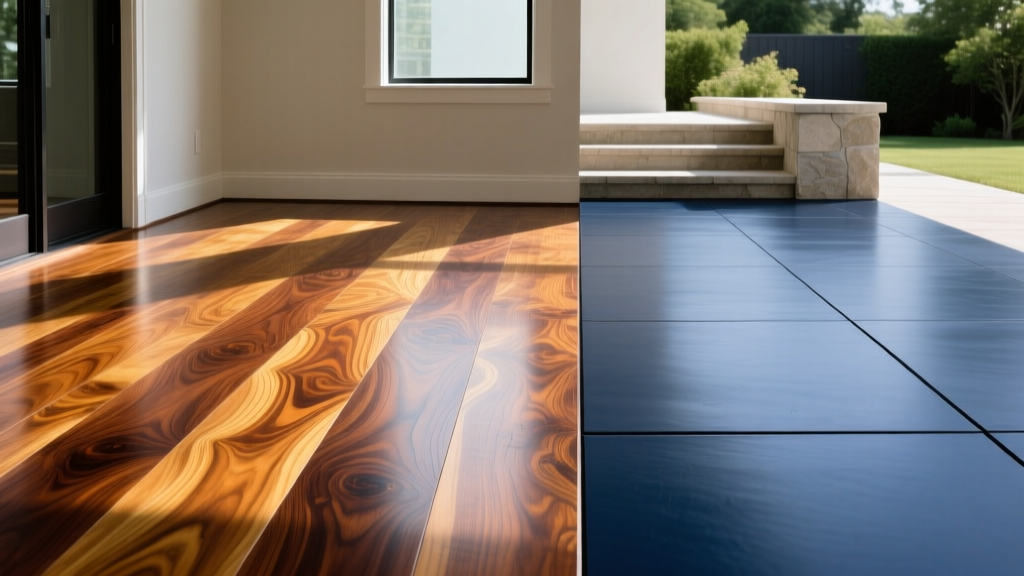
Head-to-Head Comparison Matrix
The following matrix breaks down the critical performance and application metrics for both staining systems.
| Feature | Acid Stain | Water-Based Stain |
|---|---|---|
| Color Mechanism | Chemical reaction (metallic oxides) | Physical penetration (pigment suspension) |
| Color Palette | Limited (browns, tans, blues, greens, black) | Vast (full spectrum, including brights and whites) |
| Visual Effect | Variegated, mottled, marble-like, unpredictable | Uniform, translucent, or layered for custom effects |
| Prep & Neutralization | Requires alkaline neutralization and heavy rinsing | No neutralization required; light rinsing only |
| VOC Levels | Moderate to High (depending on solvent carriers) | Ultra-Low (ideal for occupied interiors and LEED) |
| UV Stability | Excellent (inorganic oxides do not fade) | Very Good (modern inorganic pigments resist fading) |
| Material Cost | $0.20 - $0.45 per sq. ft. | $0.35 - $0.65 per sq. ft. |
Application Edge Cases: Where Projects Fail
Surface preparation dictates the success of any decorative concrete project. Both systems require an open pore structure, typically a Concrete Surface Profile (CSP) of 1 or 2, but their failure modes differ drastically.
Acid Stain Failure Modes
- Fly Ash and Slag Mixes: Modern concrete mixes often replace Portland cement with fly ash or slag to reduce carbon footprints. However, this replacement drastically reduces the calcium hydroxide available for the acid reaction. If the mix design exceeds 20% fly ash replacement, acid stains will yield weak, washed-out colors.
- Sealed or Hardened Surfaces: If a slab was treated with a cure-and-seal compound or a liquid densifier (like sodium silicate) without subsequent profiling, the acid cannot penetrate. Mechanical grinding is required to expose reactive lime.
Water-Based Stain Failure Modes
- Moisture Vapor Transmission (MVT): Because water-based stains rely on acrylic polymers to bind within the pores, excessive hydrostatic pressure or MVT will cause the polymers to emulsify and fail. Always conduct an ASTM F1869 calcium chloride test; if MVT exceeds 3 to 5 lbs per 1,000 sq. ft. per 24 hours, a moisture mitigation primer is required before staining.
- Surface Tension Issues: Highly dense, steel-troweled concrete can repel water-based stains. Adding a wetting agent or lightly profiling the surface with a 200-grit diamond pad is often necessary to break the surface tension.
Cost Breakdown: Materials, Labor, and Longevity
When budgeting for a decorative slab, material costs represent only a fraction of the total investment. Labor and preparation dominate the final invoice.
Material and Labor Estimates (Per Square Foot)
- Acid Stain DIY / Materials Only: $0.25 - $0.50 / sq. ft. (Includes stain, neutralizer, and basic acrylic sealer).
- Water-Based Stain DIY / Materials Only: $0.40 - $0.75 / sq. ft. (Includes stain, cleaner, and basic acrylic sealer).
- Professional Acid Stain Installation: $4.00 - $8.00 / sq. ft. The higher labor cost reflects the intensive prep work, multi-day neutralization/rinsing process, and hazardous material handling.
- Professional Water-Based Stain Installation: $3.00 - $6.00 / sq. ft. Faster application and zero neutralization requirements reduce labor hours significantly.
Over a 15-year lifecycle, both systems perform similarly if properly sealed and maintained with sacrificial wax coatings. However, water-based stains offer a lower total cost of ownership for commercial spaces due to faster installation times and zero downtime for toxic off-gassing.
The Alternatives: Concrete Dyes and Acrylics
If neither traditional acid nor water-based stains meet your project parameters, two primary alternatives exist in the decorative market:
1. Penetrating Solvent/Acetone Dyes
Dyes do not react chemically; they are microscopic colorants that penetrate deeply and dry in minutes. They offer vibrant, translucent colors and are ideal for fast-track commercial projects. However, dyes are notoriously UV-unstable and will fade rapidly in direct sunlight. They are strictly recommended for interior applications and are often used in conjunction with acid stains to enhance color depth.
2. Acrylic Concrete Paints and Coatings
Unlike stains that penetrate the pores, acrylic paints form a surface film. While they offer total opacity and unlimited color choices, they are prone to peeling, scratching, and hot-tire pickup in garage environments. They are a low-cost, short-term alternative but lack the permanence and depth of penetrating stains.
Decision Framework: Which Should You Choose?
Use the following logic tree to finalize your specification:
- Is the slab exterior and exposed to direct sunlight?
Choose Acid Stain for maximum UV permanence, or Water-Based Stain with UV-stable inorganic pigments. Avoid dyes entirely. - Does the concrete mix contain high volumes of fly ash or slag?
Choose Water-Based Stain. Acid stains will fail to react adequately. - Is the project an occupied interior (e.g., a retail store or hospital) with strict VOC limits?
Choose Water-Based Stain. The low-odor, low-VOC profile allows for overnight application without disrupting daytime operations. - Does the client want a natural, variegated, 'old-world' leather look?
Choose Acid Stain. The unpredictable chemical marbling cannot be perfectly replicated by water-based systems. - Is the timeline compressed, requiring same-day sealing?
Choose Water-Based Stain. Acid stains require thorough neutralization, scrubbing, and a 24-hour drying period before a sealer can be safely applied without trapping moisture and causing blushing.
By matching the chemical properties of the stain to the specific mix design, environmental exposure, and aesthetic demands of the project, contractors can eliminate callbacks and deliver permanent, high-value decorative concrete finishes.
Written by
Elena RodriguezElena Rodriguez is a civil engineer and technical writer specializing in concrete technology, masonry systems, and ASTM/ACI compliance. She earned her B.S. in Civil Engineering from Texas A&M University and spent a decade at a materials testing laboratory, performing over 2,000 concrete compressive strength tests and masonry prism evaluations. Elena is an ACI-certified Field Testing Technician (Grade I) and a member of ASTM Committee C12 on Natural Building Stone. She currently consults on forensic engineering cases involving concrete failures and moisture intrusion. Based in San Antonio, TX, Elena is a proud member of the Society of Women Engineers (SWE) and coaches her daughter's FIRST Robotics team.
More from Elena Rodriguez
View all
Walls & Panels
Cost Analysis: Light Gauge Steel Framing Advantages and Disadvantages
Evaluate light gauge steel framing advantages and disadvantages through a strict cost analysis lens, comparing material, labor, and lifecycle expenses.
Aug 4, 2026

Walls & Panels
Gypsum Board Types: Exact Specifications, Thickness & Dimensions
Compare standard, Type X, and moisture-resistant gypsum board types. Get exact specifications, thicknesses, dimensions, and ASTM standards for your project.
Aug 4, 2026

Fire Resistance
Best Fire-Resistant Outdoor Decking Materials: 2026 Buyer Guide
Discover the best fire-resistant outdoor decking materials for 2026. Compare Class A PVC, aluminum, and hardwood options for WUI compliance and safety.
Aug 4, 2026