Average Cost to Build a House in Oklahoma: 2026 Breakdown
Discover the average cost to build a house in Oklahoma in 2026. Detailed line-item breakdowns, soil engineering, and tornado-resilience upgrades.

The True Average Cost to Build a House in Oklahoma
Calculating the average cost to build a house in Oklahoma requires looking beyond national averages, which often skew higher due to coastal and metropolitan labor rates. In 2026, Oklahoma remains one of the more affordable states for residential construction, but local environmental factors—specifically expansive clay soils and severe weather risks—introduce unique engineering and material costs that out-of-state builders frequently underestimate.
For a standard 2,000-square-foot, builder-grade single-family home, the average cost to build a house in Oklahoma ranges from $145 to $195 per square foot. This translates to a total hard-cost baseline of $290,000 to $390,000. Custom architectural homes with high-end finishes and advanced weather-mitigation packages push this range to $220 to $310 per square foot.
2026 Oklahoma Construction Snapshot
- Base Builder-Grade Cost: $145 - $195 / sq. ft.
- Custom/Premium Cost: $220 - $310+ / sq. ft.National Association of Home Builders (NAHB) Construction Cost Survey, framing and interior finishes consume the largest share of the budget, but Oklahoma's site-work costs are trending upward due to stricter municipal drainage and soil-stabilization mandates.
Construction Phase Estimated Cost Range (2,000 sq ft) Cost per Sq. Ft. Site Prep & Earthwork $5,500 - $9,500 $2.75 - $4.75 Foundation (Post-Tension Slab) $11,000 - $16,000 $5.50 - $8.00 Framing (Lumber & Trusses) $32,000 - $46,000 $16.00 - $23.00 Exterior Finishes (Brick/Hardie) $22,000 - $38,000 $11.00 - $19.00 Roofing (Class 4 Impact Shingles) $11,500 - $18,000 $5.75 - $9.00 HVAC (High-Efficiency Heat Pump) $14,000 - $24,000 $14,000 - $24,000 $7.00 - $12.00 Plumbing & Electrical Rough/Finish $24,000 - $36,000 $12.00 - $18.00 Interior Finishes (Drywall, Paint, Trim) $35,000 - $55,000 $17.50 - $27.50 Cabinetry & Countertops $16,000 - $35,000 $8.00 - $17.50 Flooring (LVP, Tile, Carpet) $12,000 - $22,000 $6.00 - $11.00 Oklahoma-Specific Foundation & Soil Engineering
The most frequent point of failure for new builds in Oklahoma is foundation cracking caused by highly expansive clay soils, particularly in the Oklahoma City metro and central plains. Standard shallow foundations often fail when soil moisture fluctuates between drought and heavy spring rains.
Navigating Expansive Clay Soils
To mitigate this, structural engineers in Oklahoma routinely specify post-tension concrete slabs rather than traditional rebar-reinforced slabs. Post-tensioning uses high-strength steel cables tensioned after the concrete cures, compressing the slab and preventing it from cracking as the underlying clay expands and contracts. Expect to pay a premium of $2,500 to $4,500 over a standard slab for post-tension engineering and materials. In areas with severe soil plasticity, drilled concrete piers extending 15 to 25 feet into the bedrock may be required, adding $8,000 to $15,000 to the site-work budget.
Weather-Resilience Upgrades: Tornado and Hail Mitigation
Oklahoma's location in Tornado Alley dictates strict building codes and necessary upgrades that directly impact the average cost to build a house in Oklahoma. Investing in weather resilience not 5% to 8% to the total build cost but can reduce annual homeowners insurance premiums by 15% to 25%.
- FEMA P-361 Compliant Safe Rooms: Integrating a cast-in-place concrete or reinforced CMU safe room into the garage or master closet floor plan costs between $6,500 and $9,500. The Federal Emergency Management Agency (FEMA) outlines strict anchoring and impact-testing requirements for these structures to withstand EF5 tornadoes.
- UL 2218 Class 4 Impact-Resistant Roofing: Hail is a primary driver of insurance claims in the state. Upgrading from standard architectural shingles to Class 4 impact-resistant asphalt shingles (such as CertainTeed NorthGate or Owens Corning Duration Storm) adds $2,500 to $4,500 to the roofing budget but is often mandatory for insurance discounts.
- Reinforced Garage Doors: Wind pressure differentials during severe storms often cause standard garage doors to buckle, leading to catastrophic roof failure. Upgrading to wind-rated garage doors with heavy-duty struts and 14-gauge tracks costs an additional $800 to $1,400 per door.
- Continuous Load Path Framing: Utilizing engineered hurricane ties and structural screws (like Simpson Strong-Tie) at every truss-to-wall and wall-to-foundation connection ensures the home acts as a single unit under extreme wind uplift. This adds roughly $1,200 to $2,000 in hardware and labor.
Regional Price Variations Across the State
The average cost to build a house in Oklahoma is not uniform across the state. Labor availability, municipal impact fees, and material transport logistics create distinct pricing zones.
Oklahoma City Metro (Edmond, Norman, Yukon)
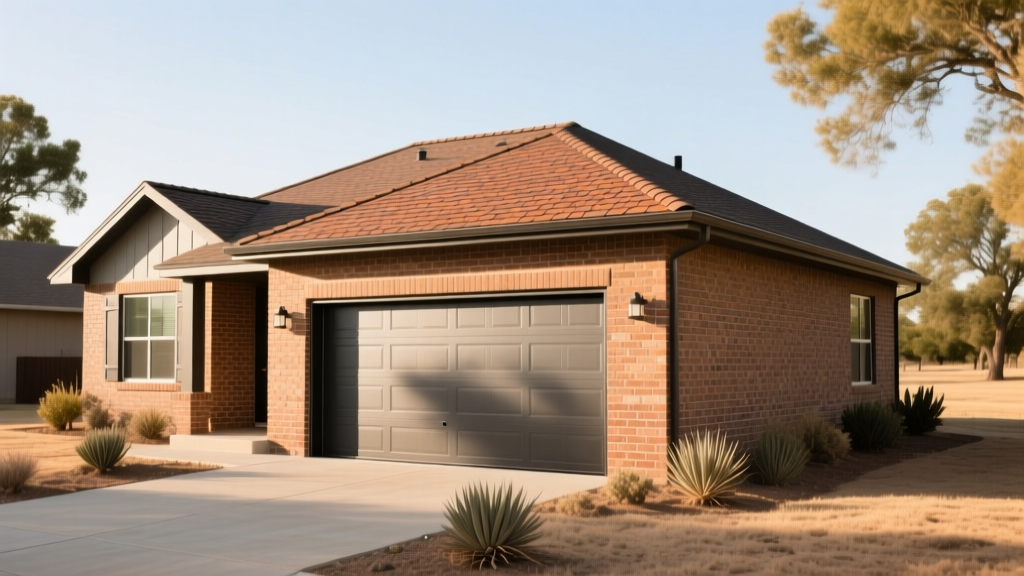
The OKC metro commands the highest construction costs in the state, averaging $165 to $210 per square foot. High demand for skilled trades, stringent municipal zoning, and higher tap fees for water and sewer connections drive these costs. Edmond, in particular, enforces strict masonry and aesthetic ordinances that force builders to use premium brick and stone veneers over vinyl or fiber cement siding.
Tulsa and Northeast Oklahoma
Tulsa's construction market averages $150 to $190 per square foot. The terrain in northeast Oklahoma is rockier and more heavily wooded than the central plains, which can increase site clearing and excavation costs by $3,000 to $6,000 per acre. However, labor rates remain slightly more competitive than in the capital region.
Rural and Western Oklahoma
In rural counties, base construction costs can drop to $135 to $160 per square foot. However, rural builds incur heavy infrastructure penalties. Drilling a private water well ($6,000 to $12,000), installing an aerobic septic system ($8,000 to $15,000), and running extended electrical lines from the nearest rural cooperative can easily add $25,000 to $40,000 to the overall project budget, negating the lower per-square-foot build cost.
Hard Costs vs. Soft Costs and Permitting
When budgeting, builders must separate hard costs (physical materials and labor) from soft costs. In Oklahoma, soft costs typically account for 12% to 18% of the total project budget.
Warning on Impact Fees: Cities like Norman and Moore have implemented aggressive utility impact fees and stormwater management requirements. A single-family residential water/sewer tap fee in these jurisdictions can exceed $4,500, which is significantly higher than the state average of $1,800. Always verify municipal fee schedules with the local public works department before finalizing land acquisition.
Architectural and structural engineering fees for a custom 2,500-square-foot home will range from $8,000 to $15,000. Because of the International Residential Code (IRC) high-wind construction requirements adopted by most Oklahoma municipalities, structural engineers must provide detailed wind-load calculations and framing elevations, which adds to the pre-construction soft costs.
Frequently Asked Questions
Is it cheaper to build or buy an existing home in Oklahoma?
As of 2026, buying an existing home is generally 10% to 15% cheaper upfront than building a comparable new home in Oklahoma, primarily due to the cost of land acquisition and current interest rates on construction loans. However, building new allows for the integration of modern energy-efficient HVAC systems, post-tension foundations, and Class 4 roofing, which drastically reduces long-term maintenance and insurance costs.
Do I need a basement in Oklahoma?
No, and it is highly discouraged. Basements are exceptionally rare in Oklahoma due to the high water table, expansive clay soils, and the extreme cost of excavating through caliche and bedrock. A standard above-ground safe room is safer, more accessible, and costs roughly 80% less than excavating a below-ground basement.
How long does it take to build a house in Oklahoma?
A standard production build takes 5 to 7 months from groundbreaking to final certificate of occupancy. Custom builds, which require specialized engineering for soil and wind loads, typically take 8 to 12 months. Spring and early summer builds often face delays due to severe thunderstorm seasons and tornado warnings halting crane and framing operations.
Written by
Sarah WhitfieldSarah Whitfield is a chartered quantity surveyor (MRICS) and construction cost analyst with 15 years of experience in material pricing, procurement strategy, and project budgeting. She earned her degree in Construction Management from the University of Reading (UK) and has worked on projects ranging from $2M custom homes to $180M mixed-use developments across North America and Europe. Sarah currently leads cost estimating for BuildMat Insight, maintaining a proprietary database of 4,000+ material price points updated quarterly. She is a frequent contributor to RSMeans cost data panels and has presented at the International Cost Engineering Council (ICEC) congress. Based in Denver, CO, Sarah is an avid trail runner and volunteer mentor for Women in Construction.
More from Sarah Whitfield
View all
Wood & Lumber
What Are the Different Types of Wood? A Builder's Guide
Compare structural softwoods, finish hardwoods, and engineered lumber. Analyze Janka ratings, MOE values, and 2026 pricing for construction.
Aug 4, 2026

Walls & Panels
Steel Framing vs Wood Framing: Corrosion and Moisture Defense
Compare steel framing vs wood framing for moisture resistance. Learn about galvanized coatings, condensation risks, and corrosion protection strategies.
Jul 21, 2026

Stone & Masonry
How to Cut Stone Veneer: Wet Saw vs Grinder Comparison
Compare the best tools for cutting stone veneer. We review wet saws, angle grinders, and chop saws to help you achieve clean, chip-free cuts.
Jul 21, 2026