Average Cost to Build a Pool: Detailed Material & Labor Breakdown
Discover the true average cost to build a pool. Detailed breakdowns of gunite, fiberglass, and vinyl prices, plus hidden excavation and equipment fees.

The True Baseline: National Averages vs. Reality
When evaluating the average cost to build a pool, homeowners are frequently misled by national averages that fail to account for site-specific variables. While the national baseline for a standard 14x28-foot inground pool sits between $45,000 and $120,000, the actual final invoice is dictated by soil composition, municipal permitting, and equipment specifications. A basic vinyl liner pool in flat, sandy terrain may cost $42,000, while a geometric gunite pool with a negative edge on a sloped, rocky lot will easily exceed $150,000.
Quick Cost Summary (14x28 ft. Standard Rectangle)
- Vinyl Liner: $38,000 – $65,000
- Fiberglass Shell: $48,000 – $85,000
- Gunite / Shotcrete: $68,000 – $125,000+
- Essential Add-ons (Heater, Auto-Cover, Lighting): +$12,000 – $25,000
Material-Specific Cost Breakdown
The choice of structural material accounts for roughly 40% to 50% of the total project budget. Each material demands different structural engineering, installation timelines, and long-term maintenance protocols. According to the Pool & Hot Tub Alliance (PHTA), proper material selection must align with local water tables and soil expansiveness.
| Material Type | Average Installed Cost | Install Time | Structural Specs & Lifespan |
|---|---|---|---|
| Gunite | $68k - $125k+ | 60 - 90 Days | 6"-12" thick, 4,000 PSI mix. 50+ years. |
| Fiberglass | $48k - $85k | 30 - 45 Days | One-piece gelcoat drop. 25-30 years. |
| Vinyl Liner | $38k - $65k | 45 - 60 Days | 27-30 mil liner, polymer walls. 10-15 years (liner). |
Gunite and Shotcrete: The Custom Standard
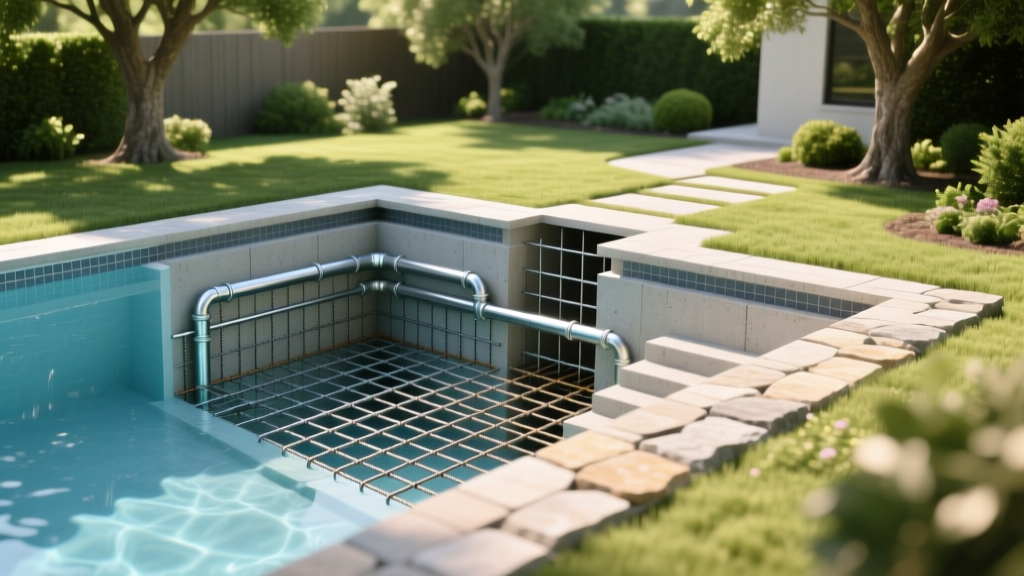
Gunite pools utilize a dry-mix concrete application sprayed over a grid of #3 or #4 steel rebar spaced on 10-inch centers. The structural shell must be a minimum of 6 inches thick, expanding to 12 inches at high-stress points like corners and the main drain sump. The primary cost driver here is labor and the curing process, which requires 28 days of hydration before plaster application.
Fiberglass: The Crane-Dependent Option
Fiberglass shells are manufactured off-site and dropped into the excavation as a single unit. While the shell itself costs between $18,000 and $35,000, the hidden cost is logistics. If your property requires a crane with a 100-foot boom reach to clear a two-story home, crane rental and road closure permits will add $3,500 to $8,000 to the budget.
Vinyl Liner: The Budget-Conscious Route
Vinyl pools rely on pre-fabricated polymer or galvanized steel wall panels backfilled with gravel. The critical specification here is the liner thickness. Never accept a 20-mil liner; demand a 27-mil to 30-mil virgin virgin vinyl with UV inhibitors. While the initial cost is lower, expect to pay $4,500 to $6,500 every 10 to 12 years for a complete liner replacement.
Excavation, Site Prep, and Hidden Dirt Costs
Excavation is the most volatile line item in any pool contract. A standard 14x28 pool with a 6-foot deep end requires moving approximately 85 to 100 cubic yards of earth. If your soil is classified as Type A (stable clay or sand) and you have wide gate access (minimum 10 feet) for a standard excavator and dump trucks, dirt removal will cost $15 to $25 per cubic yard, totaling $1,500 to $2,500.
If excavation hits solid bedrock, mechanical blasting or hydraulic hammering will increase excavation costs by $8,000 to $15,000. Similarly, a high water table requires a well-point dewatering system during construction, adding $2,500 to $4,000 in equipment rental and continuous pumping fees.
Plumbing, Electrical, and Equipment Specifications
Modern pool equipment is governed by strict energy and safety codes. The U.S. Department of Energy mandates that all new pool pumps meet specific energy conservation standards, effectively requiring variable-speed technology.
Essential Equipment Pricing Matrix
- Variable Speed Pump: Pentair IntelliFlo3 VSF or Hayward TriStar VS. Cost: $1,800 – $2,600 (installed). These pay for themselves in 18 months by reducing pumping energy use by up to 90% compared to single-speed models.
- Gas Heater: Hayward Universal H-Series 400,000 BTU. Cost: $3,500 – $4,200 (installed). Requires a dedicated 1.5-inch natural gas line or a 500-gallon propane tank.
- Heat Pump: AquaCal 140,000 BTU. Cost: $4,500 – $6,000 (installed). Highly efficient in southern climates but loses efficacy when ambient air drops below 50°F.
- Salt Chlorine Generator: Hayward AquaRite or Pentair IntelliChlor. Cost: $1,500 – $2,200 (installed). Requires a sacrificial zinc anode to protect copper heat exchangers from galvanic corrosion.
- LED Lighting: Pentair IntelliBrite color-changing fixtures. Cost: $650 – $850 per niche (installed). NEC Article 680 requires all pool lighting to be GFCI protected and bonded.
Permitting, Inspections, and Fencing Requirements
Do not underestimate the regulatory costs of pool ownership. Municipal building departments typically charge $400 to $1,200 for pool permits, which cover structural, electrical, and plumbing inspections. Furthermore, the U.S. Consumer Product Safety Commission (CPSC) enforces strict barrier guidelines to prevent drowning.
Most municipalities adopt the BOCA (Building Officials and Code Administrators) pool code. This mandates a minimum 48-inch-high perimeter fence with self-closing, self-latching gates. The fence must not have any gaps larger than a 4-inch sphere, and horizontal climbable members must be spaced at least 45 inches apart. Installing a code-compliant 6-foot aluminum ornamental fence typically costs $45 to $75 per linear foot.
Long-Term Operational Costs (The 10-Year View)
The average cost to build a pool is only the entry fee. Maintaining the asset requires a strict chemical and mechanical budget. For a standard 15,000-gallon gunite pool, anticipate the following annual operational costs:
- Electricity (Pump & Heater): $800 – $2,400
- Chemicals (Chlorine, Muriatic Acid, Algaecide): $600 – $1,000
- Water (Makeup water for evaporation and backwashing): $150 – $300
- Professional Opening/Closing & Weekly Service: $1,500 – $3,000
- Insurance Premium Increase: $150 – $350 (Requires minimum $300k liability or an umbrella policy).
Frequently Asked Questions
Does an inground pool increase my property value?
According to real estate appraisers, an inground pool typically recoups 50% to 70% of its construction cost upon resale, depending on the climate and neighborhood. In premium markets in Florida, Arizona, or Southern California, the ROI can approach 100%. In northern climates with short swim seasons, it may yield a lower return and can deter some buyers concerned with maintenance.
What is the cheapest inground pool to build?
A standard rectangular vinyl liner pool with a polymer wall structure and a basic single-speed or dual-speed pump is the lowest-cost inground option, typically starting around $38,000. However, factoring in a mandatory liner replacement every decade alters the 20-year lifecycle cost, making fiberglass highly competitive over the long term.
How much does it cost to add a pool heater after construction?
Retrofitting a gas heater to an existing pool costs between $3,000 and $5,000, assuming a gas line is already present at the equipment pad. If a new natural gas line must be trench from the street or meter, utility connection fees and trenching can add $2,000 to $6,000 to the project. Heat pumps are easier to retrofit, requiring only a dedicated 50-amp, 240-volt electrical circuit.
Written by
Elena RodriguezElena Rodriguez is a civil engineer and technical writer specializing in concrete technology, masonry systems, and ASTM/ACI compliance. She earned her B.S. in Civil Engineering from Texas A&M University and spent a decade at a materials testing laboratory, performing over 2,000 concrete compressive strength tests and masonry prism evaluations. Elena is an ACI-certified Field Testing Technician (Grade I) and a member of ASTM Committee C12 on Natural Building Stone. She currently consults on forensic engineering cases involving concrete failures and moisture intrusion. Based in San Antonio, TX, Elena is a proud member of the Society of Women Engineers (SWE) and coaches her daughter's FIRST Robotics team.
More from Elena Rodriguez
View all
Walls & Panels
Cost Analysis: Light Gauge Steel Framing Advantages and Disadvantages
Evaluate light gauge steel framing advantages and disadvantages through a strict cost analysis lens, comparing material, labor, and lifecycle expenses.
Aug 4, 2026

Walls & Panels
Gypsum Board Types: Exact Specifications, Thickness & Dimensions
Compare standard, Type X, and moisture-resistant gypsum board types. Get exact specifications, thicknesses, dimensions, and ASTM standards for your project.
Aug 4, 2026

Fire Resistance
Best Fire-Resistant Outdoor Decking Materials: 2026 Buyer Guide
Discover the best fire-resistant outdoor decking materials for 2026. Compare Class A PVC, aluminum, and hardwood options for WUI compliance and safety.
Aug 4, 2026