How Much Will It Cost to Build a Tennis Court? Smart Budget Guide
Discover how much it will cost to build a tennis court and learn expert money-saving strategies on base materials, surfacing, and site prep.

The True Baseline: How Much Will It Cost to Build a Tennis Court?
When homeowners ask, "how much will it cost to build a tennis court," the answer hinges entirely on how they manage the site footprint. A standard tournament-size playing area is 60 by 120 feet (7,200 square feet). However, the American Sports Builders Association (ASBA) mandates a total site pad of at least 70 by 130 feet (9,100 square feet) to accommodate fencing, runoff, and player overrun. Total costs range from $25,000 for a modular tile overlay on an existing slab to $120,000+ for a premium post-tension concrete court with LED lighting on raw, sloped land.
- Economy Build (Asphalt): $35,000 - $55,000
- Standard Build (Post-Tension Concrete): $50,000 - $80,000
- Premium Build (Clay or Cushioned Acrylic): $85,000 - $120,000+
Cost Breakdown by Surface Type
| Surface Material | Base + Surface Cost | 10-Year Maintenance | Lifespan |
|---|---|---|---|
| Standard Asphalt | $35k - $55k | $8,000 (Resurfacing) | 15-20 Years |
| Post-Tension Concrete | $50k - $80k | $3,000 (Color Coats) | 30+ Years |
| Modular Polypropylene | $25k - $40k (Over existing slab) | $500 (Tile replacement) | 15 Years |
| Har-Tru Clay | $60k - $90k | $15,000 (Annual top-dress) | Indefinite (with upkeep) |
Site Preparation: Where Budgets Bleed (And How to Stop It)
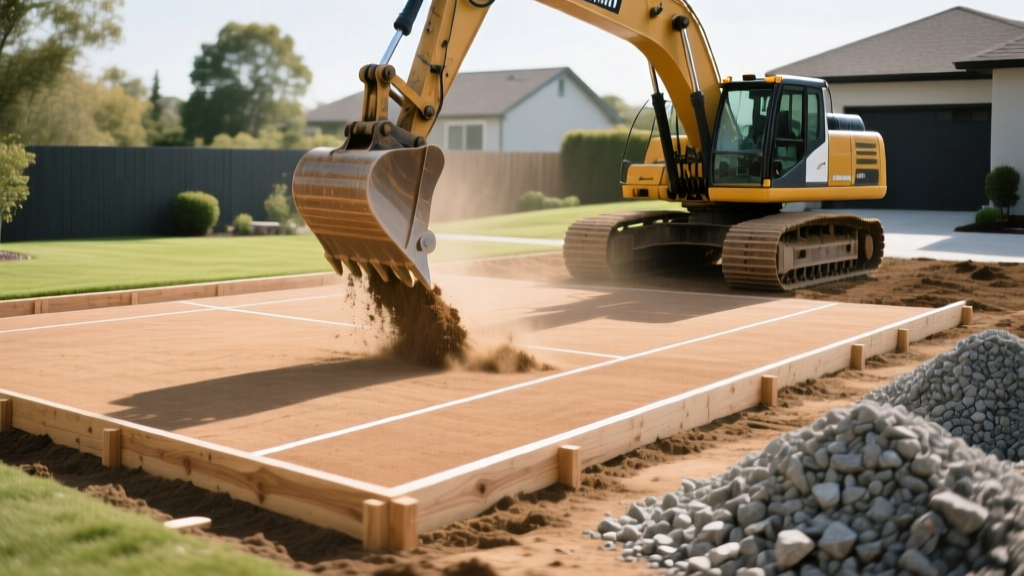
Excavation and grading consume 25% to 40% of the total budget. If your lot has a 5% slope, you will need extensive cut-and-fill operations. The most effective money-saving strategy during site prep is orientation. While the USTA Facility Guidelines recommend a strict North-South orientation to minimize sun glare, you can rotate the court up to 15 degrees to follow the natural topography of your land. This slight deviation drastically reduces the need for expensive retaining walls and imported fill dirt.
Before moving any dirt, invest $800 to $1,500 in a geotechnical soil report. Skipping this step is a false economy; hitting unyielding bedrock or expansive clay mid-excavation can trigger $10,000+ in change orders. For the base, specify 4 inches of compacted crushed aggregate (3/4-inch minus gravel) achieving 95% Standard Proctor density. Do not let contractors substitute this with cheaper, unwashed river gravel, which lacks the angular edges required for mechanical interlock and will lead to base settlement.
Surface Material Hacks: Cutting Costs Without Killing Playability
Asphalt is the traditional budget option, but it requires resurfacing every 5 to 8 years ($4,000 to $6,000 per cycle) due to thermal expansion and contraction. Post-tension concrete (PTC) costs roughly 30% more initially but utilizes high-strength steel cables spaced at 3-foot intervals to compress the slab. According to the Post-Tensioning Institute, this compression prevents structural cracking entirely. Over a 20-year horizon, PTC is actually the cheaper option because it eliminates the need for asphalt patching and crack routing.
Expert Hack: If you have an existing, slightly cracked concrete driveway or large patio that measures at least 65' x 125', bypass the $20,000 base construction entirely. Use interlocking modular polypropylene tiles (like Mateflex or SportCourt). They cost $1.50 to $3.00 per square foot, can be installed in a single weekend, and provide elite shock absorption while masking underlying slab imperfections.
Fencing, Lighting, and Nets: The Hidden Expense Multipliers
Fencing and lighting can silently add $25,000 to your project if you do not specify the right materials. For perimeter fencing, you need a 10-foot high chain link enclosure. Do not use standard residential 2-inch mesh; tennis balls will get wedged in the gaps. Specify 1.5-inch or 1.75-inch chain link mesh with 9-gauge wire. To save on wind-load engineering costs, install 85% density polypropylene wind screens only on the dominant wind side, rather than enclosing all four sides, which turns the court into a sail and requires heavier, more expensive steel posts.
For lighting, skip outdated 1000W metal halide fixtures. They require heavy electrical trenching and have a 15-minute restrike delay if power blips. Instead, install four to six 300W LED sports fixtures on 20-foot poles. LED packages cost between $8,000 and $12,000 but cut electrical trenching requirements in half and reduce energy consumption by 60%.
The DIY vs. Pro Matrix
| Construction Phase | Execution | Potential Savings | Risk Level |
|---|---|---|---|
| Clearing & Grubbing | DIY | $1,500 - $3,000 | Low |
| Rough Grading | DIY (with skid steer) | $2,000 - $4,000 | Medium |
| Laser Grading & Compaction | PRO | N/A | Critical (Requires 1% slope precision) |
| Fencing Installation | DIY | $4,000 - $6,000 | Medium (Post-hole digging) |
| Acrylic Surfacing | PRO | N/A | Critical (Squeegee technique dictates play) |
Phased Construction: Spreading the Financial Impact
If the total estimate exceeds your current capital, utilize a phased construction approach. In Year 1, fund the site excavation, base compaction, and the pouring of the post-tension concrete slab. Ensure the slab is poured with the mandatory unidirectional slope of 0.83% to 1% (a 7.2-inch drop across the 70-foot width). Install the fencing and a basic recreational net post sleeve system.
You can play on the bare, uncolored concrete pad for up to two years. In Year 2 or 3, return to apply the multi-layer acrylic surfacing system (primer, resurfacer with 60-80 mesh silica sand, and color coats). This strategy allows you to secure the most expensive, weather-dependent structural work immediately while deferring the cosmetic and finishing costs until your budget recovers.
Written by
Marcus ChenMarcus Chen is a licensed structural engineer (PE) and building materials analyst with over 12 years of experience across residential, commercial, and industrial construction. He holds a Master of Science in Civil Engineering from UC Berkeley and spent six years at Thornton Tomasetti before transitioning to independent consulting and technical writing. Marcus specializes in material selection for seismic-prone regions, concrete reinforcement strategies, and lifecycle cost analysis. His work has been cited by the American Concrete Institute (ACI) and the Structural Engineers Association of California (SEAOC). When he is not on a job site or at his desk, you will find him hiking the Sierra Nevada or restoring a 1920s craftsman bungalow in Oakland, CA.
More from Marcus Chen
View all
Construction Cost
How Much Did the Eiffel Tower Cost to Build?
How much did the Eiffel Tower cost to build in 1889? We adjust for inflation and compare its budget to modern skyscraper construction.
Aug 4, 2026

Fire Resistance
What Is a Fire Resistant Material? Testing & Certification Guide
Discover what is a fire resistant material through ASTM and UL testing. Learn how fire ratings, certifications, and assemblies work in construction.
Aug 4, 2026

Construction Cost
How Much Did the Burj Khalifa Cost to Build?
How much did the Burj Khalifa cost to build? We break down the $1.5B project and extract 5 money-saving strategies for your next build.
Jul 30, 2026