Analyzing the Cost to Build MetLife Stadium: A Budget Planning Guide
Explore the cost to build MetLife Stadium, analyzing its $1.6B budget, inflation-adjusted 2026 equivalents, and mega-project budget planning frameworks.

The $1.6 Billion Baseline: Original vs. 2026 Inflation-Adjusted Costs
When evaluating the economics of large-scale commercial and sports venues, few projects offer as comprehensive a budget planning case study as MetLife Stadium. Opened in 2010 in East Rutherford, New Jersey, the 2.1-million-square-foot facility was the most expensive stadium ever constructed at the time, with a final price tag of approximately $1.6 billion. For construction estimators and project managers operating in 2026, understanding the original cost architecture of this mega-project—and adjusting it for modern material and labor inflation—is critical for benchmarking contemporary venue estimates.
Unlike many modern sports facilities that rely heavily on municipal subsidies, MetLife Stadium was entirely privately funded by the New York Jets and New York Giants. This private capital structure necessitated rigorous cost controls, aggressive value engineering, and strict adherence to a Guaranteed Maximum Price (GMP) contract model. According to the Brookings Institution, privately funded stadiums inherently shift the risk of cost overruns entirely onto the developers, forcing a much higher degree of budgetary discipline compared to publicly subsidized projects.
| CSI MasterFormat Division | 2010 Actual Cost | 2026 Estimated Equivalent | Primary Cost Drivers |
|---|---|---|---|
| Div 02: Site Preparation & Demolition | $120,000,000 | $186,000,000 | Soil remediation, deep foundation piling |
| Div 03 & 05: Concrete & Structural Steel | $580,000,000 | $957,000,000 | ASTM A992 steel, high-strength concrete |
| Div 08 & 09: Enclosure & Finishes | $210,000,000 | $325,000,000 | Aluminum panels, limestone, ETFE canopies |
| Div 11, 12 & 13: Equipment & Specialties | $340,000,000 | $527,000,000 | Seating, HD video boards, turf systems |
| Div 21-28: MEP & Fire Protection | $250,000,000 | $387,000,000 | HVAC, specialized plumbing, life safety |
| Contingency, Fees & Soft Costs | $100,000,000 | $98,000,000 | Architecture, engineering, insurance |
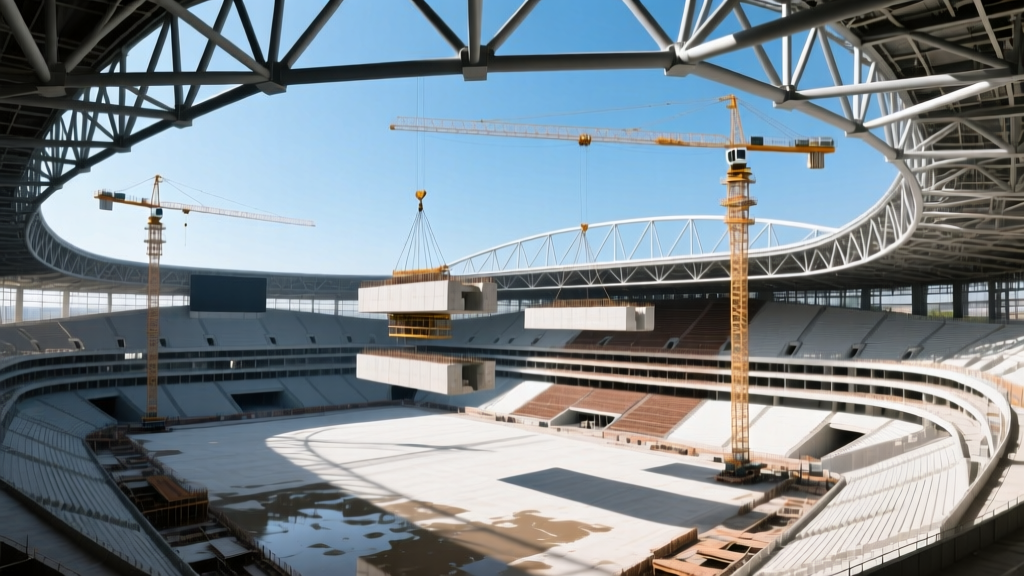
Material Breakdown: Engineering the Superstructure
The sheer scale of MetLife Stadium required procurement strategies that fundamentally altered regional supply chains. For budget planners estimating large commercial or industrial projects in 2026, the material volumes utilized here serve as a masterclass in bulk procurement and logistics staging.
Division 05: The 13,000-Ton Steel Skeleton
Because MetLife is an open-air stadium located in a high-wind, heavy-snow climate zone, the structural steel requirements were immense. The project consumed over 13,000 tons of structural steel. Estimators must note that the primary framing utilized ASTM A992 wide-flange shapes for the main concourse and seating bowl, while the long-span roof canopies required custom-fabricated hollow structural sections (HSS) and tension cable systems. In 2026, with domestic steel mills operating at high capacity and tariff fluctuations impacting imported steel, securing a 13,000-ton order requires locking in mill-direct pricing at least 18 to 24 months prior to the scheduled erection date. Failure to hedge steel prices in a GMP contract can lead to variance overruns exceeding 15% on the superstructure alone.
Division 03: High-Performance Concrete Substructures
The foundation and lower bowl utilized approximately 100,000 cubic yards of concrete. Given the marshy soil conditions of the Meadowlands, deep foundation friction piles were driven to bedrock, topped by massive pile caps. The budget planning lesson here is the cost of soil mitigation. Estimators working on similar coastal or reclaimed-land sites must allocate an additional 8% to 12% of the total Division 03 budget specifically for geotechnical remediation and deep piling, rather than relying on standard spread-footing baseline costs.
Division 11: Specialized Turf and Sub-Base Engineering
One of the most heavily debated and budget-intensive aspects of the stadium was the playing surface. The original design featured a modular, tray-based turf system that could be rolled out to accommodate different events. This specialized mechanized sub-base cost upwards of $20 million in 2010. Today, modern stadium budgets favor advanced synthetic-hybrid turf systems with integrated subsurface heating and aeration (such as the SISGrass or AirField systems). When budgeting for a multi-use venue in 2026, estimators should allocate $35 to $45 per square foot for a hybrid turf installation, inclusive of the automated drainage and heating MEP tie-ins.
Budget Planning Frameworks Derived from Mega-Venues
How can mid-tier commercial builders and estimators apply the budget planning frameworks of a $1.6 billion stadium to $20 million or $50 million projects? The core methodology lies in risk-adjusted contingency modeling and phased procurement.
"In mega-project budget planning, contingency is not a slush fund for scope creep; it is a statistically modeled risk reserve. The shift from deterministic 10% contingencies to probabilistic Monte Carlo simulations is what separates profitable commercial builds from financial disasters."
Applying Monte Carlo Simulations to Contingency
On the MetLife project, the private owners could not rely on municipal bailouts for cost overruns, a reality detailed in Congressional Research Service reports on stadium financing. Consequently, the estimating team utilized Monte Carlo simulations to model thousands of potential cost outcomes based on variable inputs like labor shortages, weather delays, and material price spikes. For a standard $30 million commercial complex in 2026, estimators should abandon the flat 5-10% contingency line item. Instead, run a 1,000-iteration simulation assigning probability distributions to high-risk CSI divisions (like Division 08 Glazing and Division 26 Electrical). The output will provide a P80 confidence level—the exact dollar amount required to ensure an 80% probability of finishing under budget.
Value Engineering vs. Scope Reduction
A critical distinction in stadium budget planning is the difference between value engineering (VE) and scope reduction. During the design development phase of MetLife, the exterior facade was value-engineered from a heavier, fully enclosed glass-and-steel curtain wall to a more porous, lightweight aluminum and limestone louver system. This maintained the architectural intent and wind-load performance while reducing the dead load on the structural steel skeleton, thereby saving millions in Division 05 costs. True VE optimizes the lifecycle cost and structural efficiency without degrading the end-user experience. Scope reduction, conversely, simply removes amenities (e.g., reducing premium club seating capacity), which directly impacts long-term revenue generation.
Risk Mitigation and Supply Chain Hedging in 2026
The modern construction landscape requires aggressive supply chain management. The budget planners behind MetLife Stadium utilized early procurement packages to secure long-lead items before the final GMP was even signed. To replicate this success in current commercial estimating, project teams must implement the following hedging strategies:
- Mill-Direct Steel Purchasing: Bypass service centers for structural steel tonnages exceeding 500 tons. Negotiate directly with domestic mills to lock in pricing and secure a place in the rolling queue, mitigating the risk of mid-project price escalations.
- Pre-Purchasing MEP Equipment: Large custom air handling units (AHUs), switchgear, and backup generators currently face 40-to-60-week lead times. Budget planners must allocate early-release capital to purchase and store this equipment off-site before the superstructure is even topped out.
- Labor Productivity Indexing: When estimating labor costs in dense urban or highly regulated zones, apply a localized productivity degradation factor. Mega-projects often suffer from site congestion; applying a 1.15 multiplier to standard RSMeans labor hours for trades working in confined, multi-tiered stadium concourses prevents severe budget shortfalls.
Ultimately, analyzing the cost to build MetLife Stadium reveals that successful budget planning for massive structures is less about finding the cheapest materials and more about mastering risk transfer, probabilistic contingency modeling, and aggressive early-stage procurement. By treating the $1.6 billion baseline not just as a historical figure, but as a dynamic framework for modern cost control, estimators can deliver highly complex commercial venues on time and within financial bounds.
Written by
Marcus ChenMarcus Chen is a licensed structural engineer (PE) and building materials analyst with over 12 years of experience across residential, commercial, and industrial construction. He holds a Master of Science in Civil Engineering from UC Berkeley and spent six years at Thornton Tomasetti before transitioning to independent consulting and technical writing. Marcus specializes in material selection for seismic-prone regions, concrete reinforcement strategies, and lifecycle cost analysis. His work has been cited by the American Concrete Institute (ACI) and the Structural Engineers Association of California (SEAOC). When he is not on a job site or at his desk, you will find him hiking the Sierra Nevada or restoring a 1920s craftsman bungalow in Oakland, CA.
More from Marcus Chen
View all
Construction Cost
How Much Did the Eiffel Tower Cost to Build?
How much did the Eiffel Tower cost to build in 1889? We adjust for inflation and compare its budget to modern skyscraper construction.
Aug 4, 2026

Fire Resistance
What Is a Fire Resistant Material? Testing & Certification Guide
Discover what is a fire resistant material through ASTM and UL testing. Learn how fire ratings, certifications, and assemblies work in construction.
Aug 4, 2026

Construction Cost
How Much Did the Burj Khalifa Cost to Build?
How much did the Burj Khalifa cost to build? We break down the $1.5B project and extract 5 money-saving strategies for your next build.
Jul 30, 2026