How Much Did Epic Universe Cost to Build? Theme Park Cost Analysis
Discover how much Epic Universe cost to build. We break down the $3B+ construction budget, comparing per-acre costs to other global mega-parks.

The Final Tally: Answering the Multi-Billion Dollar Question
When Universal Parks & Resorts first announced Epic Universe in 2019, initial estimates placed the project at roughly $2 billion. However, with the park officially opening its gates in 2025, the 2026 construction post-mortems and financial disclosures reveal a much larger figure. So, exactly how much did Epic Universe cost to build? The final consolidated project cost sits at an estimated $3.2 billion. This encompasses the 150-acre theme park footprint, three on-site hotels, the sprawling parking infrastructure, and the massive off-site roadwork required to support the new traffic load on I-4 and Universal Boulevard.
Epic Universe Budget Snapshot
- Total Project Cost: ~$3.2 Billion
- Park Construction (Attractions & Theming): ~$2.1 Billion
- Site Infrastructure & Utilities: ~$450 Million
- On-Site Hotels & Retail: ~$650 Million
- Total Site Acreage: 750 Acres
- Park Footprint Acreage: ~150 Acres
For commercial estimators and construction professionals, looking at the aggregate number is only the beginning. To understand the true cost dynamics of modern mega-park construction, we must break down the budget by per-acre metrics, subsurface engineering requirements, and specialized show-building materials.
Epic Universe vs. Global Mega-Parks: A Cost Comparison Matrix
Contextualizing the Epic Universe budget requires comparing it to other landmark theme park projects. According to data tracked by the AECOM Theme Index and industry analyses, the cost per acre varies wildly based on density, infrastructure inclusion, and intellectual property licensing. Epic Universe represents a highly dense, technology-heavy build, pushing its per-acre costs well above traditional regional parks.
| Project Name | Opening Year | Total Cost | Acreage | Cost Per Acre |
|---|---|---|---|---|
| Universal Epic Universe | 2025 | $3.2 Billion | 750 (150 park) | $14M - $21M |
| Shanghai Disneyland | 2016 | $5.5 Billion | 963 | $5.7 Million |
| Star Wars: Galaxy's Edge (FL) | 2019 | $1.0 Billion | 14 | $71.4 Million |
| Disney's Animal Kingdom | 1998 | $950 Million | 580 | $1.6 Million |
Note: Cost per acre for Epic Universe is calculated using the 150-acre park footprint ($2.1B / 150 = $14M/acre) and the total 750-acre site ($3.2B / 750 = $4.2M/acre). Galaxy's Edge reflects extreme high-density dark ride construction.
Where Did the Budget Go? Construction & Material Breakdown
Building a modern theme park is less about traditional commercial real estate and more about constructing highly specialized, technology-driven industrial facilities disguised as immersive environments. According to insights from the Themed Entertainment Association (TEA), the integration of advanced ride systems and environmental storytelling drastically inflates the cost per square foot compared to standard retail or hospitality builds.
1. Subsurface Engineering and Soil Stabilization
Central Florida’s geotechnical profile is a notorious budget multiplier. The region's karst topography, characterized by shallow sandy soils, a high water table, and unpredictable limestone cavities, makes supporting multi-million-pound show buildings incredibly complex. For Epic Universe, geotechnical engineers could not rely on standard shallow spread footings.
- Deep Foundation Systems: Heavy structures, such as the Celestial Park central hub and the massive Wizarding World of Harry Potter show buildings, required driven friction piles and auger-cast piles extending 60 to 90 feet down to stable load-bearing strata.
- Soil Improvement: Extensive vibro-replacement stone columns were utilized across the 150-acre footprint to mitigate liquefaction risks and prevent differential settlement under heavy dynamic loads from roller coasters like Stardust Racers.
- Estimated Subsurface Cost: Geotechnical stabilization and deep piling accounted for an estimated 8% to 12% of the total park construction budget.
2. Dark Ride Infrastructure and Show Buildings
Dark rides are the financial anchors of any modern mega-park. Epic Universe features several massive trackless and suspended dark rides. The construction of these 'show buildings' requires extreme precision.
Furthermore, these clear-span steel structures (often exceeding 200,000 square feet with 45-foot clear heights) require specialized HVAC systems. To maintain the integrity of fog effects, projection mapping screens, and delicate animatronics, the buildings must maintain strict temperature and humidity controls year-round, requiring massive commercial chiller plants and redundant air handling units.
3. Themed Facades and GFRC Shotcrete
The illusion of the five distinct worlds within Epic Universe relies heavily on Glass Fiber Reinforced Concrete (GFRC) and themed shotcrete. Unlike standard architectural precast, themed rockwork and architectural facades are sculpted by hand over welded rebar armatures.
- Material Application: Artisans apply shotcrete in multiple layers, carving details before the material cures. The cost for high-fidelity themed rockwork and architectural detailing ranges from $150 to $250 per square foot, compared to $15-$30 per square foot for standard CMU or EIFS commercial facades.
- Steel Armatures: The underlying steel skeletons for mountains, castles, and giant animatronic structures require complex 3D modeling and custom fabrication, acting as a massive secondary steel budget on top of the primary show building structures.
The Hidden Costs: Infrastructure and Water Management
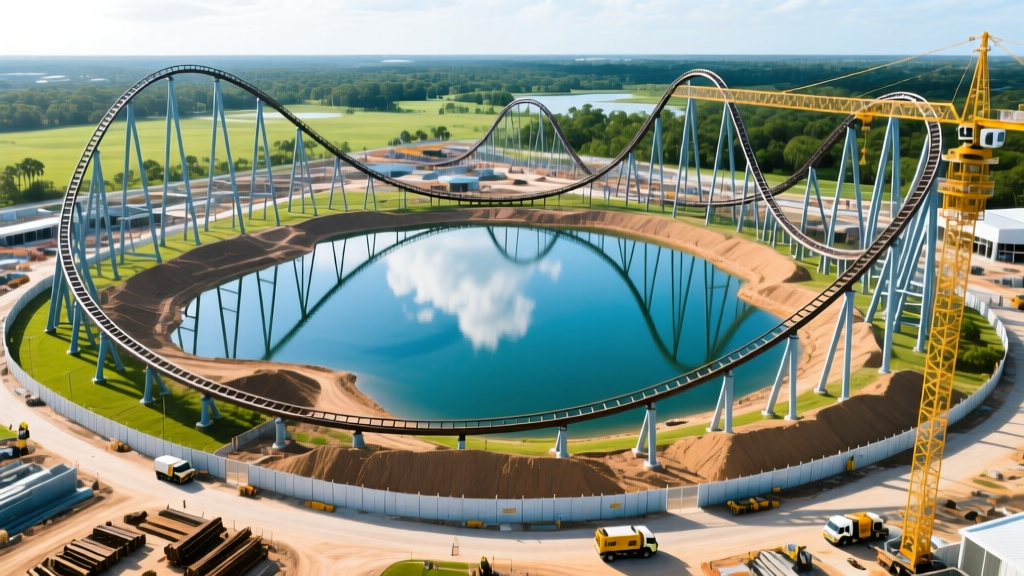
While the attractions draw the crowds, the invisible infrastructure is what allows the park to function. Epic Universe is built around a massive central lagoon (Celestial Park), which is not merely decorative but serves a critical civil engineering purpose.
"In Central Florida, water management is not an afterthought; it is the primary driver of site planning. The central lagoon acts as a massive stormwater retention basin, engineered to handle 100-year flood events while simultaneously serving as the aesthetic centerpiece of the park." — Civil Engineering Project Post-Mortem, 2025
The water management system includes miles of underground stormwater piping, advanced bio-filtration wetlands, and heavy-duty pump stations. Additionally, the off-site infrastructure required to support the park included the construction of new highway flyovers, expanded utility corridors, and a dedicated electrical substation to handle the massive power draw of the ride systems and nighttime spectaculars.
Strategic Takeaways for Commercial Estimators
Analyzing the Universal Orlando Epic Universe project provides critical benchmarks for estimators working in the entertainment, hospitality, and specialized commercial sectors:
- Geotechnical Risk Premiums: Always allocate a higher contingency for subsurface work in karst or high-water-table regions. Deep piling and soil stabilization can easily consume 10% of the structural budget.
- Tolerance-Driven Concrete Costs: When estimating floors for automated systems, robotics, or trackless vehicles, specify ultra-flat FF/FL tolerances. The labor and material costs for these pours are exponentially higher than standard industrial slabs.
- Themed vs. Standard Finishes: Never apply standard architectural finish pricing to themed environments. GFRC shotcrete and custom sculpted facades require specialized artisan labor, pushing exterior finish costs up by 500% to 800%.
Ultimately, the $3.2 billion price tag of Epic Universe reflects the new baseline for immersive, technology-driven commercial construction. As intellectual property integration and ride-system complexity continue to scale, the line between traditional building construction and advanced manufacturing will only blur further, demanding new paradigms for cost estimation and project management.
Written by
Elena RodriguezElena Rodriguez is a civil engineer and technical writer specializing in concrete technology, masonry systems, and ASTM/ACI compliance. She earned her B.S. in Civil Engineering from Texas A&M University and spent a decade at a materials testing laboratory, performing over 2,000 concrete compressive strength tests and masonry prism evaluations. Elena is an ACI-certified Field Testing Technician (Grade I) and a member of ASTM Committee C12 on Natural Building Stone. She currently consults on forensic engineering cases involving concrete failures and moisture intrusion. Based in San Antonio, TX, Elena is a proud member of the Society of Women Engineers (SWE) and coaches her daughter's FIRST Robotics team.
More from Elena Rodriguez
View all
Walls & Panels
Cost Analysis: Light Gauge Steel Framing Advantages and Disadvantages
Evaluate light gauge steel framing advantages and disadvantages through a strict cost analysis lens, comparing material, labor, and lifecycle expenses.
Aug 4, 2026

Walls & Panels
Gypsum Board Types: Exact Specifications, Thickness & Dimensions
Compare standard, Type X, and moisture-resistant gypsum board types. Get exact specifications, thicknesses, dimensions, and ASTM standards for your project.
Aug 4, 2026

Fire Resistance
Best Fire-Resistant Outdoor Decking Materials: 2026 Buyer Guide
Discover the best fire-resistant outdoor decking materials for 2026. Compare Class A PVC, aluminum, and hardwood options for WUI compliance and safety.
Aug 4, 2026