How to Estimate Cost of Building a House: Regional Pricing
Learn how to estimate cost of building a house by analyzing regional pricing, local labor rates, soil conditions, and material variations.

The Core Formula: Breaking Down Hard and Soft Costs
Understanding how to estimate cost of building a house requires moving beyond national averages, which often obscure massive localized variances. A accurate estimate begins by bifurcating your budget into hard costs (physical construction) and soft costs (design, engineering, permits). According to data tracked by the National Association of Home Builders (NAHB), hard costs typically consume 75% to 80% of the total budget, while soft costs and builder overhead/profit account for the remaining 20% to 25%.
For every $100,000 spent on physical materials and labor (hard costs), you must allocate an additional $25,000 to $33,000 for architectural plans, soil engineering, municipal impact fees, and builder margin. Failing to capitalize soft costs upfront is the primary reason self-managed builds run out of capital before drywall installation.
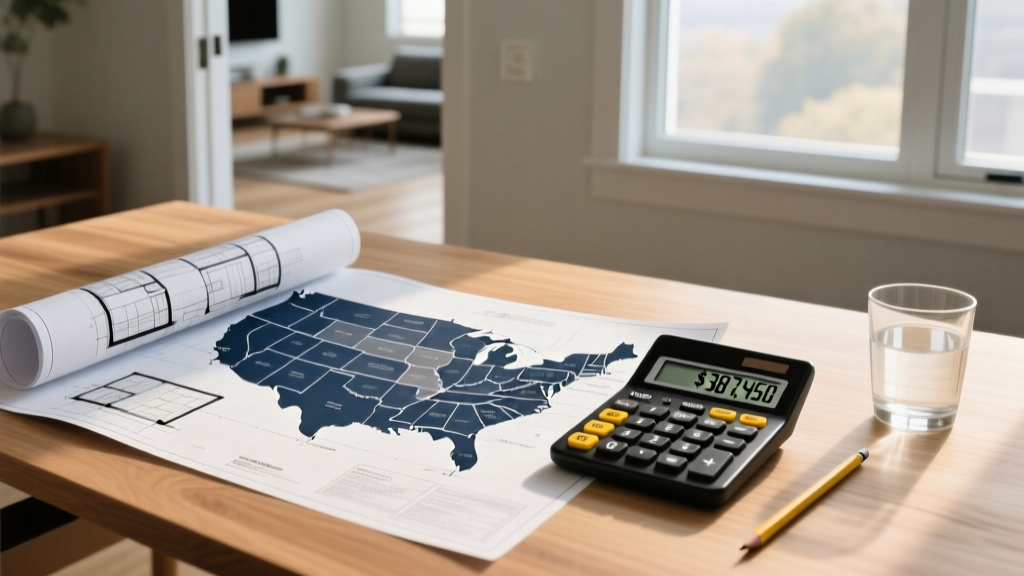
Regional Price Matrix: Cost Per Square Foot by US Census Region
Construction costs are inherently local. The US Census Bureau Construction Index tracks these fluctuations, revealing that a 2,500-square-foot home can cost $120,000 more to build in the Pacific West than in the East South Central states. The matrix below outlines baseline pricing for 2026, differentiating between production-grade builder specifications and custom architectural builds.
| Region | Production Cost / Sq Ft | Custom Cost / Sq Ft | Primary Foundation | Key Cost Driver |
|---|---|---|---|---|
| Northeast | $180 - $220 | $280 - $400+ | Full Basement / Frost Wall | Union labor, deep frost excavation |
| Midwest | $145 - $175 | $220 - $310 | Slab-on-Grade / Walkout | Weather delays, heating systems |
| South | $135 - $165 | $210 - $290 | Monolithic Slab | HVAC loads, wind mitigation |
| West | $195 - $250 | $350 - $550+ | Stem Wall / Pier & Beam | Seismic codes, WUI materials |
Deep Dive: Why the West Coast and Northeast Premium Exists
The West Coast commands the highest custom build premiums primarily due to seismic engineering and Wildland-Urban Interface (WUI) codes. In California, building in a designated WUI zone requires Class A fire-rated roofing, non-combustible exterior cladding (like fiber cement or stucco), and ember-resistant venting. Furthermore, California's Title 24 energy code mandates high-performance building envelopes, often requiring continuous exterior rigid foam insulation and triple-pane windows with a U-factor of 0.22 or lower, adding $15,000 to $25,000 to the envelope cost of an average home.
Conversely, the Northeast premium is driven by subsurface conditions and labor markets. Excavating a full basement through glacial till and bedrock can cost $25,000 to $45,000 before concrete is even poured. Additionally, frost walls must extend 48 to 60 inches below grade to prevent frost heave, vastly increasing concrete and rebar requirements compared to the shallow monolithic slabs used in the Sunbelt.
Hidden Regional Variables That Derail Budgets
National estimating software often fails to account for hyper-local geological and municipal variables. When calculating your regional estimate, audit your site for these specific budget-killers:
- Expansive Clay Soils (Texas, Colorado, Carolinas): Standard post-tension slabs may not suffice. You may require drilled concrete piers extending 15 to 25 feet into the bedrock to stabilize the foundation. Expect to pay $18 to $28 per linear foot for drilled piers, adding $20,000+ to the foundation budget.
- Hurricane Wind Zones (Gulf Coast, Atlantic Seaboard): Homes in Wind-Borne Debris Regions (WBDR) require impact-resistant glazing or engineered storm shutters. Structural framing requires continuous load paths using heavy-duty metal connectors (e.g., Simpson Strong-Tie hurricane ties) and closer roof truss spacing (16" on center instead of 24").
- Municipal Utility Tap Fees: Connecting to city water and sewer varies wildly. In fast-growing suburbs like those outside Austin, TX, or Raleigh, NC, water and wastewater capacity fees can exceed $15,000 per lot. In rural unincorporated counties, you bypass tap fees but must budget $12,000 to $20,000 for a private septic system and well drilling.
- Prevailing Wage Requirements: If your build is in a municipality that requires prevailing wages for certain permitted projects, or if you are building in a heavily unionized area (like Chicago or New York), labor costs will be 30% to 50% higher than the national median.
Step-by-Step Framework for Localizing Your Estimate
To generate a highly accurate, region-specific estimate, follow this sequential framework before finalizing your construction loan draw schedule:
- Acquire Localized RSMeans Data: Do not rely on national cost-per-square-foot calculators. Purchase a localized cost-estimating database (like RSMeans) and apply the specific City Cost Index (CCI) multiplier for your exact zip code. This adjusts baseline material and labor rates to your micro-market.
- Order a Geotechnical Soil Report: Spend the $1,500 to $3,000 on a geotechnical engineer before designing the foundation. Knowing your soil's bearing capacity and plasticity index dictates whether you need a standard spread footing or an engineered mat slab.
- Itemize Soft Costs with the Local Building Department: Call the municipal planning office and request a fee schedule for new residential construction. Specifically ask for plan review fees, school impact fees, park dedication fees, and right-of-way permits for heavy equipment.
- Factor in Debris Removal and Site Prep: Heavily wooded lots in the Pacific Northwest or rocky terrains in the Appalachians require specialized site prep. Stump removal, rock blasting, and hauling can easily add $10,000 to $30,000 before the first stake is driven.
Adjusting for Material Volatility and Local Supply Chains
Material costs are not uniform across the country; they are dictated by regional supply chains and local building codes. For example, standard SPF (Spruce-Pine-Fir) #2 framing lumber, commonly used in the Midwest and East Coast, averages $450 to $550 per thousand board feet (MBF). However, in the West Coast and mountain regions, building codes often require Douglas Fir-Larch for higher load-bearing spans and snow loads, which consistently trades 20% to 30% higher than SPF.
"When estimating concrete costs, always account for regional admixture requirements. In the Southwest, concrete mixes often require retarding admixtures to prevent premature curing in high heat, while northern climates require air-entraining admixtures to prevent freeze-thaw spalling. These chemical adjustments add $10 to $15 per cubic yard to the delivered price."
— Industry Standard Practice, FEMA Building Science Guidelines
Ultimately, mastering how to estimate cost of building a house means treating your budget as a living, localized document. By anchoring your estimates in regional soil data, specific municipal fee schedules, and localized material indices, you insulate your project from the catastrophic overruns that plague unprepared builders and homeowners.
Written by
Elena RodriguezElena Rodriguez is a civil engineer and technical writer specializing in concrete technology, masonry systems, and ASTM/ACI compliance. She earned her B.S. in Civil Engineering from Texas A&M University and spent a decade at a materials testing laboratory, performing over 2,000 concrete compressive strength tests and masonry prism evaluations. Elena is an ACI-certified Field Testing Technician (Grade I) and a member of ASTM Committee C12 on Natural Building Stone. She currently consults on forensic engineering cases involving concrete failures and moisture intrusion. Based in San Antonio, TX, Elena is a proud member of the Society of Women Engineers (SWE) and coaches her daughter's FIRST Robotics team.
More from Elena Rodriguez
View all
Walls & Panels
Cost Analysis: Light Gauge Steel Framing Advantages and Disadvantages
Evaluate light gauge steel framing advantages and disadvantages through a strict cost analysis lens, comparing material, labor, and lifecycle expenses.
Aug 4, 2026

Walls & Panels
Gypsum Board Types: Exact Specifications, Thickness & Dimensions
Compare standard, Type X, and moisture-resistant gypsum board types. Get exact specifications, thicknesses, dimensions, and ASTM standards for your project.
Aug 4, 2026

Fire Resistance
Best Fire-Resistant Outdoor Decking Materials: 2026 Buyer Guide
Discover the best fire-resistant outdoor decking materials for 2026. Compare Class A PVC, aluminum, and hardwood options for WUI compliance and safety.
Aug 4, 2026