Financing the Cost to Build a Swimming Pool: 5 Loan Options
Discover how to finance the cost to build a swimming pool. Compare HELOCs, personal loans, and cash-out refinancing with current rates and limits.
The Baseline: Evaluating the Cost to Build a Swimming Pool
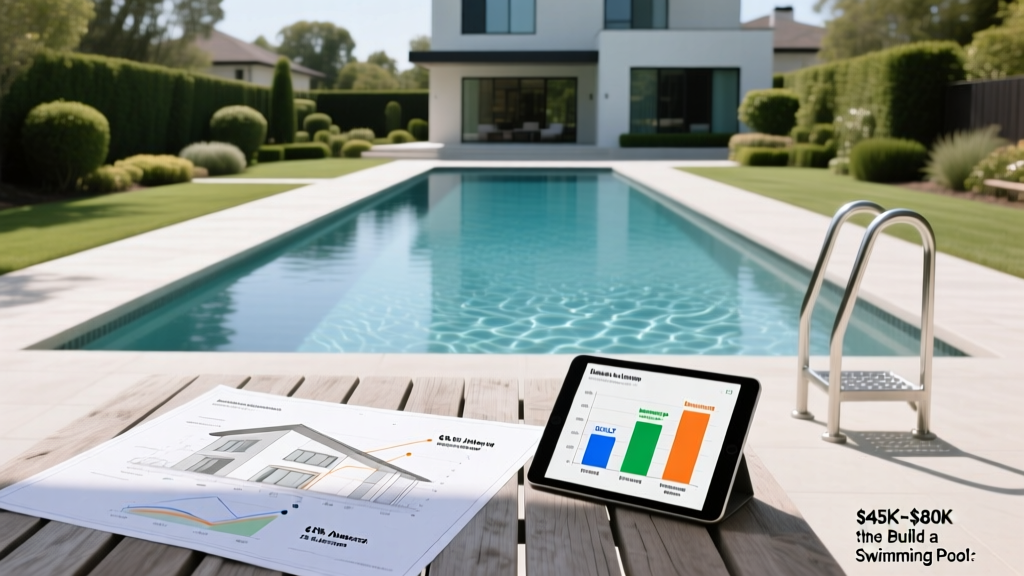
Before securing capital, you must establish an accurate baseline for the cost to build a swimming pool. In the current 2026 construction market, material and labor premiums have stabilized, but inground pools remain a major capital expenditure. According to HomeAdvisor, the national average for an inground pool ranges from $45,000 to $120,000, heavily dependent on the shell material:
- Vinyl Liner Pools: $35,000 – $65,000 (Lowest upfront cost, but liners require $4,500 replacements every 7–10 years).
- Fiberglass Pools: $40,000 – $85,000 (Pre-manufactured shells dropped into excavated sites; faster installation, lower lifetime maintenance).
- Gunite/Shotcrete (Concrete): $60,000 – $120,000+ (Fully customizable, highest durability, but requires 3 to 6 months of construction and higher long-term chemical maintenance).
Once you have a finalized quote from a licensed contractor—including decking, fencing, and initial landscaping—you can match the project scope to the appropriate financial instrument.
The 2026 Pool Financing Matrix: Comparing Your Options
Not all debt is created equal. The right financing vehicle depends on your existing mortgage rate, available equity, and the project's timeline. Below is a comparative matrix of the five primary methods to fund pool construction.
| Financing Method | Best For | Typical APR Range | Max Loan Amount | Tax Deductible? |
|---|---|---|---|---|
| Home Equity Loan | Lump-sum, fixed-price contracts | 7.0% – 9.5% | Up to 85% LTV | Yes (if improving home) |
| HELOC | Phased builds or owner-managed projects | 8.5% – 10.5% (Variable) | Up to 85% LTV | Yes (if improving home) |
| Personal Loan | Homeowners with low equity or high existing mortgage rates | 8.0% – 24.0% | $50,000 – $100,000 | No |
| Cash-Out Refinance | Rarely recommended in 2026 rate environment | 6.5% – 7.5% | Up to 80% LTV | Yes (partial) |
| Builder/Promotional Financing | Short-term payoff strategies (12-18 months) | 0% – 5.99% (Promo) / 18%+ (Standard) | Project Cost | No |
Strategic Selection: Matching Loan Types to Pool Projects
Home Equity Loan (The Lump-Sum Approach)
A home equity loan provides a single disbursement at a fixed interest rate. This is the optimal choice for turnkey pool installations where the contractor requires a 30% deposit upfront and scheduled draws thereafter. Because the rate is locked, your monthly payment remains immune to Federal Reserve adjustments. According to the Federal Trade Commission, home equity loans use your house as collateral, meaning default risks foreclosure. However, the interest is generally tax-deductible under IRS guidelines if the funds are used to 'buy, build, or substantially improve' the taxpayer’s home that secures the loan.
HELOC (The Phased Construction Approach)
A Home Equity Line of Credit (HELOC) functions like a credit card secured by your property. It features a 10-year draw period followed by a 20-year repayment phase. The Consumer Financial Protection Bureau (CFPB) notes that HELOCs are ideal for projects with unpredictable timelines. If you are acting as your own general contractor, hiring separate excavators, plumbers, and electricians, a HELOC allows you to pull funds only when invoices are due, minimizing interest accrual on unspent capital.
If you secured a first mortgage between 2020 and 2022 at a sub-4% interest rate, do not use a cash-out refinance to fund a pool. Replacing a $400,000 mortgage at 3.0% with a new $480,000 mortgage at 7.0% to extract $80,000 for a pool will cost you tens of thousands of dollars in excess interest over the life of the loan. Stick to a second mortgage (Home Equity Loan or HELOC) to preserve your primary low-rate mortgage.

Calculating Your Borrowing Power: The 80% LTV Rule
Lenders cap your borrowing power based on the Loan-to-Value (LTV) ratio. Most conventional lenders require you to retain at least 15% to 20% equity in your home after the new loan is originated. Here is the exact formula to determine your maximum pool budget:
- Determine Current Appraised Value: Assume your home is appraised at $600,000.
- Calculate Maximum Total Debt: $600,000 × 0.80 (80% LTV limit) = $480,000.
- Subtract Existing Mortgage Balance: Assume your current first mortgage balance is $300,000.
- Identify Available Equity: $480,000 - $300,000 = $180,000.
In this scenario, you have $180,000 in accessible equity, which comfortably covers a $90,000 gunite pool project while leaving a buffer for closing costs (typically 2% to 5% of the loan amount for equity loans).
Alternative Routes: Personal Loans and Builder Financing
If you lack sufficient home equity or refuse to put your property up as collateral, unsecured personal loans are the primary alternative. Lenders like SoFi, LightStream, and Upstart offer unsecured home improvement loans up to $100,000. The trade-off is a significantly higher APR (often 12% to 18% for borrowers with good, but not exceptional, credit) and shorter repayment terms (5 to 7 years), resulting in steep monthly payments.
Alternatively, many large pool builders partner with specialized lenders like HFS Financial or Lyon Financial. These 'builder financing' programs often advertise promotional rates, such as 5.99% APR for 18 months. Read the fine print carefully. Many of these offers are 'deferred interest' plans. If the pool is not paid off in full by month 18, the lender will retroactively apply a 22% to 28% APR to the original principal balance from day one.
Hidden Pool Construction Costs That Require Financing Buffers
A common mistake homeowners make is financing the exact quote provided by the pool builder. Construction projects invariably encounter site-specific variables. Always finance 15% above the base contract price to cover these hidden costs:
- Soil Remediation and Rock Excavation: If the excavator hits bedrock or expansive clay, blasting or specialized soil removal can add $5,000 to $15,000 to the bill.
- Utility Relocation: Moving existing sewer lines, gas mains, or overhead power lines to accommodate the pool footprint often requires municipal coordination and costs $2,000 to $8,000.
- Upgraded Coping and Waterline Tile: Builder-grade white coping and standard blue tile are included in base quotes. Upgrading to travertine coping or glass waterline tile typically adds $4,000 to $12,000.
- Electrical Panel Upgrades: Pool pumps, heaters, and lighting require significant amperage. If your home has an older 100-amp panel, upgrading to a 200-amp panel to support the pool equipment will cost $2,500 to $4,000.
Frequently Asked Questions
Can I use an FHA 203(k) loan to build a pool?
Generally, no. The FHA 203(k) rehabilitation loan program is designed for structural repairs and essential home improvements. While it can fund the repair of an existing pool that is in a state of disrepair, FHA guidelines explicitly prohibit using 203(k) funds to construct a new swimming pool, as it is considered a luxury addition rather than a necessary property improvement.
Will adding a pool increase my property taxes?
Yes. Because an inground pool is considered a permanent structural improvement, your county tax assessor will likely increase your home's assessed value during the next reassessment cycle. The exact tax increase depends on your local millage rate, but homeowners should budget an additional $500 to $1,500 annually in property taxes for a high-end pool installation.
What credit score do I need for a home equity pool loan?
Most traditional banks and credit unions require a minimum FICO score of 680 for a home equity loan or HELOC, with the most competitive interest rates reserved for scores above 740. If your score is below 660, you may need to explore FHA Title I home improvement loans or specialized subprime equity lenders, which carry higher fees and rates.
Written by
Elena RodriguezElena Rodriguez is a civil engineer and technical writer specializing in concrete technology, masonry systems, and ASTM/ACI compliance. She earned her B.S. in Civil Engineering from Texas A&M University and spent a decade at a materials testing laboratory, performing over 2,000 concrete compressive strength tests and masonry prism evaluations. Elena is an ACI-certified Field Testing Technician (Grade I) and a member of ASTM Committee C12 on Natural Building Stone. She currently consults on forensic engineering cases involving concrete failures and moisture intrusion. Based in San Antonio, TX, Elena is a proud member of the Society of Women Engineers (SWE) and coaches her daughter's FIRST Robotics team.
More from Elena Rodriguez
View all
Walls & Panels
Cost Analysis: Light Gauge Steel Framing Advantages and Disadvantages
Evaluate light gauge steel framing advantages and disadvantages through a strict cost analysis lens, comparing material, labor, and lifecycle expenses.
Aug 4, 2026

Walls & Panels
Gypsum Board Types: Exact Specifications, Thickness & Dimensions
Compare standard, Type X, and moisture-resistant gypsum board types. Get exact specifications, thicknesses, dimensions, and ASTM standards for your project.
Aug 4, 2026

Fire Resistance
Best Fire-Resistant Outdoor Decking Materials: 2026 Buyer Guide
Discover the best fire-resistant outdoor decking materials for 2026. Compare Class A PVC, aluminum, and hardwood options for WUI compliance and safety.
Aug 4, 2026