Cost to Build a Log Cabin: Milled Kits vs. Custom Builds
Compare the cost to build a log cabin using milled kits, handcrafted custom logs, and modular builds. Breakdown of wood species and labor rates.

The Real Cost to Build a Log Cabin: Beyond the Sticker Price
Estimating the true cost to build a log cabin requires looking past the base price of the timber shell. While a basic milled log kit might advertise for $60 per square foot, the final turnkey cost—including site prep, specialized foundation work, settling accommodations, and interior finishes—typically ranges from $200 to $350 per square foot in 2026. According to the Log Homes Council, log construction demands specific engineering for wood shrinkage and thermal mass, which directly impacts labor and material budgets.
Executive Cost Summary (Per Square Foot)
- Milled Log Kit (Materials Only): $65 - $110
- Handcrafted Custom Shell: $150 - $250+
- Modular Log Cabin (Turnkey): $180 - $240
- Average Total Turnkey Cost: $200 - $350
Construction Method Comparison: Kits vs. Handcrafted vs. Modular
The single largest variable in your budget is the manufacturing and assembly method. Each approach dictates not only the material cost but the timeline and specialized labor required on-site.
| Method | Material Cost / Sq Ft | Assembly Time | Best Use Case |
|---|---|---|---|
| Milled Kits (Swedish Cope, D-Log) |
$65 - $110 | 2 - 4 Weeks | Standardized floor plans, DIY-friendly, budget-conscious builds. |
| Handcrafted (Full Scribe, Piece-on-Piece) |
$150 - $250+ | 2 - 6 Months | Luxury custom estates, irregular timber, architectural statements. |
| Modular / Panelized (Half-log siding on SIPs) |
$120 - $160 | 1 - 2 Weeks | Strict HOAs, extreme weather zones requiring high R-values. |
Wood Species Pricing: How Timber Choice Impacts Your Budget
Not all logs are created equal. The species you select affects the upfront cost, long-term maintenance, and structural settling. Data from the USDA Forest Products Laboratory highlights significant variations in dimensional stability among common softwoods used in cabin construction.
- Eastern White Pine ($65 - $85 / sq ft): The industry standard for milled kits. It is cost-effective and easy to mill, but has a high shrinkage factor (up to 4-6% vertically). Requires extensive settling jacks and slip joints.
- Douglas Fir ($85 - $115 / sq ft): Offers superior structural strength and tighter grain, making it ideal for long spans and heavy snow-load roofs. Moderate shrinkage.
- Western Red Cedar ($120 - $160 / sq ft): The premium choice. It boasts natural tannins that resist rot and insects, exceptional thermal resistance (R-value of 1.4 per inch), and the lowest shrinkage rate of the major log species.
- Engelmann Spruce ($75 - $95 / sq ft): Harvested at high altitudes, it provides a bright, uniform white finish. Prone to checking (cracking) if not properly sealed and shaded during the curing process.
Hidden Costs: Engineering for Wood Shrinkage
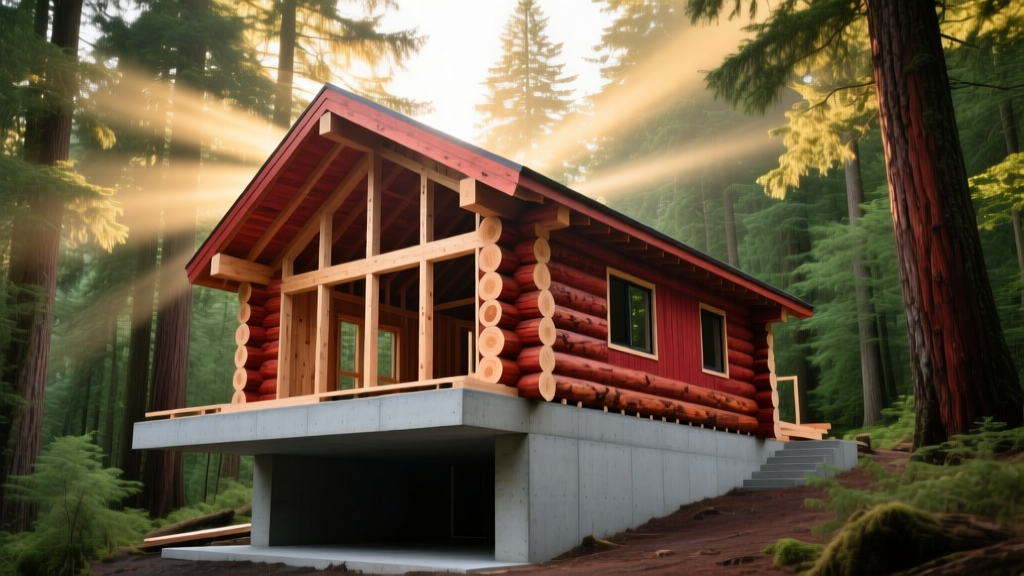
The most frequently underestimated line items in a log cabin budget are the mechanical accommodations for wood shrinkage. As green or partially dried logs acclimate to their environment, a 10-foot log wall can shrink by 3 to 6 inches over the first three years.
Settling Hardware and Plumbing
You cannot run rigid PVC plumbing or standard electrical conduits vertically through a settling log wall. Budget for the following specialized components:
- Settling Jacks: Heavy-duty threaded steel jacks placed under structural posts ($150 - $300 each). A typical 1,500 sq ft cabin requires 8 to 12 jacks.
- Plumbing Slip Joints: Flexible couplings and slip joints for vertical drain lines ($75 - $125 per joint) to prevent pipes from crushing as the walls compress.
- Window/Door Bucks: Slotted wooden frames that allow the log wall to slide down around the window without crushing the glass ($400 - $600 per opening).
Chinking and Borate Treatments
If your design utilizes a chinked style (where gaps between logs are filled), synthetic elastomeric chinking (like Perma-Chink) is mandatory over traditional mortar. Mortar cracks as logs flex; elastomeric chinking stretches. Expect to pay $8 to $12 per linear foot for professional chinking application. Additionally, a borate-based wood preservative (such as Bora-Care) must be applied to the raw logs before staining to prevent powder post beetle infestations, adding $2 to $4 per square foot to the material prep phase.
Do not use standard fiberglass batt insulation in a log cabin roof. The thermal mass of the log walls requires a roof system that prevents ice damming and condensation. Invest in Structural Insulated Panels (SIPs) for the roof ($12 - $18 per sq ft), which provide an R-40+ rating and eliminate the need for complex attic ventilation framing.
Macro Comparison: Log Cabin vs. Timber Frame vs. Stick-Built
To contextualize the cost to build a log cabin, it is helpful to compare it against other popular rural construction methods. The National Association of Home Builders regularly tracks these macro-level construction variances.
| Build Type | Avg Turnkey Cost / Sq Ft | Exterior Maintenance | Energy Efficiency |
|---|---|---|---|
| Full Log Cabin | $200 - $350 | High (Staining every 3-5 yrs) | Moderate (Thermal mass benefits) |
| Timber Frame w/ SIPs | $250 - $400 | Low (Interior wood only) | Very High (Continuous SIP envelope) |
| Stick-Built w/ Log Siding | $160 - $220 | Moderate | High (Standard cavity insulation) |
Expert Decision Framework: Which Path Should You Take?
Choosing the right path depends on your site logistics, budget flexibility, and tolerance for maintenance.
- Choose a Milled Kit if: You have a moderate budget ($200-$250/sq ft turnkey), your site is accessible by standard flatbed semi-trucks, and you are willing to manage a general contractor who understands log settling.
- Choose Handcrafted if: Budget is secondary to architectural uniqueness, you are building on a steep slope where cranes can easily position massive, irregular logs, and you want a legacy property with minimal vertical shrinkage (using piece-on-piece joinery).
- Choose Modular / Half-Log if: You live in a strict HOA or an extreme climate zone (like high-altitude Colorado) where the thermal envelope of a SIPs wall with log siding outperforms solid wood, and you want to cap your budget at $200/sq ft.
Frequently Asked Questions
How much does it cost to maintain a log cabin annually?
Expect to spend $1,500 to $3,500 annually on maintenance. This includes washing the exterior to remove pollen and dirt, inspecting chinking for tears, and reapplying UV-blocking stain every 3 to 7 years depending on sun exposure. South and West-facing walls degrade fastest and may require bi-annual spot treatments.
Are log cabins more expensive to insure?
Yes. Insurance premiums for full log structures are typically 15% to 30% higher than standard stick-built homes due to the perceived fire risk and the high cost of specialized restoration in the event of damage. Using Class-A fire-rated roofing materials and installing a monitored fire suppression system can help offset these premium hikes.
Can I use a standard concrete slab foundation for a log cabin?
While possible for single-story structures, a standard slab is rarely recommended. Log cabins are exceptionally heavy; a 2,000 sq ft log shell can weigh over 80,000 lbs. A reinforced poured concrete walk-out basement or a deep frost-protected grade beam foundation is usually required to support the concentrated point loads of the log corners and prevent differential settling.
Written by
Sarah WhitfieldSarah Whitfield is a chartered quantity surveyor (MRICS) and construction cost analyst with 15 years of experience in material pricing, procurement strategy, and project budgeting. She earned her degree in Construction Management from the University of Reading (UK) and has worked on projects ranging from $2M custom homes to $180M mixed-use developments across North America and Europe. Sarah currently leads cost estimating for BuildMat Insight, maintaining a proprietary database of 4,000+ material price points updated quarterly. She is a frequent contributor to RSMeans cost data panels and has presented at the International Cost Engineering Council (ICEC) congress. Based in Denver, CO, Sarah is an avid trail runner and volunteer mentor for Women in Construction.
More from Sarah Whitfield
View all
Wood & Lumber
What Are the Different Types of Wood? A Builder's Guide
Compare structural softwoods, finish hardwoods, and engineered lumber. Analyze Janka ratings, MOE values, and 2026 pricing for construction.
Aug 4, 2026

Walls & Panels
Steel Framing vs Wood Framing: Corrosion and Moisture Defense
Compare steel framing vs wood framing for moisture resistance. Learn about galvanized coatings, condensation risks, and corrosion protection strategies.
Jul 21, 2026

Stone & Masonry
How to Cut Stone Veneer: Wet Saw vs Grinder Comparison
Compare the best tools for cutting stone veneer. We review wet saws, angle grinders, and chop saws to help you achieve clean, chip-free cuts.
Jul 21, 2026