How Much Did It Cost to Build the Sphere? A Size & Scope Breakdown
Discover how much it cost to build the Sphere in Las Vegas. We break down the $2.3B budget by size, scope, steel, LEDs, and HVAC unit costs.

Deconstructing the $2.3 Billion Mega-Structure
When industry professionals and estimators ask how much did it cost to build the sphere in Las Vegas, the headline figure of $2.3 billion only tells a fraction of the story. For construction cost estimators, a lump-sum number is virtually useless without a granular size and scope breakdown. The Sphere at The Venetian Resort is not a standard commercial building; it is a bespoke, volumetric entertainment machine that defies traditional square-foot estimating metrics.
To understand the true unit costs of this mega-project, we must apply a Size & Scope Calculator methodology, breaking the $2.3 billion budget down into cubic volume, structural tonnage, custom optoelectronics, and specialized MEP (Mechanical, Electrical, and Plumbing) systems. By reverse-engineering these metrics, estimators can benchmark future immersive venues and large-scale experiential structures in 2026 and beyond.
Core Scope Metrics at a Glance
- Total Project Cost: $2.3 Billion
- Exterior Dimensions: 516 feet wide by 366 feet tall
- Internal Volume: 18.6 million cubic feet
- Exterior LED Area: 580,000 square feet (1.2 million custom pucks)
- Interior Display Area: 160,000 square feet (16K x 16K resolution)
- Structural Steel: ~13,000 tons
Volumetric Estimating: Cost Per Cubic Foot
Traditional construction estimating relies heavily on cost-per-square-foot ($/SF) metrics. However, for a spherical structure where the primary functional space is a massive, unobstructed acoustic and visual bowl, volumetric estimating (cost-per-cubic-foot) provides a much more accurate scope baseline. The Sphere encloses approximately 18.6 million cubic feet of conditioned air and acoustic space.
Dividing the $2.3 billion final cost by the 18.6 million cubic feet yields an average blended cost of $123.65 per cubic foot. To put this in perspective, a standard Class-A commercial office building in a major metropolitan area in 2026 averages roughly $45 to $75 per cubic foot (assuming 12-foot floor-to-floor heights and $550/SF). The Sphere's volumetric premium is driven by the lack of intermediate floor plates, requiring massive clear-span trusses, and the extreme density of AV/IT infrastructure packed into the shell.
The Steel and Concrete Exoskeleton
The structural skeleton of the Sphere required approximately 13,000 tons of custom-fabricated steel. According to structural engineering reports from Populous, the roof is supported by massive steel trusses, some weighing up to 170 tons. Erecting these required specialized temporary shoring towers and heavy-lift crane operations that do not exist in standard commercial steel erection databases.
At current 2026 fabricated and erected steel prices (averaging $2,800 to $3,500 per ton for complex, curved geometries), the structural steel package alone represents an estimated $45 million to $55 million in raw scope costs. The foundation and concrete work, utilizing roughly 54,000 cubic yards of concrete, had to support immense point-loads from the steel truss bearings, requiring deep pile foundations driven into the challenging alluvial soils of the Las Vegas valley.
The Exosphere: Calculating Custom LED Scope
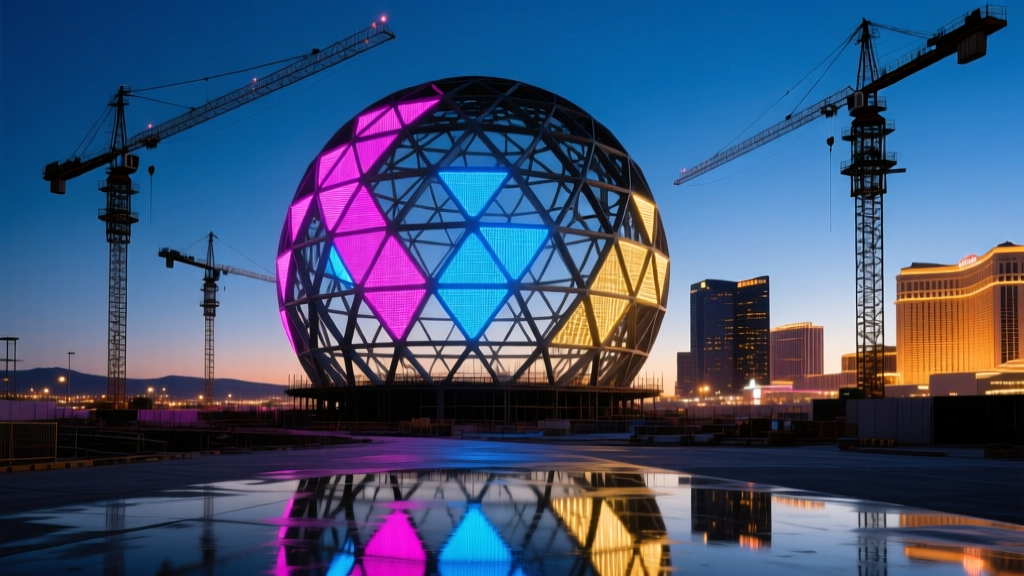
The most visually striking element of the Sphere is its Exosphere—the fully programmable exterior LED skin. This is not composed of off-the-shelf billboard modules. It consists of 1.2 million individual, custom-machined LED pucks spaced 8 inches apart, covering 580,000 square feet.
When estimating custom architectural LED facades in 2026, standard outdoor LED video walls cost between $150 and $300 per square foot. However, the Sphere's pucks required IP68 waterproofing, custom polycarbonate diffusers to withstand Mojave Desert UV radiation, and individual data/power routing. Factoring in the bespoke engineering, wind-load testing, and proprietary mounting tracks, the unit cost for the Exosphere easily exceeds $600 per square foot installed. This pushes the exterior skin materials and installation scope to roughly $348 million.
| LED Facade Type | Typical 2026 Unit Cost ($/SF) | Weatherproofing | Curvature Tolerance |
|---|---|---|---|
| Standard Outdoor Billboard | $150 - $250 | IP65 | Flat Planar Only |
| Flexible Architectural Mesh | $300 - $450 | IP66 | Single-Axis Curve |
| Sphere Exosphere (Custom Pucks) | $600 - $850+ | IP68 / UV Stabilized | Compound Spherical |
MEP & Acoustics: Cooling a Digital Sun
Estimating the mechanical scope for the Sphere requires abandoning standard ASHRAE baselines for assembly occupancies. The interior 160,000-square-foot LED screen, combined with the exterior Exosphere and the heat generated by 18,600 occupants, creates a massive thermal load. As noted by MSG Entertainment, the venue utilizes a highly advanced HVAC system capable of localized cooling.
Rather than attempting to cool the entire 18.6 million cubic feet to a uniform 72°F, the mechanical engineers designed a displacement ventilation system that targets the occupied seating bowl. Furthermore, the acoustic scope includes 167,000 individual speaker drivers and 10,000 haptic feedback seats. Wiring and calibrating this beam-forming audio system required hundreds of miles of shielded cabling, driving the electrical and low-voltage scope costs well past $150 million.
"When estimating immersive venues, the low-voltage and AV integration scope will frequently eclipse the traditional MEP budget. Estimators must allocate dedicated contingency lines for acoustic dampening materials and proprietary server racks required to render real-time 16K content."
2026 Size & Scope Calculator: Unit Cost Matrix
For estimators tasked with pricing scaled-down immersive venues, spherical theaters, or experiential pavilions in 2026, the following unit cost matrix provides a baseline derived from the Sphere's scope data, adjusted for current market conditions and supply chain realities.
| Scope Category | Estimated Unit Metric | 2026 Benchmark Cost | Estimator Notes & Edge Cases |
|---|---|---|---|
| Clear-Span Steel Truss | Per Ton (Erected) | $3,200 - $4,500 | Add 25% premium for compound-curved members and temporary shoring. |
| High-Res Interior LED | Per Square Foot | $1,200 - $2,500 | Includes mounting, calibration, and localized cooling infrastructure. |
| Haptic Seating Integration | Per Seat | $2,500 - $4,000 | Covers transducers, localized DSP, and heavy-gauge power routing. |
| Displacement HVAC (Bowl) | Per CFM | $18 - $28 | Under-floor plenum delivery; requires acoustic lining in ductwork. |
| Beam-Forming Audio Array | Per Zone / Driver Cluster | $8,000 - $15,000 | Includes DSP programming and spatial audio mapping labor. |
Lessons for Estimating Next-Generation Venues
The construction of the Sphere, as extensively documented by the Engineering News-Record, highlights a critical shift in how we estimate experiential architecture. The primary cost drivers are no longer just concrete and steel; they are optoelectronics, thermal management for high-density computing, and proprietary acoustic treatments.
When building your size and scope calculator for similar projects, avoid the trap of using standard RSMeans or commercial building data for the AV and facade packages. The integration labor required to map 16K resolution content onto a curved, spherical surface requires specialized software engineers and riggers, blending construction labor rates with high-end tech-sector compensation. Furthermore, supply chain lead times for custom-milled LED polycarbonate lenses can stretch beyond 14 months, requiring estimators to factor in significant escalation clauses and early procurement storage costs.
Ultimately, the $2.3 billion price tag of the Las Vegas Sphere is a masterclass in bespoke engineering. By isolating the unit costs of its steel exoskeleton, volumetric HVAC, and custom LED skin, estimators can accurately scope the next generation of immersive entertainment venues without falling victim to catastrophic budget overruns.
Written by
Marcus ChenMarcus Chen is a licensed structural engineer (PE) and building materials analyst with over 12 years of experience across residential, commercial, and industrial construction. He holds a Master of Science in Civil Engineering from UC Berkeley and spent six years at Thornton Tomasetti before transitioning to independent consulting and technical writing. Marcus specializes in material selection for seismic-prone regions, concrete reinforcement strategies, and lifecycle cost analysis. His work has been cited by the American Concrete Institute (ACI) and the Structural Engineers Association of California (SEAOC). When he is not on a job site or at his desk, you will find him hiking the Sierra Nevada or restoring a 1920s craftsman bungalow in Oakland, CA.
More from Marcus Chen
View all
Construction Cost
How Much Did the Eiffel Tower Cost to Build?
How much did the Eiffel Tower cost to build in 1889? We adjust for inflation and compare its budget to modern skyscraper construction.
Aug 4, 2026

Fire Resistance
What Is a Fire Resistant Material? Testing & Certification Guide
Discover what is a fire resistant material through ASTM and UL testing. Learn how fire ratings, certifications, and assemblies work in construction.
Aug 4, 2026

Construction Cost
How Much Did the Burj Khalifa Cost to Build?
How much did the Burj Khalifa cost to build? We break down the $1.5B project and extract 5 money-saving strategies for your next build.
Jul 30, 2026