How Much Does It Cost to Build a Quadplex in 2026?
Discover how much it costs to build a quadplex in 2026. Explore regional pricing, material comparisons, and hidden budget factors for 4-unit builds.

2026 Quadplex Cost Snapshot
National Average Range: $1,250,000 to $2,600,000
Cost Per Square Foot: $260 to $420 (based on a 4,800–6,400 sq. ft. footprint)
Per-Unit Cost: $312,500 to $650,000
Note: These figures represent turnkey vertical construction and site work, excluding raw land acquisition and soft costs like architectural fees.
The True Baseline: National Average vs. Regional Variances
When calculating how much does it cost to build a quadplex, geography is the most aggressive variable. A 4-unit residential building requires adherence to strict multifamily zoning, higher structural load ratings, and complex utility routing. In 2026, supply chain stabilization has normalized lumber prices, but specialized labor for multifamily fire-stopping and acoustic sealing continues to drive regional premiums.
| Region | Average Cost per Sq. Ft. | Estimated Total (5,600 sq ft) | Primary Cost Drivers |
|---|---|---|---|
| West Coast (CA, WA, OR) | $360 - $450+ | $2,016,000 - $2,520,000 | Title 24 energy codes, seismic engineering, high impact fees |
| Northeast (NY, MA, NJ) | $340 - $420 | $1,904,000 - $2,352,000 | Union labor rates, frost-depth foundations, strict fire codes |
| Southeast (FL, TX, GA) | $270 - $330 | $1,512,000 - $1,848,000 | Hurricane wind-load engineering, expansive soil mitigation |
| Midwest (OH, IL, MN) | $250 - $310 | $1,400,000 - $1,736,000 | Lower labor costs, standard frost walls, moderate impact fees |
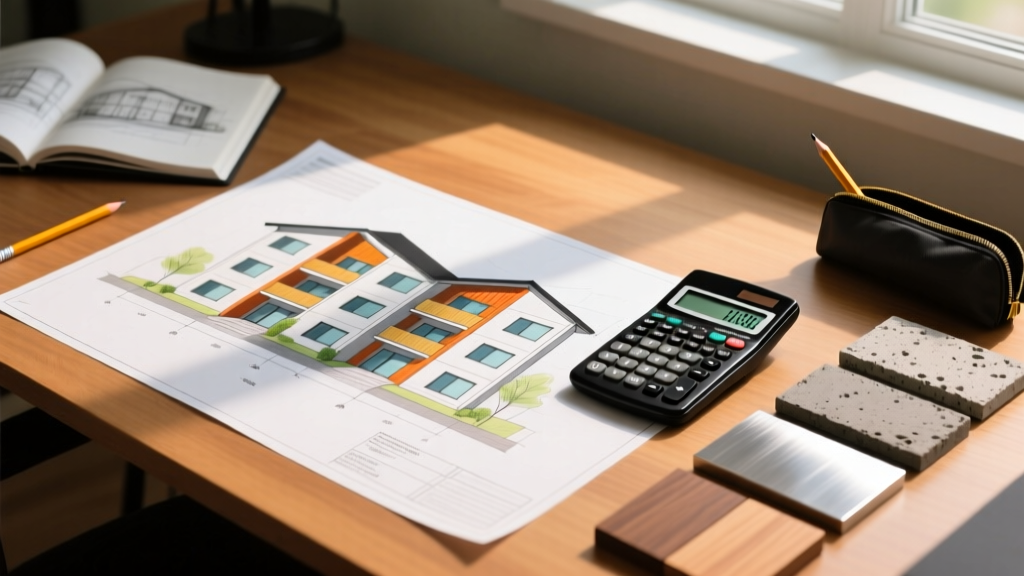
Hard Costs vs. Soft Costs in Quadplex Development
Novice developers often budget exclusively for hard costs (lumber, concrete, labor) and face severe shortfalls when soft costs hit. According to the National Association of Home Builders (NAHB), soft costs for multifamily projects routinely consume 15% to 25% of the total budget.
Hard Costs (75% - 85% of Budget)
- Site Work & Foundation: $120,000 - $180,000. Quadplexes often require engineered slab-on-grade or deep stem walls to support concentrated point loads from shared fire walls.
- Framing & Exterior: $350,000 - $550,000. Includes roof trusses, exterior sheathing, and weather-resistive barriers.
- MEP (Mechanical, Electrical, Plumbing): $400,000 - $600,000. A quadplex requires four separate HVAC systems, four distinct electrical panels (plus a house panel for common areas), and complex plumbing chases.
- Interior Finishes: $250,000 - $450,000. Flooring, cabinetry, drywall, and trim. Builder-grade finishes sit at the lower end; quartz countertops and LVP flooring push the upper limits.
Soft Costs (15% - 25% of Budget)
- Architectural & Engineering: $45,000 - $85,000. Multifamily blueprints require stamped structural, civil, and MEP engineering.
- Permits & Impact Fees: $40,000 - $120,000. Municipalities charge per-unit impact fees for schools, parks, and traffic. Water and sewer tap fees alone can exceed $15,000 per unit in developing suburbs.
- Insurance & Financing: Builder's risk insurance and construction loan interest reserves typically add $30,000 to $60,000 to the ledger.
Material & Framing Choices: Wood vs. Steel vs. ICF
The structural system you select dictates not only your framing budget but also your long-term insurance premiums and acoustic performance. For a 4-unit building, sound transmission and fire resistance are paramount.
| Framing Method | Cost Premium | Acoustic (STC Rating) | Fire & Insurance Benefits |
|---|---|---|---|
| Wood (2x6 with ZIP System) | Baseline | STC 45-50 (requires added mass) | Standard Type V construction; higher insurance premiums. |
| Cold-Formed Steel (CFS) | +8% to +12% | STC 52-58 (with resilient channels) | Non-combustible framing; lowers builder's risk and liability insurance. |
| ICF (Insulated Concrete Forms) | +15% to +22% | STC 55-60+ | 4-hour fire rating; massive discounts on property insurance; superior energy efficiency. |
Expert Recommendation: For the party walls separating the four units, utilize Cold-Formed Steel (CFS) studs like ClarkDietrich ProSTUD paired with Rockwool Safe'n'Sound insulation. This combination drastically reduces flanking noise transmission between units, a leading cause of tenant turnover in quadplexes.
Budgeting for the 'Hidden' Quadplex Expenses
When developers ask how much does it cost to build a quadplex, they frequently overlook the code-mandated expenses unique to attached multifamily structures. Failing to budget for these will result in failed inspections and costly change orders.
⚠️ Hidden Cost 1: Fire-Rated Separations (IBC Section 708)
Under the International Building Code, a quadplex is typically classified as a Group R-2 occupancy. You must install 1-hour or 2-hour fire-resistance-rated walls between units. This requires specialized materials like USG Sheetrock Firecode C panels, fire-rated putty pads for all electrical outlets on shared walls, and fire-dampers in shared duct chases. Budget Impact: $18,000 - $28,000 in premium materials and specialized labor.
⚠️ Hidden Cost 2: Acoustic Flanking Paths
Sound travels through continuous structures. If your floor joists or roof trusses span continuously across multiple units, impact noise will transfer. You must budget for structural breaks, acoustical caulking (e.g., OSI QUAD), and resilient channel installations. Budget Impact: $8,000 - $14,000.
⚠️ Hidden Cost 3: Utility Metering & Trenching
Unlike a single-family home, a quadplex requires four separate utility drops. Trenching for four distinct water lines, four gas lines, and coordinating with the local utility co-op for four electrical and gas meters adds significant site-work costs. Budget Impact: $15,000 - $35,000 depending on street distance.
Step-by-Step Budget Allocation Framework
To maintain profitability, structure your capital stack using this proven allocation framework. Data from Fannie Mae's Multifamily division suggests that maintaining strict contingency reserves is the primary differentiator between successful and stalled developments.
- Land Acquisition (15% - 20%): Ensure the parcel is zoned for R-3 or R-4 (multifamily) density. Rezoning costs can add $20,000 and 12 months to your timeline.
- Soft Costs & Design (10% - 15%): Architectural plans, civil engineering, soil testing (geotech report), and municipal permitting.
- Site Preparation & Utilities (10% - 12%): Clearing, grading, stormwater retention ponds, and utility tap-ins.
- Vertical Construction (45% - 50%): Foundation, framing, MEP rough-ins, drywall, and finishes.
- Landscaping & Hardscaping (5%): Driveways, parking pads (typically 2 spaces per unit required), and exterior grading.
- Contingency Reserve (10%): Never build a quadplex without a hard 10% contingency. Unforeseen soil conditions or mid-build code updates will demand these funds.
Financing and ROI Considerations for 4-Unit Builds
A major financial advantage of the quadplex is that it sits at the intersection of residential and commercial financing. Under U.S. Census Bureau construction metrics, 4-unit buildings are often eligible for residential construction loans (which feature lower interest rates and simpler underwriting) rather than full commercial multifamily loans, provided the developer intends to hold or sell them as condo units.
The House-Hack Strategy: If you occupy one unit and rent the other three, the property qualifies for FHA or conventional owner-occupied financing. This allows for a down payment as low as 3.5% to 5%, drastically reducing your upfront capital requirements compared to the 20% to 25% required for pure investment properties.
Frequently Asked Questions
Can I build a quadplex on a standard single-family lot?
Rarely. Most single-family lots are zoned R-1. You must verify local zoning ordinances for R-3 or R-4 density allowances. Additionally, quadplexes require higher lot coverage ratios, specific off-street parking minimums (usually 8 spaces total), and wider driveway aprons to accommodate turning radii for trash and emergency vehicles.
Is it cheaper to build a quadplex or four separate duplexes?
Building one quadplex on a single lot is generally 15% to 20% cheaper per unit than building four separate duplexes on four different lots. You save massively on land acquisition, duplicate utility tap fees, duplicate site-work, and shared structural walls. However, the quadplex requires a larger, properly zoned parcel, which can be difficult to source in infill neighborhoods.
How long does it take to build a quadplex?
The vertical construction phase typically takes 8 to 12 months. However, the pre-construction phase—encompassing zoning approvals, architectural design, and permitting—frequently adds 4 to 8 months. Budget for a total timeline of 14 to 20 months from land purchase to Certificate of Occupancy (CO).
Written by
Priya KapoorPriya Kapoor is a real estate market analyst and construction economics researcher with expertise in housing affordability, development feasibility, and infrastructure investment. She holds a Master of Regional Planning from Cornell University and previously worked as a senior analyst at CBRE's Investment Properties group, where she modeled returns for $4B in mixed-use development pipelines. Priya now runs an independent research practice advising developers, municipalities, and REITs on construction cost forecasting and market timing. She publishes the quarterly "BuildMat Market Pulse" report tracking material price indices across 12 commodity categories. Based in Austin, TX, Priya serves on the board of Habitat for Humanity Austin and is a marathon runner.
More from Priya Kapoor
View all
Construction Cost
Cost to Build a 1600 Sq Ft Home in 2026: Full Breakdown
Accurate 2026 cost to build a 1600 sq ft home—material, labor, and regional pricing breakdowns included. Plan your budget with real-time estimates.
Aug 11, 2026

Wood & Lumber
Name the Types of Wood for Pressure Treatment and Preservation
Learn how to name the types of wood best suited for pressure treatment. Compare species treatability, chemical retention levels, and 2026 preservation costs.
Aug 4, 2026

Stone & Masonry
Stone Veneer Suppliers Lindenhurst: 2026 Cost Analysis
Analyze 2026 stone veneer costs in Lindenhurst, NY. Compare local supplier pricing, delivery fees, and Suffolk County installation labor rates.
Aug 4, 2026