How Much Did SoFi Stadium Cost to Build? A Detailed Breakdown
Analyze the $5.5 billion construction cost of SoFi Stadium. We break down material, seismic, and tech expenses for commercial estimators.

The $5.5 Billion Reality: Final SoFi Stadium Construction Costs
When Stan Kroenke first proposed a new NFL stadium in Inglewood, California, the initial 2016 estimates pegged the project at $2.6 billion. By the time the facility opened its doors in September 2020, the final price tag had ballooned to an unprecedented $5.5 billion, cementing its status as the most expensive sports venue ever constructed. For commercial construction estimators and project managers analyzing mega-projects in the mid-2020s, understanding how much did SoFi Stadium cost to build requires looking past the headline number and dissecting the extreme engineering, material volatility, and scope expansions that drove the budget.
Viewed from a 2026 perspective, the $5.5 billion expenditure represents a masterclass in complex scope management. With the Turner Building Cost Index and prevailing wage rates climbing over 35% since the stadium's completion, replicating SoFi Stadium's 3.1 million square foot footprint today would likely push the estimate past $7.5 billion. Below is a forensic breakdown of where the capital was allocated.
SoFi Stadium Core Metrics
- Total Final Cost: $5.5 Billion
- Gross Square Footage: 3.1 Million sq. ft.
- Cost per Square Foot: ~$1,774
- Cost per Seat (70,240 base capacity): ~$78,500
- Peak Workforce: 10,000+ concurrent tradespeople
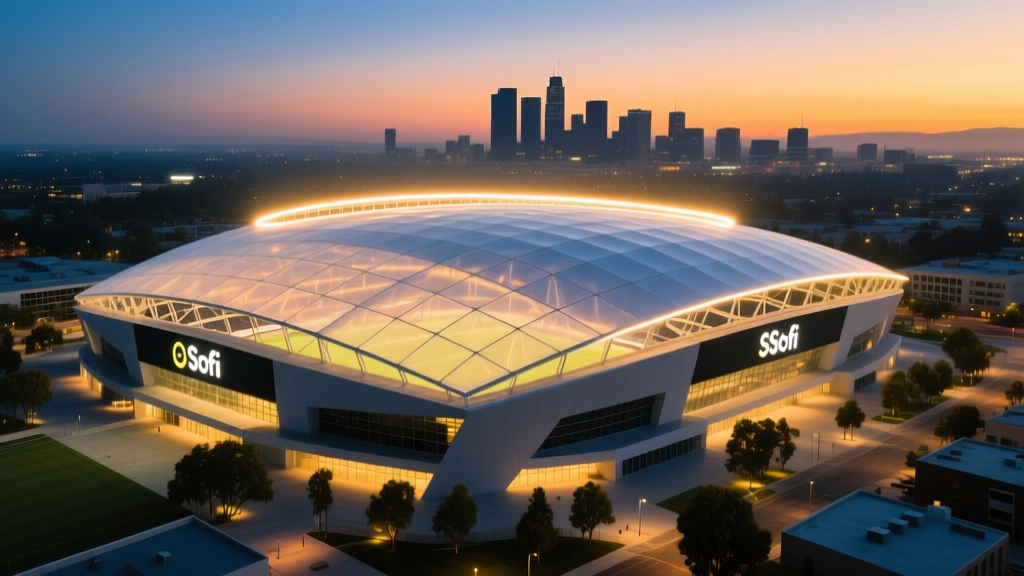
Material and Structural Deep Dive: The Canopy and Superstructure
The most visually striking and financially demanding component of the stadium is its sweeping, translucent roof canopy. Unlike traditional retractable roofs or fixed steel domes, SoFi utilizes an Ethylene Tetrafluoroethylene (ETFE) membrane system. ETFE is a fluorine-based plastic that is 1% the weight of glass, highly transparent to UV light, and self-cleaning via rainfall.
The ETFE and Steel Matrix
The canopy spans over 70,000 square feet of open space and is supported by a massive steel superstructure. According to project profiles by HKS Architects, the design required over 100,000 tons of structural steel and 100,000 cubic yards of concrete. The ETFE system comprises 1,450 individual panels, each custom-cut and tensioned to withstand high wind uplifts while allowing natural light to nourish the natural grass playing surface below.
From an estimating standpoint, ETFE systems carry a high premium. While traditional insulated metal roofing might cost $15 to $25 per square foot installed, architectural ETFE cushion systems routinely exceed $100 to $150 per square foot when factoring in the specialized aluminum extrusion framing, pneumatic air-pressure maintenance systems, and custom fabrication. The canopy alone accounted for hundreds of millions of dollars in material and specialized labor costs.
Seismic Engineering: The Base Isolation Premium
Building a 3.1-million-square-foot structure in Southern California necessitates extreme seismic resilience. Inglewood sits near the active Newport-Inglewood fault zone. Rather than relying solely on traditional moment-resisting frames to absorb seismic energy, engineers implemented a massive base isolation system.
The entire bowl structure rests on 268 friction pendulum bearings. These isolators decouple the stadium from the ground, allowing the structure to slide horizontally up to 36 inches in any direction during a major seismic event. As detailed in ASCE Civil Engineering documentation, this required pouring a continuous, heavily reinforced concrete mat foundation, followed by the precise installation and laser-leveling of each bearing before the vertical columns could be erected.
Technology Integration: The Infinity Screen
Suspended from the canopy's central oculus is the Samsung Infinity Screen, a dual-sided, 4K center-hung video board. Spanning 120 yards (the length of the playing field) and covering 70,000 square feet, it contains roughly 80 million pixels. The structural cost to hang this 2.2-million-pound display required reinforcing the canopy's central steel compression ring. The AV integration, including the 260+ distributed speakers and miles of fiber-optic cabling, pushed the technology and low-voltage fit-out budget well past $150 million, a figure that dwarfs the entire construction cost of some mid-tier collegiate arenas.
Comparative Cost Matrix: SoFi vs. Recent Mega-Stadiums
To contextualize the $5.5 billion expenditure, it is vital to compare SoFi against other modern NFL venues. The table below highlights the cost-per-seat and cost-per-square-foot metrics that define modern stadium estimating.
| Stadium (Year Opened) | Total Cost | Capacity | Cost Per Seat | Primary Cost Driver |
|---|---|---|---|---|
| SoFi Stadium (2020) | $5.5 Billion | 70,240 | $78,500 | ETFE Canopy, Seismic, AV Tech |
| Allegiant Stadium (2020) | $1.9 Billion | 65,000 | $29,200 | Retractable Tray, Black Glass |
| Mercedes-Benz (2017) | $1.5 Billion | 71,000 | $21,100 | Retractable Roof, Oculus |
| AT&T Stadium (2009) | $1.2 Billion | 80,000 | $15,000 | Retractable Roof, Arch Span |
Labor, Delays, and the Pandemic Premium
A significant portion of the $2.9 billion budget overrun was driven by labor inefficiencies and schedule compression. At peak construction, over 10,000 tradespeople were working on-site simultaneously. Managing logistics, crane swings, and safety protocols for a workforce of that magnitude inherently reduces labor productivity. Furthermore, the 2020 global supply chain crisis caused severe delays in the procurement of specialized steel and AV components. To meet the NFL's rigid opening day deadline, the ownership group authorized massive overtime premiums and expedited freight costs, a phenomenon Engineering News-Record noted as a primary factor in the final cost escalation.
Key Takeaways for Commercial Estimators
Analyzing the financial anatomy of SoFi Stadium provides critical frameworks for estimating modern mega-projects:
- Geotechnical Risk Pricing: Never underestimate the cost of base isolation in seismic zones. Estimators must factor in not just the hardware, but the extreme precision labor required to install and survey the bearings.
- Specialty Membrane Contingencies: When bidding ETFE or PTFE tensile structures, standard roofing square-footage metrics are useless. Estimators must engage specialty fabricators during the schematic design phase to account for custom extrusion tooling and pneumatic support systems.
- AV Structural Integration: Modern center-hung displays are no longer just electrical line items; they are primary structural loads. The steel required to support a 2-million-pound dynamic load suspended from a long-span roof must be isolated in the structural steel takeoff.
- Schedule Compression Multipliers: When a project has an immovable deadline (like an NFL season opener), estimators must apply a 15% to 25% labor premium for second-shift work, overtime, and out-of-sequence trade stacking.
Ultimately, the cost to build SoFi Stadium was not just a reflection of materials and labor, but the price of executing an uncompromising architectural vision in one of the most highly regulated and seismically active environments in North America.
Written by
Sarah WhitfieldSarah Whitfield is a chartered quantity surveyor (MRICS) and construction cost analyst with 15 years of experience in material pricing, procurement strategy, and project budgeting. She earned her degree in Construction Management from the University of Reading (UK) and has worked on projects ranging from $2M custom homes to $180M mixed-use developments across North America and Europe. Sarah currently leads cost estimating for BuildMat Insight, maintaining a proprietary database of 4,000+ material price points updated quarterly. She is a frequent contributor to RSMeans cost data panels and has presented at the International Cost Engineering Council (ICEC) congress. Based in Denver, CO, Sarah is an avid trail runner and volunteer mentor for Women in Construction.
More from Sarah Whitfield
View all
Wood & Lumber
What Are the Different Types of Wood? A Builder's Guide
Compare structural softwoods, finish hardwoods, and engineered lumber. Analyze Janka ratings, MOE values, and 2026 pricing for construction.
Aug 4, 2026

Walls & Panels
Steel Framing vs Wood Framing: Corrosion and Moisture Defense
Compare steel framing vs wood framing for moisture resistance. Learn about galvanized coatings, condensation risks, and corrosion protection strategies.
Jul 21, 2026

Stone & Masonry
How to Cut Stone Veneer: Wet Saw vs Grinder Comparison
Compare the best tools for cutting stone veneer. We review wet saws, angle grinders, and chop saws to help you achieve clean, chip-free cuts.
Jul 21, 2026