Cost to Build a House in Tennessee: 2026 Complete Guide
Discover the true cost to build a house in Tennessee in 2026. Get detailed pricing breakdowns, material costs, and regional labor rates for your project.
The Baseline: Average Cost to Build a House in Tennessee
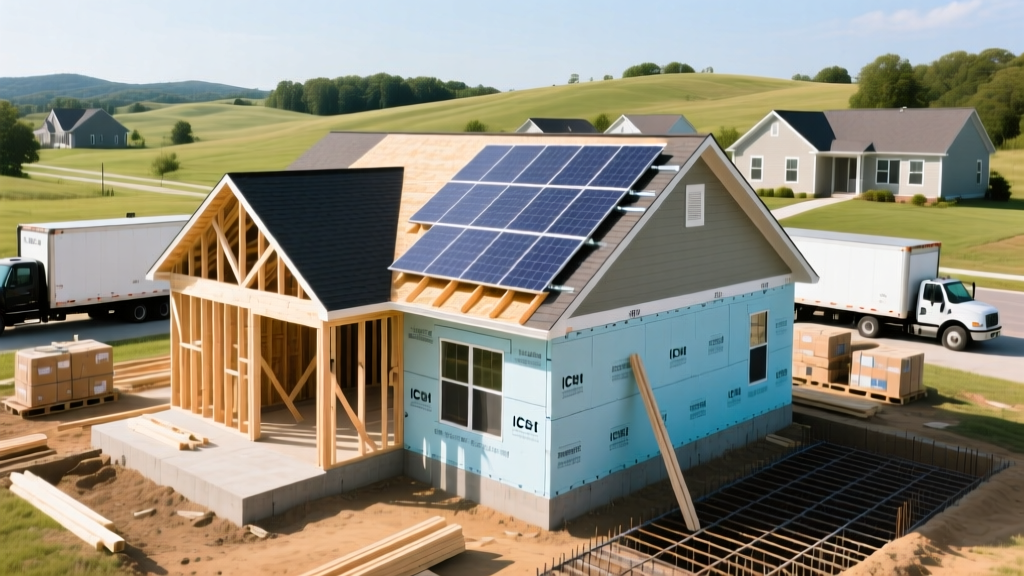
Calculating the exact cost to build a house in Tennessee requires moving beyond national averages and looking at localized material, labor, and topographical data. As of 2026, the baseline construction cost in the Volunteer State ranges from $145 to $235 per square foot for standard production builds. Custom architectural homes push this range to $280 to $400+ per square foot. For a standard 2,200-square-foot single-family home, expect a total hard and soft cost between $319,000 and $517,000 before purchasing the land.
2026 Quick Cost Summary
- Average Cost Per Sq. Ft.: $145 - $235 (Production) | $280 - $400+ (Custom)
- Total Average Build (2,200 sq ft): $319,000 - $517,000
- Land Clearing & Prep: $2,500 - $8,000 (highly dependent on tree density and rock)
- Average Permit Fees: $1,800 - $4,200
According to the National Association of Home Builders (NAHB), regional labor shortages and updated 2024/2025 IECC energy code adoptions across Tennessee counties have shifted the budget allocation, increasing the percentage of soft costs and insulation expenditures.
Regional Price Variations Across the State
Tennessee's diverse geography directly impacts site preparation and foundation costs. The state is split into three distinct geological and economic zones, each presenting unique construction challenges.
| Region / Major Hub | Avg. Cost per Sq. Ft. | Primary Foundation Type | Regional Cost Drivers |
|---|---|---|---|
| Middle TN (Nashville) | $175 - $260 | Slab-on-grade or Crawlspace | Limestone bedrock blasting, high labor demand, strict zoning. |
| East TN (Knoxville) | $155 - $240 | Daylight Basement or Crawlspace | Sloped lot grading, retaining walls, basement waterproofing. |
| West TN (Memphis) | $140 - $210 | Post-tension Slab | Expansive clay soils requiring engineered foundations, high humidity moisture barriers. |
Hard Costs vs. Soft Costs: Where Your Budget Goes
To accurately estimate your project, you must separate hard costs (physical materials and labor) from soft costs (design, engineering, and permits). In Tennessee, hard costs typically consume 75% to 80% of the total budget, while soft costs account for the remaining 20% to 25%.
Material Breakdown (Hard Costs)
Material prices have stabilized compared to the early 2020s, but specific high-performance products now mandated by updated energy codes require upfront investment.
- Framing & Lumber: Expect to pay $12 to $18 per square foot for standard 2x6 exterior wall framing. Using engineered lumber (LVL) for open-concept spans adds 10% to framing costs.
- Exterior Sheathing: Upgrading from traditional OSB and housewrap to a structural integrated weather barrier like the Huber ZIP System costs roughly $1.15 to $1.40 per square foot of wall area, but drastically reduces air infiltration and long-term moisture risks.
- Roofing: Architectural asphalt shingles (e.g., GAF Timberline HDZ) remain the standard at $4.50 to $6.50 per square foot installed. Standing seam metal roofing, increasingly popular in East TN for snow shedding, runs $14.00 to $22.00 per square foot.
- Insulation: To meet the latest IECC requirements in Tennessee's mixed-humid climate zone, builders are utilizing closed-cell spray foam (R-7 per inch) in rooflines, costing $1.80 to $2.50 per board foot, combined with blown-in fiberglass in exterior walls.
Labor and Soft Costs
Data from the U.S. Bureau of Labor Statistics indicates that specialized trade labor in the Nashville and Knoxville metropolitan areas commands a 12% to 18% premium over rural Tennessee counties. Soft costs include:
- Architectural & Engineering: 5% to 10% of total construction costs. Structural engineering for sloped lots in East TN typically adds a flat fee of $2,500 to $4,500.
- Permitting & Impact Fees: Varies wildly by municipality. Unincorporated county areas may charge under $1,500, while cities like Franklin or Brentwood can exceed $5,000 when factoring in water/sewer tap fees and school impact taxes.
Building Styles and Their Impact on Your Bottom Line
The architectural footprint dictates your foundation-to-roof ratio, heavily influencing the final cost to build a house in Tennessee.
| Home Style | Cost Modifier | Why It Costs More (or Less) |
|---|---|---|
| Ranch (Single Story) | +8% to 12% | Requires a larger foundation footprint and more roofing material per square foot of living space. |
| Two-Story Traditional | Baseline (1.0x) | Most cost-effective use of foundation and roof. Plumbing stacks can be aligned vertically to reduce material runs. |
| Barndominium (Post-Frame) | -10% to 15% | Eliminates traditional stud framing and load-bearing interior walls. Ideal for rural TN parcels, but exterior finish choices can quickly erase savings. |
Hidden Costs and Tennessee-Specific Gotchas
Out-of-state buyers and first-time builders frequently underestimate site-specific anomalies in Tennessee. Budgeting a 15% contingency is mandatory due to the following regional hazards.
The Middle Tennessee Karst Topography
Much of Middle Tennessee sits on karst topography, characterized by shallow limestone bedrock. When excavating for a crawlspace or basement, hitting solid rock is common. Blasting or mechanical rock-breaking requires specialized permits and contractors, frequently adding $8,000 to $20,000 to site preparation costs. Always mandate a geotechnical soil boring test ($1,200 - $2,500) before purchasing a lot.
"Never skip the perc test and soil boring in rural Tennessee. A lot that looks perfectly flat might sit over a limestone shelf that makes a conventional septic system impossible, forcing you into a $25,000 aerobic treatment unit."
West Tennessee Expansive Clay
West of the Tennessee River, the soil is rich in expansive clay that swells when wet and shrinks when dry. Standard slab-on-grade foundations will crack without soil remediation. Builders must use post-tensioned concrete slabs or drill concrete piers down to stable load-bearing strata, adding $4,000 to $9,000 to the foundation budget.
Rural Utilities: Well, Septic, and Power
If building outside municipal limits, connecting to utilities is entirely on your dime. According to the U.S. Census Bureau Building Permits Survey, rural residential development is surging, meaning local health departments are backlogged on septic approvals. Budget $12,000 to $18,000 for a conventional septic system, or up to $28,000 for engineered systems. Drilling a water well in the rocky eastern and middle regions costs $6,000 to $12,000 depending on depth (often 150 to 300 feet to hit potable aquifers).
Financing Your Tennessee Build
Construction-to-permanent loans remain the standard financing vehicle. In 2026, Tennessee lenders typically require a 20% down payment on the total projected cost (land + build). Because rural land appraisals can be volatile, lenders often require you to own the land outright or put 30% down if the land is heavily wooded and lacks comparable recent sales data. Ensure your builder provides a highly detailed, line-item cost breakdown; Tennessee banks will not approve draw schedules based on generalized "allowance" estimates.
Frequently Asked Questions
Is it cheaper to buy an existing home or build in Tennessee?
As of 2026, building a new home in Tennessee is generally 10% to 15% more expensive upfront than buying a comparable existing home, primarily due to land acquisition and current labor rates. However, new builds offer superior energy efficiency (lower HVAC costs) and eliminate the immediate deferred maintenance costs common in older Tennessee homes, such as replacing aging crawlspaces or updating outdated electrical panels.
What time of year is best to start building in Tennessee?
Breaking ground in late February or early March is ideal. This allows you to complete site work, foundation pouring, and framing before the heavy summer thunderstorms and high humidity of July and August, which can warp unprotected lumber and delay concrete curing. Drying-in the house before the autumn rainy season is the primary goal.
Do I need a builder's license to act as my own general contractor?
No, Tennessee law allows homeowners to act as their own general contractor for a primary residence, provided they sign an affidavit stating they will occupy the home for at least one year after completion. However, you must still hire licensed subcontractors for specialized trades like plumbing, electrical, and HVAC, as Tennessee strictly enforces licensing for these specific disciplines to ensure code compliance.
Written by
Elena RodriguezElena Rodriguez is a civil engineer and technical writer specializing in concrete technology, masonry systems, and ASTM/ACI compliance. She earned her B.S. in Civil Engineering from Texas A&M University and spent a decade at a materials testing laboratory, performing over 2,000 concrete compressive strength tests and masonry prism evaluations. Elena is an ACI-certified Field Testing Technician (Grade I) and a member of ASTM Committee C12 on Natural Building Stone. She currently consults on forensic engineering cases involving concrete failures and moisture intrusion. Based in San Antonio, TX, Elena is a proud member of the Society of Women Engineers (SWE) and coaches her daughter's FIRST Robotics team.
More from Elena Rodriguez
View all
Walls & Panels
Cost Analysis: Light Gauge Steel Framing Advantages and Disadvantages
Evaluate light gauge steel framing advantages and disadvantages through a strict cost analysis lens, comparing material, labor, and lifecycle expenses.
Aug 4, 2026

Walls & Panels
Gypsum Board Types: Exact Specifications, Thickness & Dimensions
Compare standard, Type X, and moisture-resistant gypsum board types. Get exact specifications, thicknesses, dimensions, and ASTM standards for your project.
Aug 4, 2026

Fire Resistance
Best Fire-Resistant Outdoor Decking Materials: 2026 Buyer Guide
Discover the best fire-resistant outdoor decking materials for 2026. Compare Class A PVC, aluminum, and hardwood options for WUI compliance and safety.
Aug 4, 2026