Composite Material Decking vs Wood: 2026 Cost & ROI Guide
Compare composite material decking to pressure-treated wood with 2026 pricing, lifespan data, and ROI metrics to choose the right outdoor surface.

Material Science: Capped Polymer Shells vs. Chemical Penetration
Selecting between composite material decking and pressure-treated lumber requires looking past the initial material cost and understanding the fundamental material science governing each option. In 2026, the price gap has narrowed slightly due to lumber market stabilization and advancements in capped composite manufacturing, but the structural, thermal, and maintenance implications remain vastly different.
Premium composite material decking, such as Trex Transcend Lineage or TimberTech Prime+, utilizes a co-extrusion manufacturing process. The core typically consists of a blended matrix of 50% reclaimed wood flour and 50% high-density polyethylene (HDPE) or polypropylene. This core is encapsulated during extrusion by a proprietary polymer cap, often formulated from Acrylonitrile Styrene Acrylate (ASA), which provides extreme resistance to UV degradation and moisture ingress. To be legally marketed for structural decking applications in the United States, these products must undergo rigorous testing and comply with the ASTM D7032 Standard Specification for Wood-Plastic Composites, which dictates minimum thresholds for flexural properties, impact resistance, and accelerated weathering.
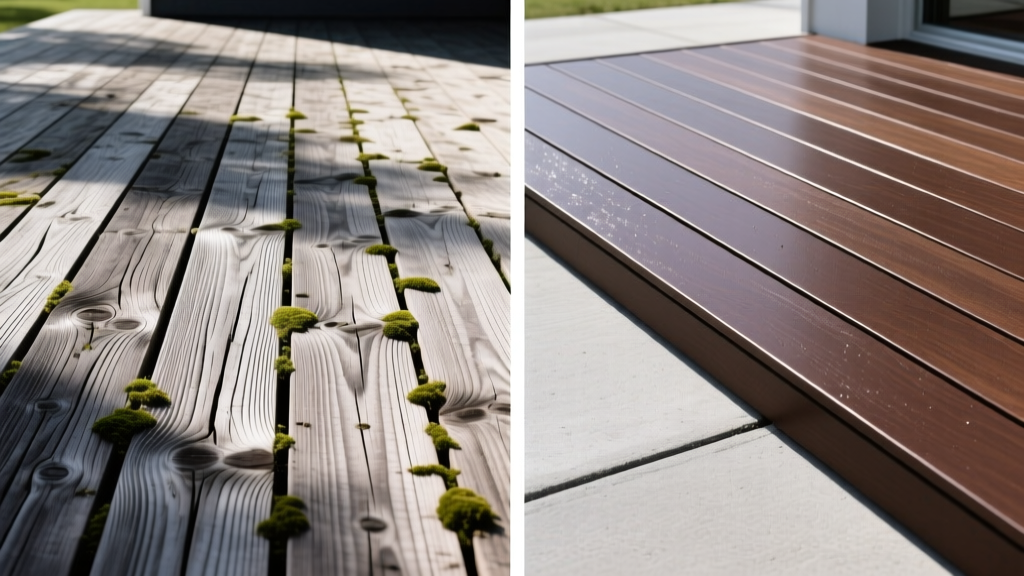
Conversely, pressure-treated wood relies on chemical penetration. The industry standard is #2 Grade Southern Yellow Pine (SYP), which is force-impregnated with preservatives like Micronized Copper Quaternary (MCQ) or Alkaline Copper Quaternary (ACQ). The American Wood Protection Association dictates retention levels under the AWPA U1 Use Category System. For above-ground deck boards, the required retention level is 0.25 pounds per cubic foot (pcf), while structural posts in ground contact require 0.40 pcf. Unlike composite, wood is a hygroscopic, anisotropic material that constantly exchanges moisture with its environment, leading to dimensional instability.
2026 Installed Cost and Material Pricing Matrix
The following matrix breaks down the realistic 2026 costs for a standard 400-square-foot, ground-level rectangular deck. Pricing reflects premium capped composite versus standard pressure-treated SYP, including substructure and professional installation labor.
| Cost Factor (Per Sq. Ft.) | Pressure-Treated SYP | Premium Capped Composite |
|---|---|---|
| Deck Boards (Material Only) | $2.80 - $3.50 | $9.50 - $13.00 |
| Fasteners & Hardware | $0.40 - $0.60 | $1.80 - $2.50 |
| Substructure (PT Joists/Beams) | $4.50 - $5.50 | $4.50 - $5.50 |
| Professional Labor | $10.00 - $14.00 | $16.00 - $22.00 |
| Total Installed Cost | $17.70 - $23.60 | $31.80 - $43.00 |
While the upfront premium for composite material decking is roughly 60% to 80% higher, this calculation excludes the mandatory bi-annual maintenance cycle required for pressure-treated wood, which drastically alters the long-term financial picture.
Structural Framing and Thermal Dynamics
The most common point of failure in composite deck installations stems from treating the material identically to wood during the framing phase. Composite material decking possesses a significantly higher coefficient of thermal expansion (CTE) along its longitudinal axis compared to natural lumber.
Furthermore, joist spacing requirements differ. While #2 SYP can safely span 16 inches on-center (OC) under standard residential live loads (40 psf), many 5.5-inch wide composite profiles require 12-inch OC joist spacing to prevent sagging, especially in high-heat environments where the polymer matrix softens slightly. Failing to reduce joist spacing to 12 inches OC for composite boards routinely results in deflection failures and voided manufacturer warranties.
Fastener Compatibility and the 'Mushrooming' Defect
Fastening methodologies are entirely incompatible between the two materials. Pressure-treated wood is typically face-screwed using #10 x 3-inch structural screws (such as Simpson Strong-Tie SDWS or GRK RSS) or ring-shank galvanized nails. Because modern copper-based preservatives are highly corrosive to standard zinc, 304 or 316 stainless steel fasteners, or heavily polymer-coated structural screws, are mandatory to prevent black leaching streaks and structural shear failure.
Composite material decking cannot be face-screwed with standard wood screws. Driving a standard bugle-head screw through a composite board displaces the dense polymer cap, causing a raised ridge of material around the screw head known in the industry as 'mushrooming.' This defect traps moisture and ruins the aesthetic. Composite requires either pre-drilled and countersunk face screws with color-matched composite plugs (like the TimberTech Cortex system) or specialized hidden fastener clips (like the Trex Hideaway system) that lock into the grooved edges of the boards, allowing for lateral thermal movement while maintaining a completely fastener-free surface.
Lifecycle Maintenance and the 25-Year ROI Calculation
To accurately evaluate the return on investment, builders and homeowners must project the 25-year lifecycle cost, which is the standard warranty period for premium capped composites.
- Pressure-Treated Wood Maintenance: To prevent UV graying, checking, and moisture rot, SYP decks require power washing, sanding, and the application of a penetrating oil-based or film-forming semi-transparent stain every 2 to 3 years. In 2026, professional deck restoration costs average $3.50 to $5.00 per square foot per cycle. Over 25 years, a 400 sq. ft. deck will incur roughly $11,200 to $16,000 in maintenance costs.
- Composite Maintenance: Capped composite requires no sanding, staining, or sealing. Maintenance consists of a bi-annual wash using a mild, non-abrasive surfactant and a garden hose or low-pressure power washer (under 1,500 PSI with a 40-degree fan tip). The 25-year maintenance cost for a 400 sq. ft. composite deck rarely exceeds $800 in DIY cleaning supplies.
When factoring in the compounding maintenance costs of wood, the financial crossover point—where the total investment in composite becomes cheaper than the total investment in wood plus maintenance—typically occurs between year 7 and year 9. Beyond year 10, composite material decking yields a strictly positive ROI compared to wood.
Edge Cases and Critical Failure Modes
Both materials have specific vulnerabilities that must be mitigated during design and construction.
Composite Failure Modes
The primary vulnerability of composite material decking is moisture wicking through uncapped cross-sections. If a board is ripped on a table saw to fit a border or fascia, the exposed HDPE/wood-flour core is left unprotected. If this exposed end is not sealed with a manufacturer-approved end-cap sealant or covered by a fascia board, it will wick moisture, leading to core swelling, cap delamination, and fungal growth inside the board. Additionally, installing boards tightly butt-jointed without accounting for thermal expansion will cause the boards to buckle and push up off the joists during peak summer heat.
Wood Failure Modes
Pressure-treated wood is highly susceptible to 'checking' (longitudinal cracking along the grain) as the exterior dries faster than the interior core. While superficial checking is normal, severe checks can compromise the structural integrity of the board and create splinter hazards. Furthermore, wood in constant contact with moisture or soil is vulnerable to fungal decay and termite ingress if the chemical retention level drops below the AWPA U1 threshold, which can happen if the wood is improperly cut and the end-grain is not field-treated with a copper naphthenate preservative.
Decision Framework: Specifying the Right Surface
Use the following parameters to make a definitive material selection for your 2026 outdoor project:
Specify Pressure-Treated Wood If:
- The strict budget cap for the project is under $24 per square foot installed.
- The design calls for a rustic, natural, or traditional aesthetic that polymers cannot authentically replicate.
- The deck is located in a heavily shaded, dry, or temperate climate where extreme UV exposure and heavy moisture cycling are minimal.
- The homeowner is committed to a strict bi-annual maintenance and staining schedule.
Specify Composite Material Decking If:
- The budget accommodates $35 to $45+ per square foot installed.
- The deck is situated in high-UV environments, near saltwater, or in regions with extreme freeze-thaw cycles where wood would rapidly degrade.
- The design mandates a fastener-free surface utilizing hidden clip systems.
- The homeowner demands a zero-maintenance surface and expects a 25-year structural and fade/stain warranty.
By aligning the material's physical properties and lifecycle costs with the specific environmental and financial parameters of the project, builders can eliminate premature failures and ensure the outdoor structure performs flawlessly for decades.
Written by
Sarah WhitfieldSarah Whitfield is a chartered quantity surveyor (MRICS) and construction cost analyst with 15 years of experience in material pricing, procurement strategy, and project budgeting. She earned her degree in Construction Management from the University of Reading (UK) and has worked on projects ranging from $2M custom homes to $180M mixed-use developments across North America and Europe. Sarah currently leads cost estimating for BuildMat Insight, maintaining a proprietary database of 4,000+ material price points updated quarterly. She is a frequent contributor to RSMeans cost data panels and has presented at the International Cost Engineering Council (ICEC) congress. Based in Denver, CO, Sarah is an avid trail runner and volunteer mentor for Women in Construction.
More from Sarah Whitfield
View all
Wood & Lumber
What Are the Different Types of Wood? A Builder's Guide
Compare structural softwoods, finish hardwoods, and engineered lumber. Analyze Janka ratings, MOE values, and 2026 pricing for construction.
Aug 4, 2026

Walls & Panels
Steel Framing vs Wood Framing: Corrosion and Moisture Defense
Compare steel framing vs wood framing for moisture resistance. Learn about galvanized coatings, condensation risks, and corrosion protection strategies.
Jul 21, 2026

Stone & Masonry
How to Cut Stone Veneer: Wet Saw vs Grinder Comparison
Compare the best tools for cutting stone veneer. We review wet saws, angle grinders, and chop saws to help you achieve clean, chip-free cuts.
Jul 21, 2026