Decking Composite Material vs Wood: Cost and Performance Comparison
Compare decking composite material to pressure-treated wood. Analyze costs, lifespan, maintenance, and structural performance to choose the right deck.
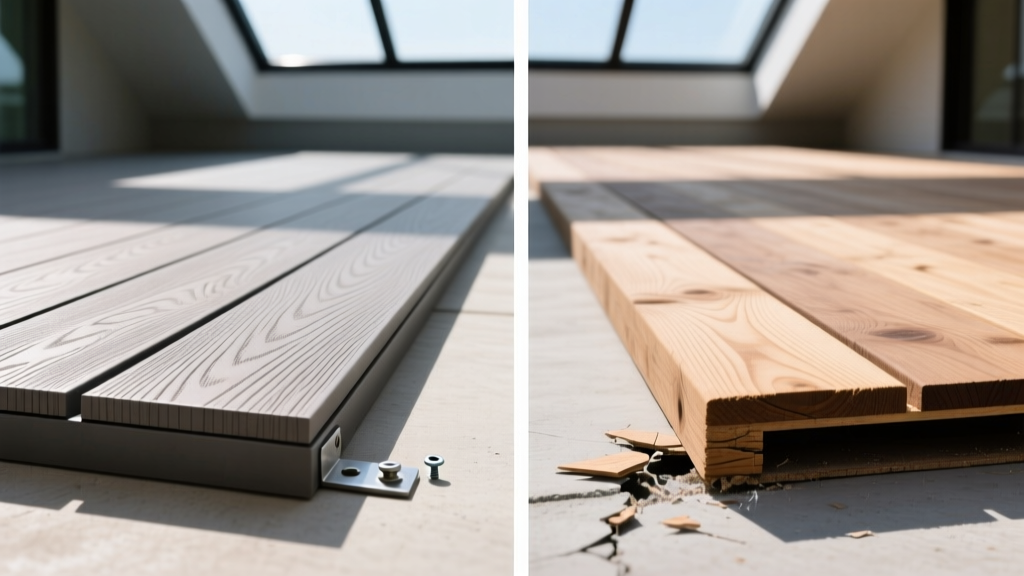
The Core Debate: Capped Composite vs. Pressure-Treated Lumber
Choosing between a decking composite material and traditional pressure-treated Southern Yellow Pine (SYP) is no longer just a matter of upfront budget. Modern capped composite boards have fundamentally altered the structural and maintenance realities of outdoor builds. While pressure-treated wood remains the baseline for framing, its use as a decking surface is increasingly challenged by the lifecycle economics and dimensional stability of advanced polymer composites.
This comparison strips away marketing claims to evaluate the exact mechanical properties, 10-year cost trajectories, and failure modes of both materials, providing a definitive framework for your build.
Quick Decision Framework
- Choose Pressure-Treated Wood if: Your budget is strictly capped below $25 per square foot (installed), you prefer the authentic thermal mass and traction of real timber, and you are committed to annual sealing and staining.
- Choose Decking Composite Material if: You prioritize a 25+ year fade and stain warranty, want to eliminate annual refinishing, and are willing to pay a 40-60% upfront premium for long-term lifecycle savings.
Upfront Costs and Long-Term ROI Breakdown
The most common miscalculation in deck planning is evaluating material costs in isolation. A comprehensive financial analysis must include fasteners, specialized labor, and a 10-year maintenance projection. Below is a realistic cost matrix for a standard 400-square-foot single-level deck in 2026.
| Cost Category | Pressure-Treated SYP | Mid-Tier Capped Composite | Premium Capped Composite |
|---|---|---|---|
| Decking Material (per sq ft) | $4.50 - $6.00 | $8.50 - $11.00 | $12.00 - $15.50 |
| Fasteners & Hidden Clips | $0.80 (Face screws) | $2.20 (Hidden clips) | $3.50 (Color-matched plugs) |
| Installation Labor (per sq ft) | $12.00 - $15.00 | $16.00 - $20.00 | $18.00 - $24.00 |
| 10-Year Maintenance Cost | $1,800 - $2,500 | $150 - $300 | $150 - $300 |
| Estimated 10-Year Total (400 sq ft) | $10,520 - $12,300 | $12,580 - $14,700 | $15,350 - $18,500 |
According to industry lifecycle analyses, the break-even point where composite decking becomes cheaper than pressure-treated wood—factoring in professional staining and board replacement—typically occurs around year 11 to 13.
Structural Performance and Failure Modes
Wood and composite behave entirely differently under environmental stress. Understanding these mechanical differences dictates how your substructure must be framed.
Thermal Expansion and Joist Spacing
Pressure-treated wood expands and contracts primarily in width (tangential and radial movement) due to moisture absorption, with negligible longitudinal expansion. Decking composite material, however, expands and contracts primarily in length due to thermal fluctuations.
According to research from the U.S. Forest Products Laboratory, a 20-foot composite board can expand up to 1/4 inch during a 100-degree Fahrenheit temperature swing. If installed without proper butt-joint gapping, composite boards will buckle and push off the joists. Furthermore, while wood decking can safely span 16 inches on-center (OC) even when laid diagonally, composite decking strictly requires 12-inch OC joist spacing for diagonal patterns to prevent sagging under load, as the polymer matrix lacks the sheer tensile strength of solid timber grain.
Moisture Intrusion and Rot
The primary failure mode for SYP is fungal decay and cupping. Even with modern micronized copper azole (MCA) treatments, the cut ends of pressure-treated boards remain vulnerable if not sealed with end-grain preservatives. The American Wood Council emphasizes that prolonged moisture traps at joist interfaces are the leading cause of premature deck failure. Modern capped composite boards feature a fully encased polymer shell (usually high-density polyethylene or PVC) that is entirely impervious to water absorption, completely eliminating rot and structural cupping.
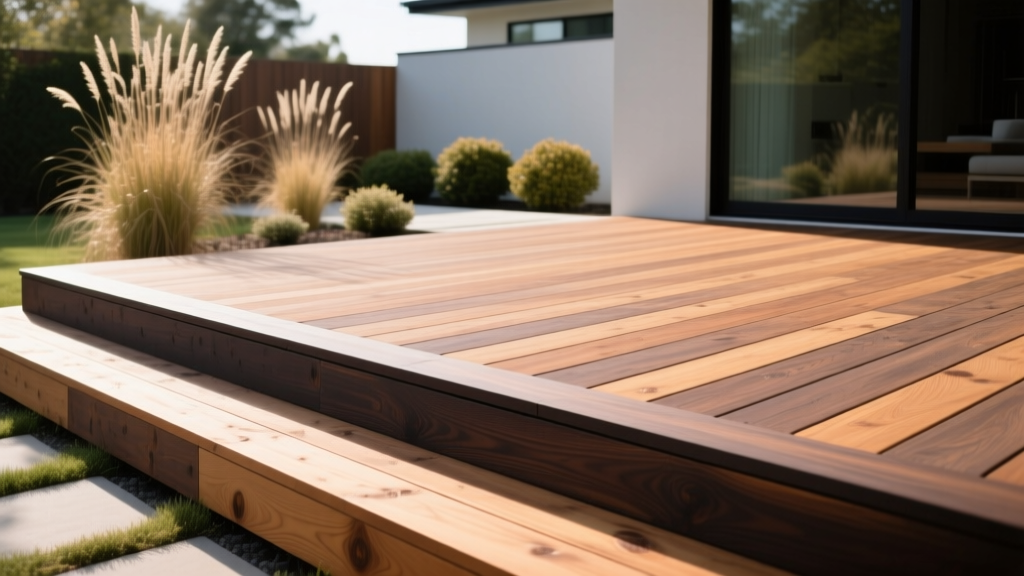
Fastener Systems: Face Screws vs. Hidden Clips
The aesthetic and structural integrity of your deck surface relies heavily on the fastening method, which differs drastically between materials.
- Wood (Face Screwing): SYP is typically face-screwed using 3-inch structural screws (like GRK RSS or Simpson Strong-Tie). Pre-drilling is rarely required for modern self-tapping screws, but the screw heads remain visible and can trap moisture, leading to localized rot around the fastener hole over time.
- Composite (Hidden Fasteners): Most composite boards are pre-grooved to accept hidden stainless steel or polymer clips (e.g., Trex Hideaway or TimberTech CONCEALoc). This creates a clean, screw-free surface and automatically enforces the required 3/16-inch expansion gap between boards. For premium builds, the Cortex hidden fastening system uses color-matched composite plugs driven over face screws, offering superior pull-out resistance for high-wind zones while maintaining a seamless look.
Maintenance Realities: Beyond the Marketing
Composite manufacturers market their products as 'maintenance-free,' which is a dangerous misnomer. They are 'low-maintenance.' Fine Homebuilding notes that while composite will never need sanding or staining, it requires specific cleaning protocols to prevent surface mold.
Warning: The Composite Mold Misconception
Mildew and black mold do not grow on the plastic cap of composite decking; they grow on the organic debris (pollen, dirt, leaf tannins) that settles on the surface. If you fail to sweep and rinse your composite deck bi-annually, the organic layer will foster mold growth that can permanently stain the micro-texture of the composite shell. Use a specialized composite deck cleaner (like Resist Mist or 30 SECONDS Outdoor Cleaner) rather than high-pressure power washing, which can etch and scar the polymer cap.
Top Tier Decking Composite Material Models Evaluated
If you opt for composite, the market is segmented into mid-tier (PE shell, wood-flour core) and premium (PVC shell, advanced mineral cores). Here is how the top 2026 models perform:
Trex Transcend Lineage
Profile: 4-sided capped, heat-mitigating technology.
Pros: Exceptional fade resistance; the heat-mitigating shell stays significantly cooler in direct sunlight than older generation composites. Deep wood-grain embossing.
Cons: Heavier than PVC alternatives, requiring strict adherence to 16" OC framing limits.
TimberTech Advanced PVC (Landmark)
Profile: 100% PVC (no wood flour core).
Pros: Impervious to moisture wicking; can be used in direct ground contact or over water. Multi-width boards allow for custom pattern layouts without ripping boards.
Cons: PVC is more susceptible to surface scratching from heavy furniture dragging compared to PE-capped boards.
Fiberon Promenade
Profile: Lightweight PVC with slip-resistant micro-texture.
Pros: Extremely lightweight, making DIY installation easier. Excellent traction when wet, ideal for pool surrounds.
Cons: Color options are more limited and lean heavily into lighter, contemporary tones rather than traditional deep woods.
Environmental Impact and End-of-Life Disposal
Pressure-treated wood is a natural, renewable resource, but the chemical preservatives (like MCA or alkaline copper quaternary) complicate end-of-life disposal. Treated lumber cannot be burned in residential fireplaces due to toxic off-gassing and must be taken to specialized construction landfills.
Conversely, modern decking composite material is heavily reliant on recycled plastics (HDPE from milk jugs and detergent bottles) and reclaimed wood fibers. Trex, for example, diverts over 500 million pounds of plastic film from landfills annually. However, once a capped composite board reaches the end of its 30-year life, the fused polymer and wood-flour matrix is notoriously difficult to separate and recycle, meaning it will likely end up in a landfill, albeit inert and non-leaching.
Final Verdict: Which Material Wins Your Build?
There is no universal winner; the correct choice depends on your financial timeline and maintenance tolerance. If you are building a rental property, a short-term flip, or a ground-level deck on a strict budget, pressure-treated SYP remains an unbeatable value, provided you commit to the annual sealing regimen using penetrating oil-based sealers like Ready Seal or Penofin.
However, if this is your forever home, or if the deck is elevated and difficult to access for annual staining, investing in a premium decking composite material like TimberTech Advanced PVC or Trex Transcend Lineage is the superior structural and financial decision. The elimination of annual chemical treatments, combined with the eradication of splinters and rot, fundamentally upgrades the daily utility of your outdoor living space.
Written by
Priya KapoorPriya Kapoor is a real estate market analyst and construction economics researcher with expertise in housing affordability, development feasibility, and infrastructure investment. She holds a Master of Regional Planning from Cornell University and previously worked as a senior analyst at CBRE's Investment Properties group, where she modeled returns for $4B in mixed-use development pipelines. Priya now runs an independent research practice advising developers, municipalities, and REITs on construction cost forecasting and market timing. She publishes the quarterly "BuildMat Market Pulse" report tracking material price indices across 12 commodity categories. Based in Austin, TX, Priya serves on the board of Habitat for Humanity Austin and is a marathon runner.
More from Priya Kapoor
View all
Construction Cost
Cost to Build a 1600 Sq Ft Home in 2026: Full Breakdown
Accurate 2026 cost to build a 1600 sq ft home—material, labor, and regional pricing breakdowns included. Plan your budget with real-time estimates.
Aug 11, 2026

Wood & Lumber
Name the Types of Wood for Pressure Treatment and Preservation
Learn how to name the types of wood best suited for pressure treatment. Compare species treatability, chemical retention levels, and 2026 preservation costs.
Aug 4, 2026

Stone & Masonry
Stone Veneer Suppliers Lindenhurst: 2026 Cost Analysis
Analyze 2026 stone veneer costs in Lindenhurst, NY. Compare local supplier pricing, delivery fees, and Suffolk County installation labor rates.
Aug 4, 2026