How Much Does a Deck Cost to Build in 2026? Full Pricing Framework
Discover exactly how much a deck costs to build in 2026. Use our selection framework to match materials, framing, and labor to your exact budget tier.

The 2026 National Deck Cost Baseline
Determining exactly how much a deck costs to build requires moving past national averages and analyzing your specific site conditions, material selections, and structural requirements. In 2026, the national average for a standard 200-square-foot ground-level deck ranges from $8,500 to $14,000. However, this baseline is practically useless for high-end outdoor living spaces or complex multi-level builds. According to Angi's comprehensive deck cost analysis, material choices and labor rates account for an 80% variance in final pricing.
Labor rates in 2026 have stabilized between $45 and $85 per hour depending on regional demand and contractor licensing. To accurately budget your project, you must deconstruct the build into four distinct cost centers: decking surface, structural framing, railing systems, and site preparation. This selection framework will guide you through each tier, ensuring your capital is allocated to the components that deliver the highest longevity and return on investment.
Material Cost Matrix: Price Per Square Foot Installed
The surface material dictates not only the initial capital outlay but also the 20-year lifecycle cost. The following matrix breaks down 2026 installed costs (materials plus professional labor) for a standard rectangular deck with basic stair access.
| Material Type | Material Cost / Sq. Ft. | Installed Cost / Sq. Ft. | 20-Year Maintenance Cost |
|---|---|---|---|
| Pressure-Treated Pine (PTP) | $3.50 – $5.00 | $15.00 – $22.00 | $2,500 (Staining/Sealing) |
| Cedar / Redwood | $6.00 – $9.00 | $24.00 – $32.00 | $2,000 (Oiling/Sealing) |
| Capped Composite (Mid-Tier) | $7.50 – $10.50 | $35.00 – $48.00 | $200 (Cleaning) |
| Premium PVC (High-Tier) | $11.00 – $15.00 | $50.00 – $70.00 | $150 (Cleaning) |
| Aluminum Decking | $14.00 – $18.00 | $65.00 – $90.00 | $0 |
Structural Framing: Wood vs. Steel in 2026
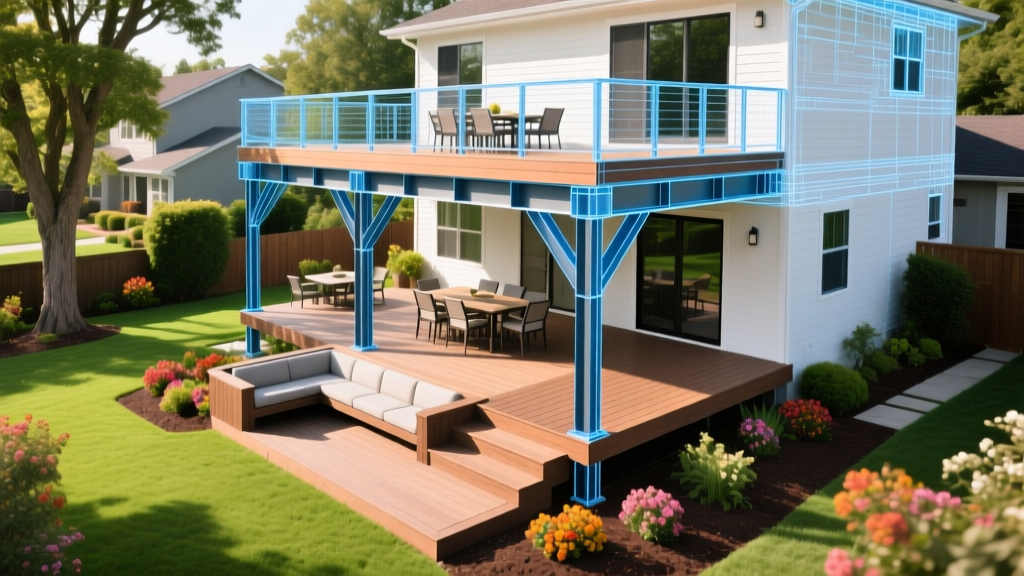
Homeowners frequently obsess over the decking surface while ignoring the skeleton beneath it. Standard pressure-treated Southern Yellow Pine framing costs between $4.00 and $6.00 per square foot. While adequate for basic builds, wood framing is susceptible to warping, crown shifting, and moisture rot, which can cause composite boards to buckle or gap unevenly over time.
For premium composite or PVC builds, upgrading to a steel framing system like Fortress Evolution or Lightweight Steel adds $5.00 to $8.00 per square foot to the framing budget. Steel framing guarantees perfectly straight joists that will not twist or shrink, ensuring hidden fastener systems remain intact. Furthermore, if you plan to install decking boards in a diagonal pattern, building codes and manufacturer warranties mandate reducing joist spacing from the standard 16 inches on-center (O.C.) to 12 inches O.C. This structural upgrade alone increases framing lumber and labor costs by approximately 18%.
The Budget Tier Selection Framework
Use this tiered framework to align your material selections with your financial parameters and long-term property goals.
Tier 1: The Essential Build ($15–$25 per sq. ft. installed)
Target Profile: Budget-conscious homeowners, DIY builders, or property flippers needing immediate functional outdoor space with maximum ROI upon resale.
- Surface: #1 Grade Pressure-Treated Pine or basic Cedar.
- Framing: Standard 2x8 or 2x10 PTP joists at 16" O.C. with standard Simpson Strong-Tie galvanized hangers.
- Railings: 4x4 wood posts with 2x4 top rails and standard pickets, or basic aluminum balusters to meet the 4-inch sphere code requirement.
- Fasteners: Ceramic-coated deck screws (e.g., GRK Fasteners RSS). Face-screwing is mandatory; hidden clips are incompatible with natural wood due to seasonal expansion and contraction.
Tier 2: The Mid-Range Composite Upgrade ($35–$55 per sq. ft. installed)
Target Profile: Long-term homeowners seeking a zero-maintenance lifestyle without crossing into luxury pricing. This tier offers the best balance of lifecycle cost and aesthetic appeal.
- Surface: Capped wood-plastic composites like Trex Enhance Naturals or TimberTech Prime+ Collection. These feature a protective polymer shell that resists staining and UV fading.
- Framing: PTP lumber, but upgraded with butyl flashing tape (e.g., Trex Protect) applied to all joist tops to prevent moisture infiltration and wood rot.
- Railings: Composite railing systems with square aluminum balusters. This eliminates the need to paint or stain railings while maintaining a modern sightline.
- Fasteners: Stainless steel hidden clip systems (e.g., Trex Hideaway). This requires grooved-edge boards and provides a clean, screw-free surface.
Tier 3: The Premium Outdoor Living Space ($65–$100+ per sq. ft. installed)
Target Profile: Custom luxury homes, high-end entertainment spaces, and coastal properties requiring extreme weather and salt-air resistance.
- Surface: Cellular PVC boards like Azek Vintage Collection or premium composites like Trex Transcend Lineage. PVC offers superior moisture resistance and can be heat-bent for custom radius edges.
- Framing: Powder-coated steel framing with integrated wire-management channels for low-voltage lighting.
- Railings: Frameless tempered glass panels or marine-grade stainless steel cable railings (e.g., Feeney CableRail) to preserve unobstructed views.
- Extras: Integrated LED riser lighting, under-deck drainage systems (e.g., Trex RainEscape), and custom-built fascia wrap-arounds.
If you are building a Tier 2 or Tier 3 deck over a usable patio or storage area, failing to install an under-deck drainage system during the initial framing phase will cost you 300% more to retrofit later. Systems like DrySpace or Trex RainEscape must be integrated into the joist bays before the decking surface is laid.
Hidden Cost Variables That Break Budgets
When calculating how much a deck costs to build, contractors often provide a base square-footage quote that excludes critical site-specific variables. According to the Remodeling Magazine Cost vs. Value Report, outdoor projects frequently suffer from scope creep. Anticipate the following hidden costs:
- Demolition and Haul-Away ($800 – $2,500): Tearing down an existing 200-sq-ft wood deck and paying local landfill tipping fees for treated lumber (which often requires special disposal) adds significant upfront labor.
- Helical Piers vs. Concrete Footings ($150 – $400 per pier): If your soil has poor load-bearing capacity or a high frost line, traditional poured concrete sonotubes may fail inspection. Helical steel piers are driven deep into stable bedrock, costing roughly $250 per pier installed, but they eliminate the need for curing time and prevent frost heave.
- Stair Landings and Stringers ($1,200 – $3,000): Stairs are priced per tread, not per square foot. A multi-tier staircase requiring a mid-point concrete landing pad and custom-cut stringers will drastically increase labor hours. Closed-tread stairs (where the riser is enclosed with fascia) cost roughly 40% more in materials and labor than open-tread designs.
- Permitting and HOA Engineering ($400 – $1,500): Municipalities increasingly require stamped structural engineering plans for decks attached to homes with cantilevered ledgers or heights exceeding 30 inches.
Decision Matrix: Matching Your Profile to the Right Build
Use the following logic flow to finalize your material and structural selections based on your specific constraints.
- IF your primary goal is maximizing immediate resale value on a mid-market home, THEN select a Tier 2 Capped Composite build. The North American Decking and Railing Association notes that composite decks consistently yield a 65-75% ROI at resale due to buyer preference for zero-maintenance features.
- IF your deck is located within 1,500 feet of a saltwater coastline, THEN you must eliminate all exposed ferrous metals. Select PVC decking, aluminum framing, and stainless steel or composite railings. Standard galvanized hardware will corrode within 36 months in marine environments.
- IF you plan to install heavy amenities like a built-in gas fire pit, a hot tub, or an outdoor kitchen, THEN your framing must be upgraded. Hot tubs require reinforced 2x6 joists spaced at 12" O.C. and additional cross-bracing to handle dynamic live loads exceeding 100 lbs per square foot.
- IF you are building a ground-level platform less than 18 inches above grade, THEN avoid wood framing entirely. Ground-level decks trap moisture and lack cross-ventilation. Use steel framing or specialized ground-contact rated composite sleepers to prevent rapid structural decay.
By applying this selection framework, you transition from guessing at national averages to engineering a precise, localized budget. Prioritize your capital toward structural framing and hidden fastening systems, as these are the components that dictate the lifespan and safety of your outdoor investment.
Written by
Marcus ChenMarcus Chen is a licensed structural engineer (PE) and building materials analyst with over 12 years of experience across residential, commercial, and industrial construction. He holds a Master of Science in Civil Engineering from UC Berkeley and spent six years at Thornton Tomasetti before transitioning to independent consulting and technical writing. Marcus specializes in material selection for seismic-prone regions, concrete reinforcement strategies, and lifecycle cost analysis. His work has been cited by the American Concrete Institute (ACI) and the Structural Engineers Association of California (SEAOC). When he is not on a job site or at his desk, you will find him hiking the Sierra Nevada or restoring a 1920s craftsman bungalow in Oakland, CA.
More from Marcus Chen
View all
Construction Cost
How Much Did the Eiffel Tower Cost to Build?
How much did the Eiffel Tower cost to build in 1889? We adjust for inflation and compare its budget to modern skyscraper construction.
Aug 4, 2026

Fire Resistance
What Is a Fire Resistant Material? Testing & Certification Guide
Discover what is a fire resistant material through ASTM and UL testing. Learn how fire ratings, certifications, and assemblies work in construction.
Aug 4, 2026

Construction Cost
How Much Did the Burj Khalifa Cost to Build?
How much did the Burj Khalifa cost to build? We break down the $1.5B project and extract 5 money-saving strategies for your next build.
Jul 30, 2026