How to Clean Composite Decking Material: DIY vs Pro Cost Guide
Discover the true cost to clean composite decking material. Compare DIY vs. professional pricing, top cleaners, and hidden maintenance expenses.

The Financial Reality of 'Low-Maintenance' Decking
Composite decking is heavily marketed as a low-maintenance alternative to pressure-treated lumber, eliminating the need for annual sanding, staining, and sealing. However, 'low maintenance' does not mean 'no maintenance.' Over time, composite boards accumulate pollen, dirt, tannin stains from falling leaves, and organic growth like mold or mildew. Understanding how to clean composite decking material is not just about preserving aesthetics; it is a critical financial strategy to protect your investment and avoid voiding manufacturer warranties. In 2026, replacing a single 16-foot premium composite board costs between $85 and $120, plus labor. Improper cleaning techniques can easily cause irreversible damage to the polymer cap, turning a simple Saturday chore into a costly structural repair.
Cost Matrix: DIY vs. Professional Soft Washing
When budgeting for deck maintenance, homeowners generally choose between a DIY approach or hiring a professional exterior cleaning service. The table below breaks down the average costs for a standard 500-square-foot composite deck.
| Maintenance Method | Upfront Equipment Cost | Cost per Sq Ft (500 sq ft deck) | Time Investment | Risk to Warranty |
|---|---|---|---|---|
| DIY Soap & Water | $0 - $25 (Brush/Sprayer) | $0.02 - $0.05 | 3 - 4 Hours | Very Low |
| DIY Commercial Cleaner | $20 - $40 (Chemicals) | $0.04 - $0.08 | 2 - 3 Hours | Low (if rinsed properly) |
| Pro Soft Washing | $0 | $0.35 - $0.60 | 0 Hours (1 hr on-site) | Low (if licensed pro) |
| Pro Pressure Washing | $0 | $0.25 - $0.45 | 0 Hours | HIGH (High etch risk) |
Cleaning Agent Economics: Commercial vs. DIY Solutions
The chemical agents used to clean composite decking vary wildly in price and efficacy. Selecting the wrong chemical can degrade the UV inhibitors embedded in the polymer capping. Here is a breakdown of the most common solutions:
- Warm Water and Mild Dish Soap (Dawn or Dawn Ultra): The most cost-effective and universally warranty-approved method. A standard $5 bottle of concentrated dish soap diluted in a 5-gallon bucket is sufficient for 500 square feet. Cost: ~$0.01 per sq ft.
- Oxygen Bleach (Sodium Percarbonate): Products like OxiClean or Biokleen Oxygen Bleach are highly effective against organic stains, mildew, and tannins without damaging the composite polymers or harming surrounding landscaping. A 4lb tub costs roughly $25 and covers up to 1,000 square feet. Cost: ~$0.025 per sq ft.
- Manufacturer-Branded Cleaners: Products like Trex Clean or TimberTech DeckCleaner are formulated specifically for their proprietary capping technologies. These typically cost $20 to $35 per 32oz bottle, which must be diluted to cover 500 square feet. Cost: ~$0.05 per sq ft.
- White Vinegar and Baking Soda: A popular DIY eco-friendly mixture. While cheap (~$3 per batch), vinegar is mildly acidic. While occasional use is generally fine, frequent use of acidic solutions can slowly degrade the alkaline components of the wood-flour core if the cap is micro-scratched. Use with caution.
⚠️ The $110 Mistake: Pressure Washer Etching & Bleach Damage
Never use Chlorine Bleach (Sodium Hypochlorite) on composite decking. Chlorine breaks down the cellular structure of the wood fibers inside the composite and strips the UV protectants from the polymer cap, leading to severe fading and chalking.
Pressure Washing Limits: According to Trex Company's official maintenance guidelines, you may only use a pressure washer up to 3,100 PSI, and only if equipped with a 40-degree fan tip, keeping the wand at least 8 inches from the surface. Conversely, TimberTech's care instructions strictly cap pressure washing at 1,500 PSI. Using a 0-degree or 15-degree tip will permanently etch the capping, creating microscopic grooves that trap dirt and void your 25-year fade and stain warranty. A single etched 16-foot board costs $85-$120 to replace.
Professional Soft Washing: When to Hire a Pro
If your deck has gone without cleaning for multiple years and has deep-set black mold or heavy pollen buildup, DIY scrubbing may be insufficient. Professional 'soft washing' is the industry standard for composite decks. Unlike pressure washing, soft washing relies on chemical dwell time rather than mechanical force.
Professionals use a low-pressure pump (under 500 PSI) to apply a specialized, diluted sodium hypochlorite and surfactant mixture. The surfactant allows the solution to cling to the vertical railings and horizontal boards, breaking down organic matter at the cellular level without etching the polymer cap. Expect to pay between $175 and $300 for a standard 500-square-foot deck. When hiring, explicitly require the contractor to provide proof of insurance and state in the contract that they will use 'low-pressure soft washing techniques compliant with composite manufacturer warranties.'
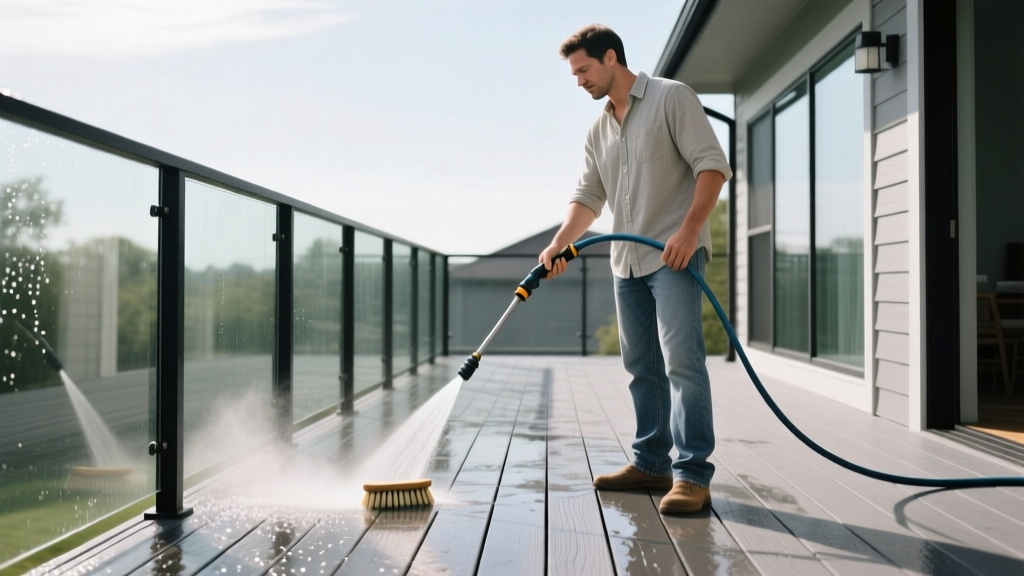
Step-by-Step Cleaning Protocol (DIY)
Follow this exact sequence to clean your deck efficiently while minimizing water usage and protecting the board capping.
- Clear and Dry Sweep (15 Minutes): Remove all furniture, planters, and grill mats. Use a stiff-bristled broom to sweep away loose debris. Pay special attention to the gaps between boards; clogged gaps prevent drainage and cause water to pool, accelerating mold growth on the board edges.
- Pre-Rinse with Garden Hose (10 Minutes): Wet the entire deck surface with a standard garden hose. This prevents the cleaning solution from absorbing too quickly into dry surface dirt and ensures an even application.
- Apply Cleaning Solution (20 Minutes): Using a $15 pump-action garden sprayer, apply your chosen oxygen bleach or soap solution. Work in manageable 10x10 foot sections. Allow the solution to dwell for 10 to 15 minutes, but do not let it dry on the surface. If the sun is beating down, mist the area lightly with water to keep it wet.
- Mechanical Agitation (30 Minutes): Use a soft-bristle deck brush (nylon, never wire or stiff metal) attached to a telescoping pole. Scrub in the direction of the board's embossed wood grain. Scrubbing against the grain can push dirt deeper into the textured grooves of the polymer cap.
- Thorough Rinsing (20 Minutes): Rinse the deck thoroughly with a garden hose. This is the most critical step. Leaving soap or oxygen bleach residue on the deck will result in a hazy, white film once it dries, which is incredibly difficult to remove without a second wash.
Long-Term Lifecycle Cost Context
To understand the true value of composite decking maintenance, compare it to the lifecycle costs of pressure-treated wood. Over a 25-year period, a 500-square-foot pressure-treated wood deck requires sanding and staining every 2 to 3 years. At an average professional cost of $3.50 per square foot, wood maintenance totals roughly $14,500 over 25 years. In contrast, cleaning a composite deck twice a year using DIY oxygen bleach costs approximately $25 per wash, totaling just $1,250 over the same 25-year lifespan. The financial data overwhelmingly supports the initial premium paid for composite materials, provided the homeowner adheres to proper, low-impact cleaning protocols.
Expert Troubleshooting FAQs
How do I remove stubborn rust stains from metal furniture?
Rust stains can penetrate the polymer cap if left untreated. Do not use steel wool or abrasive pads. Instead, apply a commercial rust remover containing oxalic acid (like Bar Keepers Friend Soft Cleanser). Apply a small amount to a microfiber cloth, rub gently in a circular motion, and rinse immediately. Test in an inconspicuous area first, as strong acids can slightly lighten the pigment of darker composite boards.
Can I use ice melt on my composite deck in the winter?
Yes, but with strict limitations. Use a calcium chloride-based ice melt. Avoid rock salt (sodium chloride) or ice melts with added colorants or traction agents (like sand or pumice), which will scratch the capping. The Trex maintenance guide notes that while calcium chloride is safe for the boards, it can leave a white, chalky residue that must be washed away with a garden hose once the ice melts and temperatures rise above freezing.
Why does my deck look chalky and faded after cleaning?
A chalky appearance is usually one of two things: leftover soap residue that was not rinsed properly, or UV degradation from using chlorine bleach. If it is soap residue, a second rinse with a mixture of 1 part white vinegar to 10 parts water will cut the film. If the board has been chemically burned by bleach, the UV inhibitors are gone, and the board will likely need to be replaced.
Written by
James ThorntonJames Thornton is a construction industry veteran with 25 years of hands-on experience in wood framing, lumber grading, and residential building codes. He started as a framing carpenter in rural Oregon, earned his ICC Residential Building Inspector certification, and eventually became a senior plan reviewer for the City of Portland Bureau of Development Services. James holds a B.S. in Wood Science & Technology from Oregon State University and is a certified lumber grader through the West Coast Lumber Inspection Bureau (WCLIB). He has inspected over 3,000 residential construction sites and authored the city's internal guide on advanced framing techniques (2x6 at 24" O.C.). James lives in Bend, OR, where he builds custom timber-frame cabins and competes in lumberjack sports.
More from James Thornton
View all
Insulation
Best Home Insulation Materials: Complete 2026 Guide
Compare top home insulation materials for 2026. Find R-values, installed costs per square foot, and best uses for fiberglass, spray foam, and mineral wool.
Aug 4, 2026

Sustainable Building
Certify Your Green Building Material for LEED and WELL
Step-by-step guide to certifying a green building material for LEED v5 and WELL v2. Master EPDs, HPDs, and VOC limits for 2026 project specifications.
Aug 4, 2026

Stone & Masonry
Veneer Stacked Stone Panels: Interior Design & Style Showcase
Discover how veneer stacked stone panels transform interiors. Explore modern design profiles, material pairings, and technical installation specs.
Aug 4, 2026