How Much Will a Deck Cost to Build? Lifecycle and Maintenance Costs
Discover how much a deck costs to build when factoring in 20-year maintenance. Compare wood, composite, and PVC lifecycle expenses to make the right choice.

The Day-One Illusion: Why Initial Build Quotes Lie
When homeowners research how much will a deck cost to build, they typically focus exclusively on the day-one invoice: materials, labor, and permits. In 2026, a standard 400-square-foot pressure-treated pine deck might cost between $7,200 and $9,600 to construct, while a premium capped composite deck of the same size ranges from $14,000 to $20,000. Looking only at these upfront figures, wood appears to be the undisputed budget champion.
However, this perspective ignores the true financial burden of outdoor living spaces: the lifecycle maintenance cost. A deck is an exposed, horizontal surface subjected to UV degradation, freeze-thaw cycles, and moisture intrusion. According to data from Angi's national cost database, failing to account for ongoing sealing, staining, and structural repairs can double or triple the 20-year cost of a 'budget' wood deck, ultimately making it more expensive than premium alternatives.
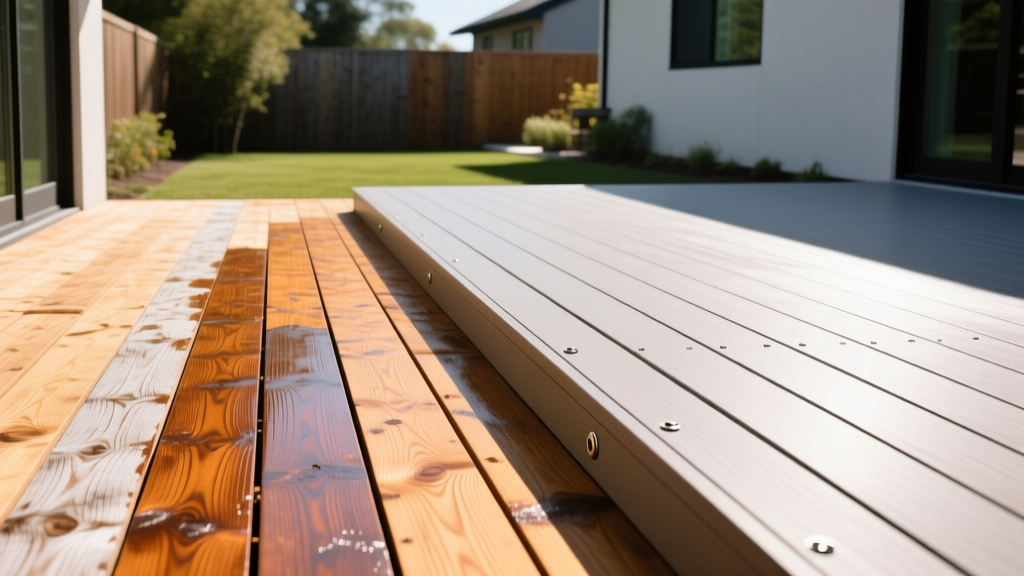
Material Breakdown: Upfront Build Cost vs. 20-Year Maintenance Burden
To understand the true cost of ownership, we must project the expenses over a standard 20-year lifespan. The table below illustrates the financial reality of the three most common decking materials, factoring in 2026 labor rates and material prices.
| Material Type | Upfront Build Cost (per sq. ft.) | 20-Year Maintenance Cost (per sq. ft.) | Total 20-Year Lifecycle Cost |
|---|---|---|---|
| Pressure-Treated Pine | $18 - $24 | $22 - $35 | $40 - $59 |
| Capped Composite | $35 - $50 | $4 - $8 | $39 - $58 |
| Cellular PVC | $45 - $65 | $2 - $5 | $47 - $70 |
Pressure-Treated Pine: The High-Maintenance Budget Trap
Pressure-treated (PT) lumber is injected with chemical preservatives to resist rot and insects, but it offers zero protection against UV rays or moisture absorption. To prevent the wood from graying, checking (splitting), and cupping, it requires rigorous maintenance.
- The Staining Cycle: PT pine must be cleaned and re-stained every 1.5 to 2 years. Using a high-quality penetrating oil like Cabot Australian Timber Oil (approximately $65 per gallon in 2026, covering roughly 300 square feet), a 400 sq. ft. deck requires $90 in materials per application.
- Labor Costs: Professional power washing and staining services average $3.00 to $4.50 per square foot. Over 20 years, you will pay for this service 8 to 10 times, adding $9,600 to $18,000 in labor alone.
- Failure Modes: If maintenance is deferred, water infiltrates the end grains. This leads to structural rot, particularly where deck boards meet the joists, often requiring premature board replacement at $15+ per linear foot.
Capped Composite: The Middle-Ground Sweet Spot
Capped composite boards, such as the Trex Transcend Lineage or TimberTech Prime+ Collections, feature a wood-flour core encased in a protective polymer shell. This shell eliminates the need for sanding and staining entirely.
According to the Trex official care guidelines, maintenance is restricted to seasonal cleaning. A simple wash with mild soap and water using a soft-bristle brush costs virtually nothing in materials and only a few hours of DIY labor per year. However, composite is not invincible. In heavily shaded, damp environments, the wood fibers inside the core can harbor mold if the protective cap is scratched or compromised by improper installation of hidden fasteners.
Cellular PVC: The 'Build and Forget' Premium
Cellular PVC boards like the TimberTech Advanced PVC Landmark Collection contain zero organic wood fibers. This makes them entirely impervious to rot, mold, and insect damage. The upfront cost to build with PVC is the highest, but the maintenance cost approaches absolute zero. The only ongoing expense is an occasional rinse with a garden hose to remove pollen and dirt. For homeowners who view their time as highly valuable, PVC offers the lowest total cost of ownership when factoring in the opportunity cost of weekend labor.
⚠️ The Substructure Trap: Where Budgets Go to Die
When calculating how much a deck will cost to build and maintain, 90% of homeowners forget the substructure. Standard pressure-treated joists and beams have a lifespan of 15 to 20 years. If you install 25-year warranted composite or PVC deck boards on top of standard PT joists, your framing will rot before your deck boards do.
The Fix: Budget an additional $4 to $6 per square foot to apply a butyl-based joist flashing tape (like Trex Protect) to all framing members before laying the boards. For a true lifetime deck, upgrade to light-gauge steel framing (such as Trex Elevations), which adds roughly $10 per square foot to the initial build but guarantees the substructure will outlast the decking.
Calculating Your True Cost of Ownership (Decision Matrix)
Use this practical framework to decide which material aligns with your financial and lifestyle parameters:
- Choose Pressure-Treated Wood IF: Your strict maximum upfront budget is under $20 per square foot, you enjoy DIY weekend projects, and you plan to move out of the home within 5 to 7 years (passing the maintenance burden to the next owner).
- Choose Capped Composite IF: You want a balance of natural wood aesthetics and low maintenance, you have an upfront budget of $35–$50 per square foot, and you plan to stay in the home for 10+ years to recoup the initial premium through saved labor costs.
- Choose Cellular PVC IF: You are building in a high-moisture environment (coastal areas, heavy shade, or near water features), you have zero interest in ever staining a deck, and your upfront budget exceeds $50 per square foot.
Expert Maintenance Schedules to Protect Your Investment
Regardless of the material you choose, adhering to a strict maintenance schedule prevents catastrophic failures. The USDA Forest Products Laboratory emphasizes that moisture management is the primary driver of outdoor wood degradation.
Spring (Moisture & Mold Prevention)
- All Materials: Clear all debris from the gaps between deck boards. Clogged gaps trap water, accelerating rot in wood and causing efflorescence or mold in composites.
- Wood Decks: Perform the 'water drop test.' Splash water on the boards; if it soaks in rather than beading up, the sealant has failed and immediate re-staining is required.
Summer (UV & Thermal Management)
- Composite/PVC: Check for thermal expansion issues. In peak summer heat, composite boards can expand up to 1/8th of an inch per 10 feet. Ensure butt joints are not buckling and that proper gapping was maintained during installation.
- Wood Decks: Inspect for 'cupping' (edges of the board rising higher than the center). This indicates moisture imbalance between the top and bottom of the board and requires immediate sanding and sealing of all six sides of replacement boards.
Autumn (Structural Integrity Check)
- All Materials: Inspect the ledger board where the deck attaches to the house. This is the most common point of catastrophic structural failure. Ensure the flashing is intact and that lag screws are not rusting. If building in a coastal zone, verify that all hardware (joist hangers, nails) is rated for corrosive environments, such as Simpson Strong-Tie ZMAX or stainless steel equivalents.
The Bottom Line
Asking how much a deck will cost to build is only the first step in a complex financial equation. By shifting your focus from the day-one contractor quote to the 20-year lifecycle cost, you can make a mathematically sound decision. While wood offers a low barrier to entry, composite and PVC materials frequently prove to be the more economical choice over the lifespan of the structure, buying back your weekends and protecting your home's exterior envelope from moisture-related decay.
Written by
Sarah WhitfieldSarah Whitfield is a chartered quantity surveyor (MRICS) and construction cost analyst with 15 years of experience in material pricing, procurement strategy, and project budgeting. She earned her degree in Construction Management from the University of Reading (UK) and has worked on projects ranging from $2M custom homes to $180M mixed-use developments across North America and Europe. Sarah currently leads cost estimating for BuildMat Insight, maintaining a proprietary database of 4,000+ material price points updated quarterly. She is a frequent contributor to RSMeans cost data panels and has presented at the International Cost Engineering Council (ICEC) congress. Based in Denver, CO, Sarah is an avid trail runner and volunteer mentor for Women in Construction.
More from Sarah Whitfield
View all
Wood & Lumber
What Are the Different Types of Wood? A Builder's Guide
Compare structural softwoods, finish hardwoods, and engineered lumber. Analyze Janka ratings, MOE values, and 2026 pricing for construction.
Aug 4, 2026

Walls & Panels
Steel Framing vs Wood Framing: Corrosion and Moisture Defense
Compare steel framing vs wood framing for moisture resistance. Learn about galvanized coatings, condensation risks, and corrosion protection strategies.
Jul 21, 2026

Stone & Masonry
How to Cut Stone Veneer: Wet Saw vs Grinder Comparison
Compare the best tools for cutting stone veneer. We review wet saws, angle grinders, and chop saws to help you achieve clean, chip-free cuts.
Jul 21, 2026