10x16 Deck Material List: Maximizing Durability and Lifespan
Build a lasting outdoor space with our durable 10x16 deck material list. Compare framing, composite decking, and hardware for maximum lifespan.

Why a 10x16 Footprint Demands Structural Integrity
A 10x16 deck yields 160 square feet of usable outdoor living space, making it the ideal footprint for a combined dining and lounge area. However, mid-sized decks carry substantial structural loads. According to the International Residential Code (IRC), residential decks must support a minimum live load of 40 pounds per square foot (psf) and a dead load of 10 psf. For a 160-square-foot footprint, your framing and footings must safely distribute a total design load of 8,000 pounds to the soil below.
When prioritizing durability and lifespan, the focus must shift from mere code compliance to long-term material resilience. Wood rot, galvanic corrosion, and UV degradation are the primary enemies of deck longevity. This comprehensive 10x16 deck material list is engineered from the ground up to mitigate these failure modes, ensuring your structure lasts for decades rather than just a few seasons.
The Core 10x16 Deck Material List: Framing and Footings
The substructure dictates the ultimate lifespan of your deck. If the framing fails, the surface decking is irrelevant. For a 10x16 deck, we assume the 16-foot dimension runs parallel to the house ledger board, with 10-foot joists projecting outward. This configuration requires a robust beam system and properly treated lumber.
Lumber Treatment Standards
Not all pressure-treated (PT) lumber is created equal. The American Wood Protection Association (AWPA) categorizes treatment levels based on exposure. For deck framing, you must specify the correct retention levels:
- UC4A (Above Ground): Minimum 0.25 pcf (pounds per cubic foot) preservative retention. Use for joists, beams, and blocking that are elevated and ventilated.
- UC4B (Ground Contact): Minimum 0.40 pcf preservative retention. Mandatory for support posts embedded in concrete or resting on post bases near soil splash zones.
| Component | Material Specification | Quantity (Approx.) | Durability Upgrade |
|---|---|---|---|
| Footings | 12-inch Sonotubes, 3000 PSI concrete | 3 to 4 tubes | Extend 6 inches below local frost line to prevent heaving. |
| Posts | 6x6 PT Southern Yellow Pine (UC4B) | 3 to 4 posts | Use 6x6 instead of 4x4 to resist twisting and notching weakness. |
| Beams | 2x10 PT SYP (3-ply built-up) | One 16-foot beam | Crown all boards upward before nailing to prevent mid-span sagging. |
| Joists | 2x8 PT SYP (UC4A) @ 16" OC | 13 joists (10 ft) | Apply butyl rubber joist tape to all top edges before decking. |
| Blocking | 2x8 PT SYP scraps | 15 linear feet | Install mid-span blocking to prevent joist rotation and bounce. |
Decking Surface: Lifespan vs. Maintenance Matrix
The surface material takes the brunt of environmental abuse. When building a deck meant to last 25+ years, the initial material cost must be weighed against the cumulative cost of maintenance, sealing, and eventual replacement. The American Wood Council's DCA 6 guidelines emphasize proper drainage and ventilation for all decking types, but material choice dictates the maintenance schedule.
| Material Type | Specific Product Example | Expected Lifespan | Maintenance Requirement | Cost per Sq Ft (Materials) |
|---|---|---|---|---|
| Pressure-Treated Pine | Standard #1 Grade SYP | 10 - 15 years | High (Annual cleaning, bi-annual sealing) | $2.50 - $3.50 |
| Capped Composite | Trex Transcend Lineage | 25 - 30 years | Low (Bi-annual soap and water wash) | $9.00 - $11.50 |
| Capped PVC | Azek Landmark Series | 30 - 50+ years | Very Low (Resists staining and mold entirely) | $12.00 - $15.00 |
| Tropical Hardwood | Ipe (Tabebuia) | 40 - 75 years | Medium (UV oil annually to maintain color, else silver patina) | $14.00 - $18.00 |
For maximum durability with minimal upkeep, capped PVC or high-end capped composites are the superior choices. According to the Trex limited warranty documentation, their premium capped boards are protected against fading and staining for 25 years, a benchmark that traditional lumber simply cannot match without rigorous annual intervention.
Fasteners and Hidden Hardware: The Hidden Failure Points
A deck will only last as long as its weakest fastener. Galvanic corrosion occurs when dissimilar metals interact in the presence of an electrolyte (rainwater). The copper-based preservatives used in modern pressure-treated lumber (like ACQ and MCQ) are highly corrosive to standard galvanized steel.
Critical Hardware Warning
Never use standard zinc-plated or hot-dipped galvanized (G90) hardware with modern pressure-treated lumber. You must specify G185 galvanized coating (like Simpson Strong-Tie ZMAX) or Type 304/316 Stainless Steel. If you are building within 10 miles of a saltwater coastline, Type 316 stainless steel is non-negotiable for all joist hangers, structural screws, and post bases. Refer to the Simpson Strong-Tie corrosion guidelines for exact environmental specifications.
Essential Hardware List for 10x16 Deck
- Joist Hangers: 26x LUS28-2Z (2x8 double-shear hangers, ZMAX coated).
- Post Bases: 3x ABA44Z (Adjustable post bases, keeps wood elevated 1 inch above concrete to prevent wicking).
- Beam-to-Post Connectors: 3x BC4Z or structural through-bolts (1/2-inch hot-dipped galvanized).
- Deck Screws: If face-fastening composite, use color-matched stainless steel composite screws (e.g., Cortex hidden fastener system or TrapEase 3). For hardwood, use pre-drilled stainless steel trim-head screws.
- Joist Tape: 2 rolls (approx. 75 ft each) of butyl-rubber joist tape (e.g., Trex Protect or Grace Vycor). Do not use asphalt-based flashing tape, as it dries out, cracks, and loses adhesion after 5-7 years of thermal cycling.
High-Traffic Zones: Railings and Stairs
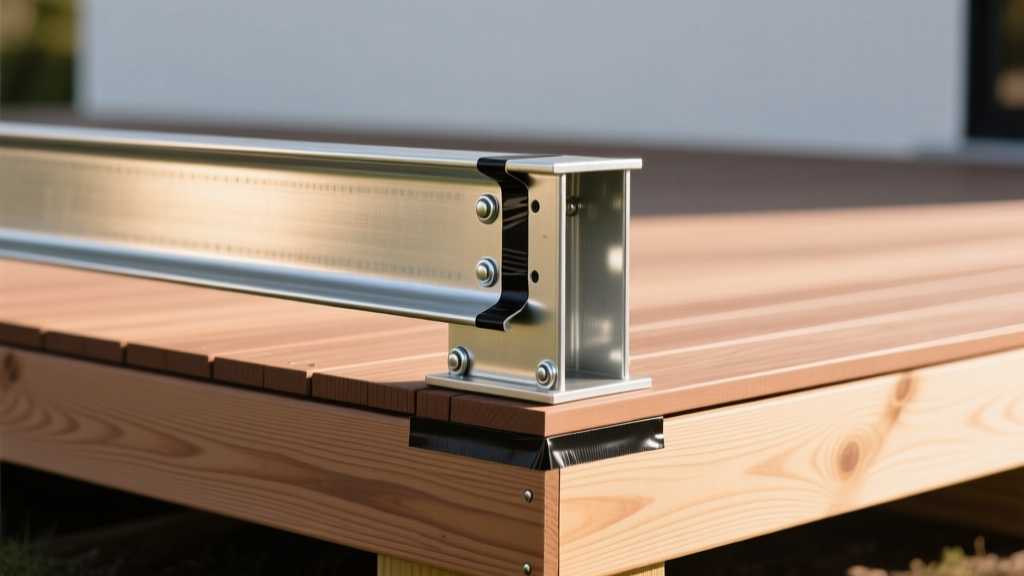
Railings and stairs endure the most physical impact and moisture exposure. Wood railings are notorious for rotting at the base where the post meets the deck surface. To maximize lifespan on a 10x16 deck, transition to non-wood railing systems.
Aluminum Railings: Powder-coated aluminum (such as Trex Signature or Deckorators ALX) offers a 25+ year lifespan with zero risk of rot, splintering, or insect damage. They require only occasional wiping and maintain structural rigidity indefinitely. For a 10x16 deck with one 10-foot stair stringer and railings on three sides (approx. 42 linear feet of railing), budget roughly $60 to $90 per linear foot for premium aluminum systems.
Common 10x16 Deck Construction Mistakes That Shorten Lifespan
Even with premium materials, poor execution will destroy a deck prematurely. Avoid these three critical errors:
1. Exceeding Cantilever Limits
Many builders attempt to cantilever joists past the beam to reduce the number of footings. The IRC limits joist cantilevers to one-quarter of the joist span. For a 10-foot 2x8 joist, the maximum allowable cantilever is 2.5 feet. Exceeding this creates a fulcrum effect that can lift the ledger board off the house during heavy edge loads, leading to catastrophic structural failure and water intrusion behind the home's siding.
2. Improper Ledger Board Flashing
The ledger board is the most common point of deck collapse and home water damage. You must install a continuous piece of Z-flashing or peel-and-stick membrane (like Grace Ice & Water Shield) that tucks up behind the house's weather-resistant barrier (WRB) and laps down over the ledger board. Never rely solely on caulk to seal the top edge of the ledger.
3. Trapping Moisture in Built-Up Beams
When constructing a 3-ply 2x10 beam, moisture can easily become trapped between the plies, accelerating rot from the inside out. To prevent this, apply a bead of exterior-grade polyurethane construction adhesive between each ply before nailing them together, and cap the top of the finished beam with a custom-bent aluminum or PVC coil-stock flashing cap.
Real-World Cost vs. Lifespan ROI
When evaluating the 10x16 deck material list, consider the 25-year total cost of ownership. A pressure-treated wood deck may cost $4,500 in materials initially, but requires $300-$500 annually in sealants, cleaners, and eventual board replacement, pushing the 25-year cost well over $12,000. A capped composite deck requires $10,500 in upfront materials but less than $50 annually in maintenance, resulting in a lower lifetime cost and a significantly higher return on investment when factoring in labor and time.
Written by
Sarah WhitfieldSarah Whitfield is a chartered quantity surveyor (MRICS) and construction cost analyst with 15 years of experience in material pricing, procurement strategy, and project budgeting. She earned her degree in Construction Management from the University of Reading (UK) and has worked on projects ranging from $2M custom homes to $180M mixed-use developments across North America and Europe. Sarah currently leads cost estimating for BuildMat Insight, maintaining a proprietary database of 4,000+ material price points updated quarterly. She is a frequent contributor to RSMeans cost data panels and has presented at the International Cost Engineering Council (ICEC) congress. Based in Denver, CO, Sarah is an avid trail runner and volunteer mentor for Women in Construction.
More from Sarah Whitfield
View all
Wood & Lumber
What Are the Different Types of Wood? A Builder's Guide
Compare structural softwoods, finish hardwoods, and engineered lumber. Analyze Janka ratings, MOE values, and 2026 pricing for construction.
Aug 4, 2026

Walls & Panels
Steel Framing vs Wood Framing: Corrosion and Moisture Defense
Compare steel framing vs wood framing for moisture resistance. Learn about galvanized coatings, condensation risks, and corrosion protection strategies.
Jul 21, 2026

Stone & Masonry
How to Cut Stone Veneer: Wet Saw vs Grinder Comparison
Compare the best tools for cutting stone veneer. We review wet saws, angle grinders, and chop saws to help you achieve clean, chip-free cuts.
Jul 21, 2026