Material Cost to Build a Deck Per Square Foot: 2026 Guide
Calculate the exact material cost to build a deck per square foot in 2026. Deep dive into composite, wood, PVC, framing, and hidden hardware expenses.

Deconstructing the Material Cost to Build a Deck Per Square Foot
When calculating the material cost to build a deck per square foot, homeowners and contractors frequently make a critical estimating error: they only price the surface decking boards. According to industry data from Forbes Home Improvement, surface materials typically account for only 30% to 40% of the total material budget. The remaining 60% is consumed by the substructure, hidden fasteners, railings, and concrete footings.
To provide an accurate installation guide for 2026, we must shift away from the flawed "board-only" metric. This guide breaks down the true, fully-loaded material cost to build a deck per square foot, incorporating structural lumber, premium composites, cellular PVC, and the specialized hardware required to prevent premature structural failure.
Surface Decking Material Costs: Wood vs. Composite vs. PVC
The surface material dictates the baseline cost and the long-term maintenance profile of the outdoor space. Below is the 2026 pricing matrix for surface decking materials alone, followed by the fully-loaded cost (including standard pressure-treated framing and basic hardware).
| Material Category | Brand / Model Example | Surface Board Cost (Per Sq Ft) | Fully-Loaded Material Cost (Per Sq Ft) |
|---|---|---|---|
| Pressure-Treated Pine | #2 Grade SYP (Southern Yellow Pine) | $2.50 - $3.80 | $12.00 - $16.50 |
| Mid-Grade Composite | Trex Select / TimberTech Prime+ | $6.00 - $8.50 | $18.00 - $24.00 |
| Premium Composite | Trex Transcend Lineage | $10.50 - $13.50 | $25.00 - $32.00 |
| Cellular PVC | AZEK Vintage Collection | $12.00 - $16.00 | $28.00 - $38.00 |
| Aluminum | Wahoo Decks / AridDek | $18.00 - $24.00 | $35.00 - $48.00 |
The Composite and PVC Tier Breakdown
When selecting composite or PVC, the Trex Official Product Lines and AZEK catalogs offer distinct performance tiers. Mid-grade composites utilize a higher percentage of recycled wood flour, making them slightly more susceptible to moisture absorption and staining over a 15-year period. Premium lines like Trex Transcend Lineage feature a fully encapsulated polymer shell that resists fading and scratching, justifying the $4.00 to $5.00 per square foot premium.
Cellular PVC (like AZEK Vintage) contains zero wood flour. It is completely impervious to rot and termites, making it the mandatory choice for ground-level decks, dock installations, or high-humidity coastal environments where standard composite core materials might wick moisture from the end-cuts.
The Substructure: Framing Material Cost Per Square Foot
The substructure is the backbone of your deck. A $12.00 per square foot premium PVC surface will be ruined in seven years if the joists beneath it rot. For a standard 16-inch on-center (OC) joist layout, you will need approximately 0.65 linear feet of joist material per square foot of deck space.
- Pressure-Treated SYP Joists: A 2x8x16' #2 Grade PT joist costs roughly $14.00 to $18.00 in 2026. This translates to a framing material cost of $3.00 to $4.50 per square foot.
- Light-Gauge Steel Framing: Systems like Fortress Evolution or Trex Elevate steel framing cost between $8.00 and $12.00 per square foot. While the upfront material cost triples, steel framing eliminates warping, crowning, and shrinking, which is critical when installing rigid PVC or aluminum decking that will not flex to match warped wood joists.
- Beams and Posts: For a multi-level deck or a structure spanning more than 10 feet, you will need 4x6 or 6x6 PT posts and doubled-up 2x10 or 2x12 beams. Add $1.50 to $2.50 per square foot to your framing budget for heavy timber structural supports.
Never skip butyl joist tape. Products like G-Tape or Trex Protect cost approximately $0.60 to $0.85 per square foot of deck area. This tape seals the top of the joists, preventing water infiltration and the freeze-thaw cycle degradation that causes standard PT joists to split and rot prematurely. If you are spending $25+ per square foot on composite surface boards, spending $0.75 to protect the substructure is non-negotiable.
Hardware, Fasteners, and Railing Cost Multipliers
The "per square foot" metric often collapses when railings and specialized fasteners are introduced. Railings are priced per linear foot, not square foot, and heavily skew the final material cost.
Fastener Selection and Hidden Costs
Standard galvanized deck screws cost roughly $0.15 per square foot. However, modern composite and PVC installations require specialized fasteners to maintain warranty compliance and aesthetic integrity:
- Hidden Clip Systems: Trex Hideaway or TimberTech CONCEALoc clips cost $0.90 to $1.40 per square foot. These are mandatory for grooved-edge composite boards.
- Edge Fasteners: The CAMO Edge Deck Fastening System drives screws at a 28-degree angle through the shoulder of the board. The tool costs $60, and the specialized coated screws add $0.65 per square foot.
- Structural Screws: For framing, bypass standard lag bolts. GRK RSS structural screws or Simpson Strong-Drive SDWS screws eliminate the need for pre-drilling and provide superior sheer strength, adding about $0.30 per square foot to the framing budget.
Railing Material Impact
A 320-square-foot deck (16' x 20') with railings on three sides requires 56 linear feet of railing.
- PT Wood Railing with Aluminum Balusters: $25 - $40 per linear foot ($3.50 - $7.00 per deck sq ft).
- Composite Railing (e.g., Trex Signature): $60 - $90 per linear foot ($8.50 - $15.75 per deck sq ft).
- Cable or Glass Railing: $120 - $200+ per linear foot ($17.00 - $35.00+ per deck sq ft).
As demonstrated, upgrading from wood to cable railing on a 320 sq ft deck can add over $5,000 to the material cost, drastically inflating the "per square foot" average.
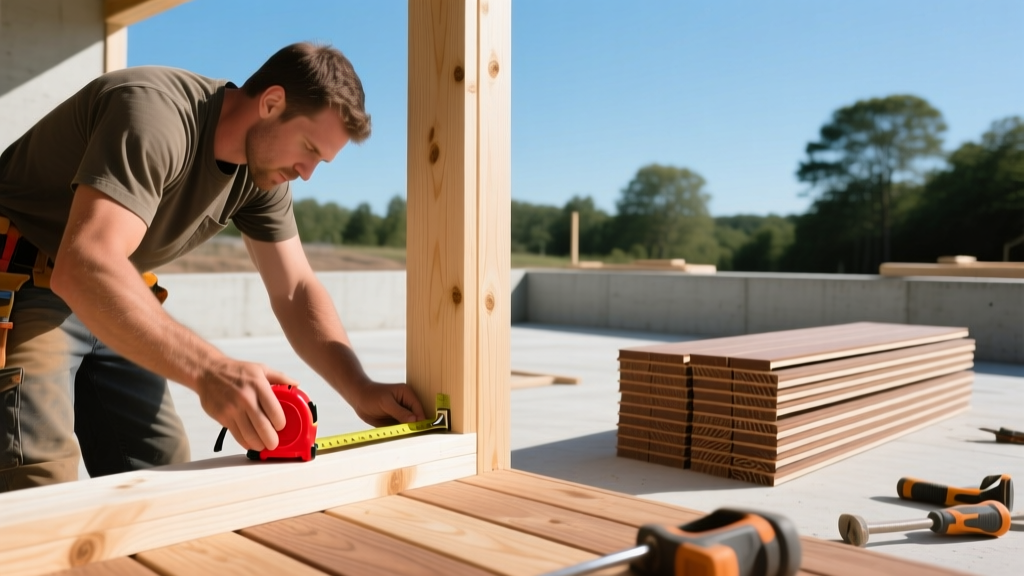
Step-by-Step Material Takeoff Framework (16x20 Deck Example)
To calculate the precise material cost to build a deck per square foot for your specific project, follow this takeoff framework for a standard 320-square-foot rectangular deck.
- Calculate Surface Area and Waste: 16' x 20' = 320 sq ft. Add 10% for off-cuts and waste (Total: 352 sq ft). If using 16' composite boards that cover 0.78 sq ft each (5.5" width + 1/8" gap), you need exactly 452 linear feet of decking, or roughly 29 boards.
- Substructure Takeoff: For 16" OC joists spanning 16 feet, you need 15 joists. Purchase 15 2x8x16' PT lumber boards. Add 2 2x10x16' boards for the ledger and rim joists.
- Hardware and Tape: Calculate 15 joists x 16 feet = 240 linear feet of joist tape. Purchase five 50-foot rolls of butyl tape. Order one box of 500 hidden composite clips (covers up to 500 sq ft).
- Concrete Footings: A 320 sq ft deck typically requires 6 to 8 footings. At 1.5 bags of 80lb Quikrete per sonotube, budget for 12 bags of concrete and 8 PT 6x6 posts.
- Aggregate the Costs: Sum the surface boards, framing lumber, concrete, hardware, tape, and railings. Divide the final sum by 320 (the actual livable square footage, not the wasted material square footage) to find your true material cost per square foot.
Installation Edge Cases and Material Failure Modes
Understanding material costs requires understanding how materials fail when installed incorrectly. Budgeting for the right materials prevents catastrophic failure modes.
Thermal Expansion in PVC and Composite
Unlike wood, composite and PVC expand and contract significantly along their length based on temperature. AZEK PVC, for instance, requires a 1/8-inch gap for every 10-degree Fahrenheit drop below the maximum expected temperature. If you install a 16-foot PVC board tightly against a fascia board on a 90°F summer morning, the board will buckle and warp when the temperature drops to 30°F in the winter. Always purchase color-matched PVC shims or specialized expansion gap spacers to ensure uniform gapping during installation.
The "Mushrooming" Effect on Face-Screwed Composites
If you choose to face-screw mid-grade composite boards to save money on hidden fasteners, you must use composite-specific screws (like the Cortex system) that include a countersink tool and color-matched plugs. Standard wood screws will cause "mushrooming"—where the compressed composite material pushes up around the screw head, creating a permanent, unsightly bump that traps water and accelerates localized degradation.
End-Cut Sealing on Wood-Composite Blends
While fully encapsulated composites and cellular PVC do not require end-sealing, mid-grade composites with exposed wood-flour cores at the cut ends act like straws, wicking moisture directly into the board's core. Always budget $25 for a can of clear end-sealant (like Trex End Sealer) and apply it to every rip-cut or cross-cut during installation. Failing to do so will result in edge-swelling and void the manufacturer's 25-year warranty.
Written by
James ThorntonJames Thornton is a construction industry veteran with 25 years of hands-on experience in wood framing, lumber grading, and residential building codes. He started as a framing carpenter in rural Oregon, earned his ICC Residential Building Inspector certification, and eventually became a senior plan reviewer for the City of Portland Bureau of Development Services. James holds a B.S. in Wood Science & Technology from Oregon State University and is a certified lumber grader through the West Coast Lumber Inspection Bureau (WCLIB). He has inspected over 3,000 residential construction sites and authored the city's internal guide on advanced framing techniques (2x6 at 24" O.C.). James lives in Bend, OR, where he builds custom timber-frame cabins and competes in lumberjack sports.
More from James Thornton
View all
Insulation
Best Home Insulation Materials: Complete 2026 Guide
Compare top home insulation materials for 2026. Find R-values, installed costs per square foot, and best uses for fiberglass, spray foam, and mineral wool.
Aug 4, 2026

Sustainable Building
Certify Your Green Building Material for LEED and WELL
Step-by-step guide to certifying a green building material for LEED v5 and WELL v2. Master EPDs, HPDs, and VOC limits for 2026 project specifications.
Aug 4, 2026

Stone & Masonry
Veneer Stacked Stone Panels: Interior Design & Style Showcase
Discover how veneer stacked stone panels transform interiors. Explore modern design profiles, material pairings, and technical installation specs.
Aug 4, 2026