Material Deck Comparison: Wood vs Composite in 2026
Compare top material deck options for 2026. We analyze pressure-treated wood, ipe, capped composite, PVC, and aluminum with exact costs and specs.

The 2026 Decking Material Matrix
Selecting the right material deck surface requires balancing upfront capital expenditure against long-term maintenance, thermal performance, and structural limitations. The market has bifurcated into natural organics and engineered polymers, each with distinct failure modes. Below is the current benchmark matrix for material-only costs and performance metrics.
| Material Type | Avg Material Cost (2026) | Expected Lifespan | Janka Hardness / Density | Maintenance Cycle | Thermal Expansion Rate |
|---|---|---|---|---|---|
| Pressure-Treated Pine (SYP) | $3.50 - $5.00 / sq ft | 15 - 20 Years | 870 lbf | Annual sealing | Low (swells/shrinks with moisture) |
| Tropical Hardwood (Ipe) | $12.00 - $16.00 / sq ft | 40+ Years | 3,684 lbf | Biennial UV oil (optional) | Very Low |
| Capped Composite (PE Core) | $8.50 - $12.50 / sq ft | 25 - 30 Years | N/A (Flexural strength dependent) | None (wash only) | Moderate (requires 1/8" gaps) |
| Advanced PVC (Cellular) | $11.00 - $15.00 / sq ft | 30 - 50 Years | N/A | None | High (requires 1/8" per 10°F) |
| Extruded Aluminum | $15.00 - $22.00 / sq ft | Lifetime | N/A (Structural rigidity) | None | Negligible |
Natural Wood: Pressure-Treated Pine vs. Tropical Hardwoods
Wood remains the baseline for deck construction, but the chemical preservation and species selection have evolved significantly. Standard Southern Yellow Pine (SYP) is no longer treated with Chromated Copper Arsenate (CCA) or Alkaline Copper Quaternary (ACQ) for residential use. Modern SYP utilizes Micronized Copper Azole (MCA) or Copper Azole Type C (CA-C). According to the American Wood Protection Association (AWPA), MCA provides robust decay resistance while being significantly less corrosive to standard galvanized fasteners than older ACQ formulations.
The Ipe Alternative: Density and Fastener Corrosion
Tropical hardwoods like Ipe (Tabebuia serratifolia) offer unparalleled surface hardness. With a Janka rating of 3,684 lbf, Ipe resists scratching and denting far better than composite alternatives. However, its density (roughly 69 lbs/ft³) and high tannic acid content dictate strict installation protocols:
- Pre-drilling is mandatory: Standard deck screws will snap under the torque required to drive them into Ipe.
- Fastener composition: You must use Type 305 or 316 stainless steel screws. Standard galvanized or polymer-coated screws will corrode within 3 to 5 years due to the wood's natural acidity.
- End-grain sealing: Ipe will check (split) at the cut ends as it acclimates. Applying a wax-based end sealer (like Anchorseal) immediately after cutting is non-negotiable to prevent moisture intrusion.
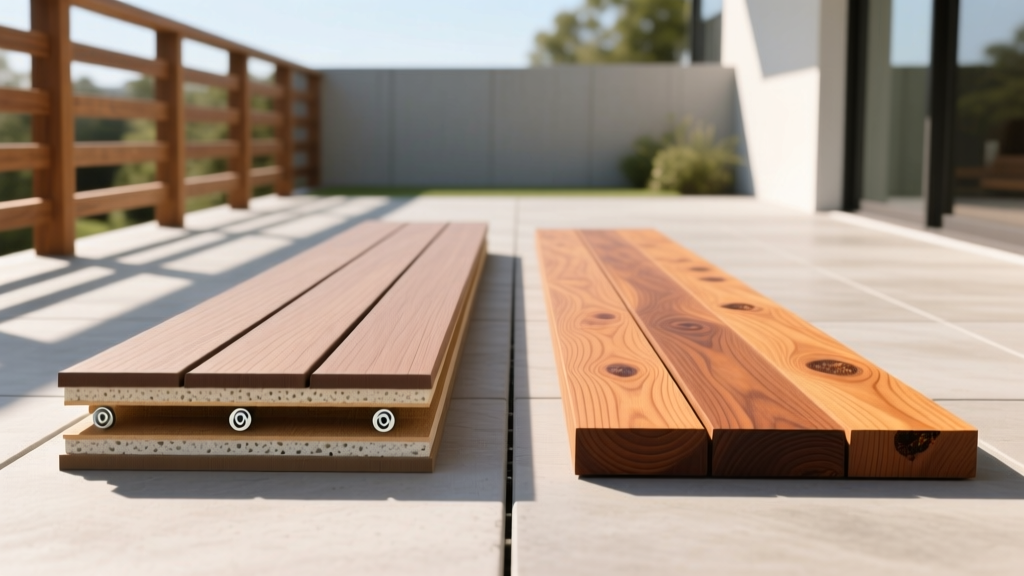
Capped Composite vs. Advanced PVC: The Polymer Battle
The engineered decking sector is dominated by two distinct chemistries: wood-plastic composites (WPC) and cellular polyvinyl chloride (PVC). Understanding the core composition is critical for predicting long-term performance.
Capped Composite (WPC)
Modern composites feature a wood-flour and high-density polyethylene (HDPE) core encapsulated by a polypropylene or polyethylene cap. Premium lines, such as Trex Transcend Lineage, utilize advanced heat-mitigating technology in the cap layer to reflect solar radiation. Failure Mode: The primary vulnerability of WPC is moisture intrusion at the cut ends. While the cap is impervious, the exposed core can absorb water if not properly sealed or if the hidden fastener system cuts too deeply into the board edge, compromising the cap's seal.
Advanced Cellular PVC
PVC decking (e.g., TimberTech Advanced PVC, Wolf Serenity) contains no organic wood fibers. This makes it entirely immune to rot, mold, and moisture absorption. Failure Mode: Thermal expansion. PVC has a high Coefficient of Linear Thermal Expansion (CLTE). A 20-foot PVC board can expand or contract up to 1/2 inch across a 100°F temperature swing. Installers must leave strict 1/8-inch gaps for every 10°F of temperature difference between the installation day and the historical maximum temperature of the region.
Heat Retention and Solar Reflectance Index (SRI)
A major historical complaint regarding polymer decking is surface heat. In direct 95°F sunlight, early-generation dark composites routinely exceeded 140°F, making them unwalkable barefoot. Material science has addressed this via Solar Reflectance Index (SRI) optimization.
Aluminum Decking: The Niche Fire-Rated Alternative
For homes located in Wildland-Urban Interface (WUI) zones, or for commercial applications requiring non-combustible materials, extruded aluminum is the only viable deck surface. Systems like Wahoo Decks or LockDry feature interlocking profiles that create a watertight, dry-under-deck environment without the need for secondary membrane systems.
- Fire Rating: Aluminum decking inherently meets ASTM E84 Class A surface burning characteristics, making it compliant in strict California WUI building codes.
- Coating Standards: Ensure the aluminum is powder-coated to AAMA 2604 specifications, which guarantees superior resistance to UV fading and chalking compared to standard liquid paints.
- Acoustics: Aluminum can be noisy during heavy rain. Premium systems incorporate rubberized acoustic dampening strips within the interlocking joints to mitigate the "pinging" sound.
Substructure Compatibility and Hidden Fasteners
The material deck surface you choose directly dictates the required substructure framing and fastening methodology. Ignoring these dependencies is the leading cause of premature deck failure.
Joist Spacing Requirements
- 5/4x6 Pressure-Treated Wood: 16 inches on-center (OC) maximum for perpendicular layouts; 12 inches OC for diagonal.
- Capped Composite: Strictly 16 inches OC maximum. Composite lacks the tensile rigidity of solid wood and will sag over time if placed on 24-inch OC framing.
- PVC and Aluminum: Many structural PVC and aluminum profiles are engineered to span 24 inches OC, but 16 inches OC is highly recommended to prevent a "bouncy" feel under dynamic foot traffic.
Joist Tape and Moisture Management
Regardless of the decking material, the top of your wooden joists must be protected. Asphalt-based flashing tapes degrade under UV exposure and can melt in high heat, compromising the adhesion. Always specify butyl-based joist tape. Butyl remains pliable across extreme temperature ranges, self-seals around fastener penetrations, and prevents the wood-to-deck interface from trapping moisture, which is the primary catalyst for joist rot.
Written by
Elena RodriguezElena Rodriguez is a civil engineer and technical writer specializing in concrete technology, masonry systems, and ASTM/ACI compliance. She earned her B.S. in Civil Engineering from Texas A&M University and spent a decade at a materials testing laboratory, performing over 2,000 concrete compressive strength tests and masonry prism evaluations. Elena is an ACI-certified Field Testing Technician (Grade I) and a member of ASTM Committee C12 on Natural Building Stone. She currently consults on forensic engineering cases involving concrete failures and moisture intrusion. Based in San Antonio, TX, Elena is a proud member of the Society of Women Engineers (SWE) and coaches her daughter's FIRST Robotics team.
More from Elena Rodriguez
View all
Walls & Panels
Cost Analysis: Light Gauge Steel Framing Advantages and Disadvantages
Evaluate light gauge steel framing advantages and disadvantages through a strict cost analysis lens, comparing material, labor, and lifecycle expenses.
Aug 4, 2026

Walls & Panels
Gypsum Board Types: Exact Specifications, Thickness & Dimensions
Compare standard, Type X, and moisture-resistant gypsum board types. Get exact specifications, thicknesses, dimensions, and ASTM standards for your project.
Aug 4, 2026

Fire Resistance
Best Fire-Resistant Outdoor Decking Materials: 2026 Buyer Guide
Discover the best fire-resistant outdoor decking materials for 2026. Compare Class A PVC, aluminum, and hardwood options for WUI compliance and safety.
Aug 4, 2026