The Real Cost to Build a Deck Yourself: A DIY Installation Guide
Discover the true cost to build a deck yourself. This DIY installation guide breaks down material prices, hidden tool fees, and framing mistakes.
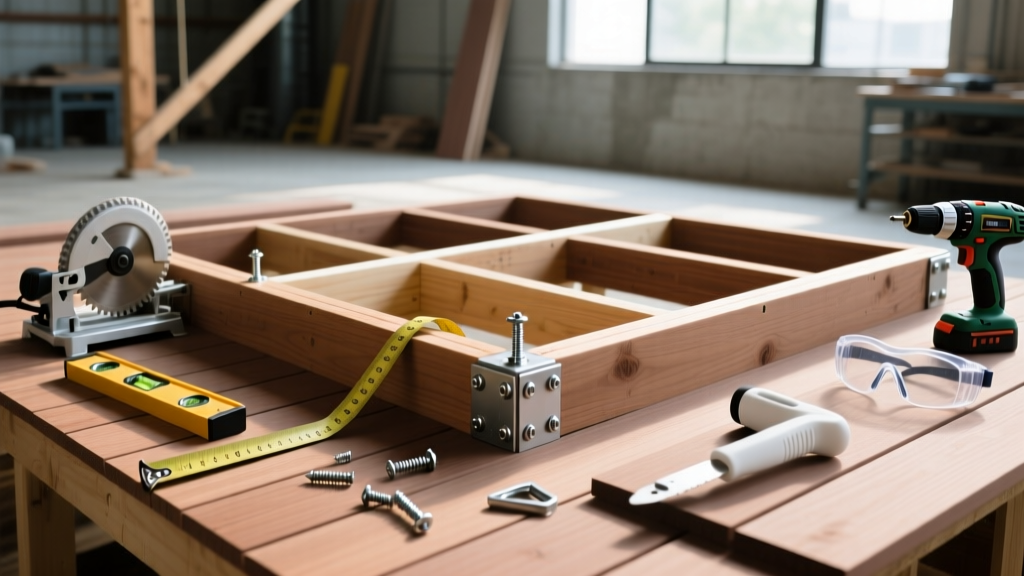
The Financial Reality: Calculating the Cost to Build a Deck Yourself
Calculating the true cost to build a deck yourself requires looking beyond the price tag of lumber and composite boards. While hiring a professional contractor typically costs between $40 and $75 per square foot, a DIY approach reduces the direct financial outlay to $15 to $35 per square foot. However, the gap between professional quotes and DIY material receipts is often filled with hidden expenses: specialized tool rentals, permit fees, structural fasteners, and the financial impact of installation errors.
For a standard 12x16-foot (192 square foot) ground-level or low-elevation deck, the baseline material cost ranges from $3,200 for pressure-treated pine to $7,500 for premium PVC decking. This guide deconstructs the installation process phase-by-phase, providing exact material costs, structural requirements, and the failure modes that inflate DIY budgets.
- Professional Installation: $7,680 – $14,400
- DIY Material Cost (Pressure-Treated Wood): $3,200 – $4,100
- DIY Material Cost (Mid-Grade Composite): $5,500 – $6,800
- Hidden DIY Costs (Permits, Tools, Waste): $450 – $850
Phase-by-Phase Installation Costs and Material Breakdown
Phase 1: Site Preparation and Footings
The foundation dictates the lifespan of your deck. According to the American Wood Council’s DCA-6 guidelines, footings must extend below the local frost line to prevent frost heave. For a 12x16 deck, you will typically need six to eight footings.
- Sonotubes (10-inch diameter): $14 to $18 each.
- Concrete (80-lb bags of Sakrete or Quikrete): $6.50 per bag. A 10-inch tube buried 36 inches deep requires roughly 2.5 bags ($16.25 per hole).
- Post Bases (Simpson Strong-Tie ZMAX EPB44): $18 to $22 each. Never embed pressure-treated posts directly in concrete; the moisture trap accelerates rot at the end-grain.
- Excavation Tool Rental: A manual post hole digger is free but labor-intensive. A two-man gas auger rents for $75 to $95 per day. If you hit bedrock or heavy clay, budget an extra $150 for a rock bit or manual rock bar.
Phase 2: Ledger Board and Framing
If your deck attaches to the house, the ledger board is the most critical structural and waterproofing component. The International Residential Code (IRC Section R507) strictly prohibits attaching ledger boards to house rim joists with nails alone; structural screws or through-bolts are mandatory.
- Lumber (2x10 Pressure-Treated): $14 to $18 per 16-foot board.
- Structural Screws (Simpson Strong-Tie SDWS 3-inch): $0.45 per screw. Code typically requires these spaced every 16 inches in a staggered pattern.
- Z-Flashing (Galvanized Steel): $3.50 per linear foot. This must slip behind the house siding and over the ledger board to prevent water intrusion.
- Joist Hangers (Simpson LUS28 for 2x8s): $1.15 each. You will need two per joist (one at the ledger, one at the beam).
- Joist Hanger Nails (1.5-inch galvanized): $8 per box. Alternatively, structural connector screws (SD #9 x 1.5") cost about $0.12 each but eliminate the need for a pneumatic nailer.
Phase 3: Decking Boards and Fasteners
The visible surface represents the largest variable in your budget. When calculating board footage, always add a 10% waste factor for wood (due to grain defects and cuts) and a 5% waste factor for composite.
| Material Type | Cost Per Sq. Ft. | Fastener Cost | Max Joist Spacing (Straight) |
|---|---|---|---|
| 5/4x6 Pressure-Treated Pine | $2.20 - $2.80 | $0.08/sq ft (Deck Screws) | 16" On-Center |
| Capped Composite (e.g., Trex Select) | $7.50 - $9.50 | $1.20/sq ft (Hidden Clips) | 16" On-Center |
| Advanced PVC (e.g., TimberTech Landmark) | $11.00 - $14.00 | $1.50/sq ft (Hidden Clips) | 16" On-Center |
The "Hidden" DIY Costs Most Guides Ignore
Budgeting solely for lumber and concrete guarantees a mid-project financial shortfall. Factor these mandatory auxiliary costs into your spreadsheet before purchasing materials:
- Building Permits: $150 to $450 depending on your municipality. Skipping this risks a stop-work order and forced demolition.
- Material Delivery Fees: Lumber yards charge $75 to $150 for flatbed delivery. Composite materials often ship on pallets requiring a forklift or manual offloading.
- Flashing Tape: Products like Trex Protect or Grace Deck Protector cost $0.60 per linear foot. Applying this over every joist and the ledger board prevents moisture accumulation and doubles the life of your framing.
- Composite Expansion Gaps: If building with composite, you must purchase specific start/stop clips ($1.50 each) and color-matched fascia screws ($0.25 each) for perimeter picture-framing.
Code Warning: Never attach a deck ledger board to a brick veneer or stucco wall. These are non-structural claddings. The Trex Installation Guide and IRC codes mandate that structural loads must transfer directly to the house's solid wood or concrete foundation framing using specialized masonry anchors or freestanding post configurations.
Common DIY Installation Mistakes That Destroy Your Budget
The true cost to build a deck yourself spikes when installation errors require tearing out completed work. Avoid these three high-frequency DIY failure modes:
1. Incorrect Joist Spacing for Composite Decking
Pressure-treated wood decking is rigid enough to span 16 inches on-center (OC). However, many composite brands require 12-inch OC spacing if you plan to lay the boards on a diagonal (45-degree angle). If you frame your deck at 16-inch OC and later decide on a diagonal composite layout, the boards will sag and fail inspection. The Fix: Adding sister joists to an existing frame costs an additional $3.50 per linear foot in lumber and doubles your framing labor.
2. Ledger Board Water Intrusion
Failing to install Z-flashing behind the house siding allows rainwater to funnel directly into the end-grain of your ledger board and the house's rim joist. Within 3 to 5 years, this causes severe structural rot. The Fix: Replacing a rotted house rim joist requires jacking up the house, removing interior drywall, and replacing structural framing—a repair that routinely exceeds $5,000.
3. Undersized Concrete Footings
Pouring 8-inch diameter footings in expansive clay soil or areas with high water tables leads to differential settling. When one corner of the deck sinks, the decking boards buckle and the stairs pull away from the stringers. The Fix: Always calculate the tributary load. A standard deck requires footings with a minimum bearing area of 1.5 to 2 square feet, meaning a 16-inch or 18-inch diameter bell-bottom hole is often required by local inspectors, not a standard 10-inch tube.
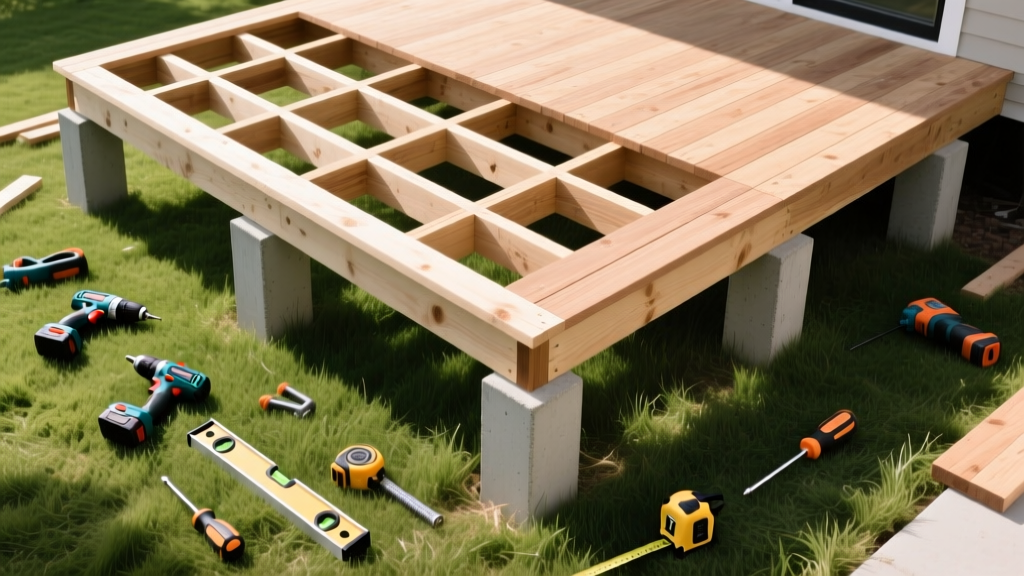
Decision Framework: Should You DIY the Entire Build?
Use this matrix to determine which phases of the build you should tackle yourself and where you should hire a specialist:
Safe to DIY (High Savings)
- Digging post holes and pouring concrete footings.
- Cutting and installing pressure-treated framing and joists.
- Laying straight-pattern decking boards.
- Building standard wood stair stringers.
Consider Hiring Out (High Risk)
- Attaching ledger boards to masonry or complex siding.
- Bending composite fascia for curved deck perimeters.
- Installing glass or cable railings (tensioning errors are common).
- Electrical wiring for low-voltage deck lighting (requires code compliance).
Sourcing Materials and Pro-Tips for Maximizing Your Budget
To keep the cost to build a deck yourself as low as possible without sacrificing structural integrity, optimize how and where you source materials. Avoid big-box home improvement stores for your primary framing lumber; their pressure-treated stock is often stored outdoors and warped, leading to a 15% rejection rate at the register. Instead, open a cash account at a local commercial lumber yard. They store framing lumber indoors, offer volume discounts on joist hangers and structural screws, and provide free cut-lists based on your approved permit plans.
Finally, rent a powder-actuated tool ($40/day) if you are attaching framing to a concrete foundation or retaining wall. Attempting to drill and anchor concrete with a standard hammer drill and wedge anchors will add hours of labor and frequently results in cracked concrete or spinning anchors, compromising the lateral load resistance of your structure.
Written by
Marcus ChenMarcus Chen is a licensed structural engineer (PE) and building materials analyst with over 12 years of experience across residential, commercial, and industrial construction. He holds a Master of Science in Civil Engineering from UC Berkeley and spent six years at Thornton Tomasetti before transitioning to independent consulting and technical writing. Marcus specializes in material selection for seismic-prone regions, concrete reinforcement strategies, and lifecycle cost analysis. His work has been cited by the American Concrete Institute (ACI) and the Structural Engineers Association of California (SEAOC). When he is not on a job site or at his desk, you will find him hiking the Sierra Nevada or restoring a 1920s craftsman bungalow in Oakland, CA.
More from Marcus Chen
View all
Construction Cost
How Much Did the Eiffel Tower Cost to Build?
How much did the Eiffel Tower cost to build in 1889? We adjust for inflation and compare its budget to modern skyscraper construction.
Aug 4, 2026

Fire Resistance
What Is a Fire Resistant Material? Testing & Certification Guide
Discover what is a fire resistant material through ASTM and UL testing. Learn how fire ratings, certifications, and assemblies work in construction.
Aug 4, 2026

Construction Cost
How Much Did the Burj Khalifa Cost to Build?
How much did the Burj Khalifa cost to build? We break down the $1.5B project and extract 5 money-saving strategies for your next build.
Jul 30, 2026