Best Deck Material Plymouth MA: 2026 Climate & Cost Guide
Discover the best deck material for Plymouth, MA homes. Compare PVC, composite, and wood costs, coastal building codes, and 2026 pricing for your project.
The Plymouth Microclimate: Why Standard Decking Fails
Building a deck in Plymouth, Massachusetts, means battling a punishing coastal microclimate. Situated on the western shore of Cape Cod Bay, Plymouth properties endure an average of 60 freeze-thaw cycles annually, driving Nor'easters that deposit heavy salt aerosols, and summer humidity that regularly exceeds 80%. These conditions rapidly destroy traditional pressure-treated lumber and uncapped composites through moisture intrusion, UV degradation, and galvanic corrosion.
When evaluating deck material Plymouth homeowners must prioritize dimensional stability, salt-air resistance, and minimal thermal expansion. A material that performs perfectly in a dry, inland climate like Arizona will likely cup, stain, or delaminate within three years in Plymouth's coastal environment. This guide breaks down the exact material specifications, structural framing requirements, and 2026 local costs necessary to build a deck that survives the New England coast.
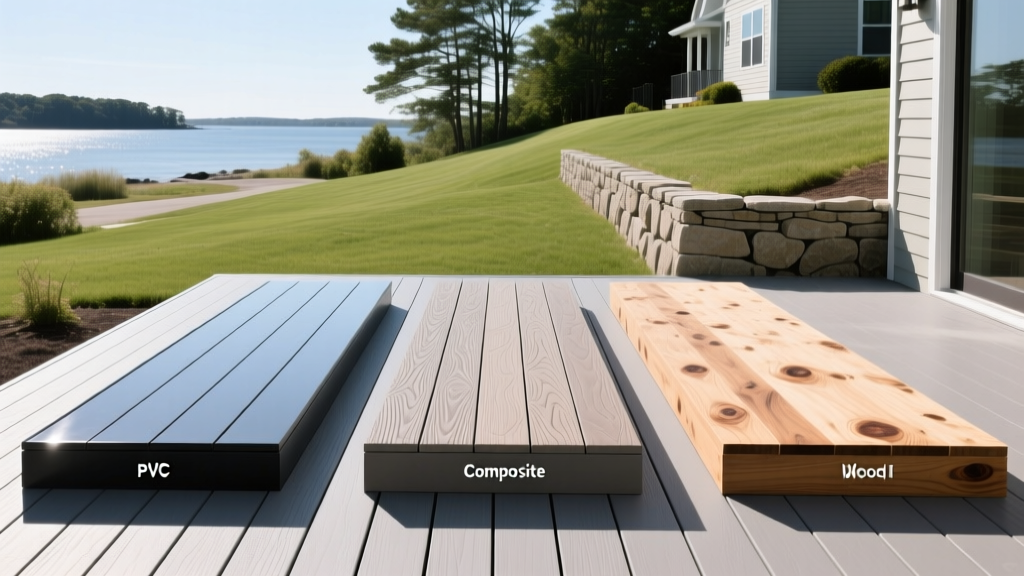
Material Showdown: What Survives Cape Cod Bay?
The market offers dozens of decking lines, but only a fraction meet the rigorous demands of coastal Massachusetts. Below is a comparison of the top three viable material categories for Plymouth properties in 2026.
| Material Category | Top 2026 Product Line | Moisture Resistance | Material Cost (per sq. ft.) |
|---|---|---|---|
| Advanced PVC | TimberTech Landmark Collection | Superior (100% Synthetic) | $14.50 - $18.00 |
| Capped Composite | Trex Transcend Lineage | High (Polymer Shell) | $11.00 - $15.00 |
| Tropical Hardwood | Premium Ipe (Tabebuia) | Moderate (Requires Oiling) | $18.00 - $24.00 |
1. Advanced PVC (The Coastal Champion)
For homes within a half-mile of Plymouth Harbor or Long Beach, Advanced PVC is the undisputed best deck material. Unlike composites, which contain wood fibers encased in plastic, PVC is 100% synthetic. This means zero organic material is present to absorb ambient moisture, harbor mold spores, or swell during Plymouth's humid July weeks. The TimberTech Advanced PVC Landmark Collection features a proprietary polymer blend that resists salt-air degradation and offers superior slip resistance when wet—a critical safety factor for coastal fog and sea spray.
Edge Case: PVC expands and contracts more than composite with temperature swings. Installers must strictly follow the manufacturer's gapping guidelines, leaving a minimum 3/16-inch gap at end joints when installing during Plymouth's cold spring months (April/May) to prevent buckling in August.
2. Capped Polymer-Composite (The Balanced Alternative)
If PVC's synthetic feel is a dealbreaker, high-end capped composites like Trex Transcend Lineage offer a wood-grain aesthetic with robust protection. The key is the "cap." Budget composites only cap the top surface, leaving the bottom and grooved edges exposed to absorb ground-level moisture. Transcend Lineage features a 3-sided protective shell that blocks moisture intrusion. While highly resistant to the elements, composite decking can retain heat in direct, unshaded southern exposures. If your Plymouth property lacks mature tree canopy, opt for lighter colorways like Biscayne or Jasper to mitigate thermal expansion and barefoot burn.
The Hidden Vulnerabilities: Framing and Fasteners
Homeowners often spend $15,000 on premium PVC decking, only to mount it on standard pressure-treated joists using coated deck screws. In a coastal environment, the substructure will rot and rust long before the deck boards fail. According to the American Wood Council's DCA-6 guide, proper structural connections are paramount for life-safety and longevity.
- Joist Tape is Mandatory: Apply a high-quality butyl flashing tape (e.g., Trex Protect or G-Tape) to the top of every pressure-treated joist. This prevents water from pooling between the joist and the deck board, stopping rot and preventing the joist from acting as a moisture wick into the composite.
- Fastener Upgrades: Discard standard ceramic-coated screws. The salt aerosols in Plymouth will cause them to bleed rust stains onto your expensive decking within one winter. Use 316-grade stainless steel screws (such as Simpson Strong-Tie or FastenMaster Cortex 316 SS). Note: 304-grade stainless is insufficient for direct coastal exposure.
- Hardware Connectors: For joist hangers and post bases, use Simpson Strong-Tie ZMAX (G185 hot-dipped galvanized) or stainless steel equivalents. Standard G90 galvanized hardware will corrode rapidly when in contact with the copper-based preservatives (MCQ or ACQ) used in modern pressure-treated lumber.
Footings and Soil: Navigating Plymouth's Frost Line
Plymouth's soil composition varies wildly from dense glacial till inland to sandy, poorly-drained loam near the coast. Furthermore, the Massachusetts State Building Code (780 CMR) mandates a minimum footing depth of 48 inches below grade to bypass the frost line. If footings are poured too shallow, winter frost heave will lift the deck posts, causing severe structural racking and snapping railings.
2026 Plymouth Permitting & Conservation Setbacks
Before purchasing materials, verify your lot's zoning constraints. Plymouth has extensive wetlands, vernal pools, and coastal dune systems regulated by the local Conservation Commission under the Massachusetts Wetlands Protection Act. If your proposed deck falls within 100 feet of a wetland or 50 feet of a coastal bank, you will need to file a Notice of Intent (NOI) and may be restricted to specific permeable decking materials or elevated structural designs to prevent shading native vegetation or altering drainage. Always consult the Massachusetts State Building Code portal and your local building inspector before finalizing your framing plan.
Complete Cost Breakdown: 400 Sq. Ft. Coastal Deck
Below is a realistic 2026 cost estimate for a 16x25 (400 sq. ft.) elevated deck in Plymouth, utilizing Advanced PVC decking, 316 stainless steel hidden fasteners, and helical pier footings. Labor rates reflect current Southeastern Massachusetts prevailing wages.
| Project Phase | Material / Service | Estimated Cost |
|---|---|---|
| Substructure | PT Lumber, Joist Tape, ZMAX Hardware | $4,800 |
| Footings | 12x Helical Piers (Installed) | $3,600 |
| Decking | Advanced PVC (400 sq ft + 10% waste) | $6,600 |
| Fasteners | 316 SS Hidden Clips & Cortex Plugs | $850 |
| Railing | Aluminum/Glass (60 linear ft) | $4,500 |
| Labor & Permits | Professional Installation & Town Fees | $9,500 |
| Total Estimated Project Cost | $29,850 | |
Expert Verdict: What Should You Buy?
For Plymouth homeowners seeking a zero-maintenance, weather-proof outdoor space, Advanced PVC (TimberTech Landmark) is the optimal investment. The premium upfront cost is entirely offset by the elimination of annual sanding, staining, and the inevitable structural repairs caused by moisture intrusion. If budget constraints require a pivot, Trex Transcend Lineage provides excellent protection, provided you strictly enforce the use of butyl joist tape and 316 stainless steel fasteners. Never compromise on the substructure; in coastal Massachusetts, the skeleton of your deck is just as critical as the skin.
For further reading on structural safety and railing codes, consult the North American Deck and Railing Association (NADRA) code resources to ensure your build meets all national and local safety standards.
Written by
Priya KapoorPriya Kapoor is a real estate market analyst and construction economics researcher with expertise in housing affordability, development feasibility, and infrastructure investment. She holds a Master of Regional Planning from Cornell University and previously worked as a senior analyst at CBRE's Investment Properties group, where she modeled returns for $4B in mixed-use development pipelines. Priya now runs an independent research practice advising developers, municipalities, and REITs on construction cost forecasting and market timing. She publishes the quarterly "BuildMat Market Pulse" report tracking material price indices across 12 commodity categories. Based in Austin, TX, Priya serves on the board of Habitat for Humanity Austin and is a marathon runner.
More from Priya Kapoor
View all
Construction Cost
Cost to Build a 1600 Sq Ft Home in 2026: Full Breakdown
Accurate 2026 cost to build a 1600 sq ft home—material, labor, and regional pricing breakdowns included. Plan your budget with real-time estimates.
Aug 11, 2026

Wood & Lumber
Name the Types of Wood for Pressure Treatment and Preservation
Learn how to name the types of wood best suited for pressure treatment. Compare species treatability, chemical retention levels, and 2026 preservation costs.
Aug 4, 2026

Stone & Masonry
Stone Veneer Suppliers Lindenhurst: 2026 Cost Analysis
Analyze 2026 stone veneer costs in Lindenhurst, NY. Compare local supplier pricing, delivery fees, and Suffolk County installation labor rates.
Aug 4, 2026