Cost to Build a Small Deck: 2026 Installation Breakdown
Discover the true cost to build a small deck in 2026. This installation guide breaks down material prices, labor, and hidden expenses for 100 sq ft builds.

Defining the Baseline: The 10x10 Foot Model
When contractors and homeowners discuss a 'small deck,' they are typically referring to a footprint between 80 and 120 square feet. For the purpose of this 2026 installation and cost guide, we will use a 10x10-foot (100 sq ft) attached deck as our baseline model. This size is large enough to accommodate a standard dining set but small enough to bypass complex engineering requirements in most municipalities, provided it is under the local height threshold (usually 30 inches above grade).
Calculating the true cost to build a small deck requires moving beyond simple per-square-foot averages. You must account for the structural skeleton, code-mandated hardware, and the specific joist spacing required by modern decking manufacturers.
2026 Material Cost Matrix by Decking Type
Material costs for a 100 sq ft deck vary drastically based on the surface board and the required substructure. The table below outlines the exact material costs (excluding labor) for three primary categories, assuming a standard 16-inch on-center (OC) joist spacing for wood and 12-inch OC for synthetics.
| Material Category | Surface Board Cost (100 sq ft) | PT Framing & Hardware | Total Material Cost |
|---|---|---|---|
| #2 Pressure-Treated Pine | $250 - $350 | $450 - $600 | $700 - $950 |
| Capped Composite (e.g., Trex Select) | $700 - $950 | $550 - $700 | $1,250 - $1,650 |
| Capped PVC (e.g., AZEK Landmark) | $1,100 - $1,500 | $550 - $700 | $1,650 - $2,200 |
Step-by-Step Installation & Labor Cost Allocation
If you hire a professional crew, labor typically accounts for 50% to 65% of the total project cost. For a 10x10 deck, expect professional installation labor to range from $1,500 to $3,500, depending on site accessibility and regional rates. Here is how that labor and time breaks down across the installation phases.
Phase 1: Ledger Board and Footings (20% of Labor)
The structural integrity of an attached deck relies entirely on the ledger board connection and the footings. According to the American Wood Council's Prescriptive Residential Deck Construction Guide, the ledger must be bolted directly to the home's rim joist using 1/2-inch galvanized lag screws or structural screws (like Simpson SDWS), spaced according to the deck's live load.
- Footings: A 10x10 deck typically requires two to three concrete footings. Digging 36-inch to 48-inch deep holes (depending on your local frost line) and pouring concrete is the most labor-intensive initial step.
- Alternative: Helical piles (e.g., Deck Foot Anchors) cost about $60 to $90 per pile in materials but save roughly 4 to 6 hours of manual labor, making them highly cost-effective for small decks where heavy concrete mixing is impractical.
Phase 2: Framing and Joist Spacing (35% of Labor)
Framing requires precision to ensure the surface boards lay flat. For a small deck, you will typically use 2x8 or 2x10 pressure-treated southern yellow pine for the joists.
Phase 3: Decking and Fascia (45% of Labor)
Installing the surface boards is the most visible phase. While face-screwing pressure-treated pine is fast, composite decking requires hidden fastener systems (like the Trex Hideaway or CAMO Marksman Pro). Hidden fasteners add roughly $1.50 to $2.50 per square foot in material costs and increase installation time by about 20%, as each board must be individually locked into place.
The Hidden Costs That Derail Small Deck Budgets
When homeowners research the cost to build a small deck, online calculators often omit the peripheral components that are legally required or structurally necessary. Budget an additional 20% to 30% for the following items:
1. Stairs and Stringers: Even a small deck requires egress. A standard 3-to-4 step staircase requires custom-cut stringers (or pre-fabricated steel stringers), treads, and risers. Stairs add $400 to $800 in materials and require a dedicated concrete pad at the base.
2. Railings: If your deck is over 30 inches high, the International Residential Code (IRC) mandates a 36-inch high railing system. Aluminum railing systems (e.g., Trex Signature) cost $60 to $100 per linear foot, whereas pressure-treated wood balustrades cost $25 to $40 per linear foot. For a 10x10 deck with three exposed sides (30 linear feet), railings alone will cost between $750 and $3,000.
3. Permits and Inspections: Most jurisdictions require a building permit for attached decks, regardless of size. Permit fees typically range from $75 to $250. Failing to pull a permit can result in fines and forced demolition.
Hardware and Fastener Deep Dive
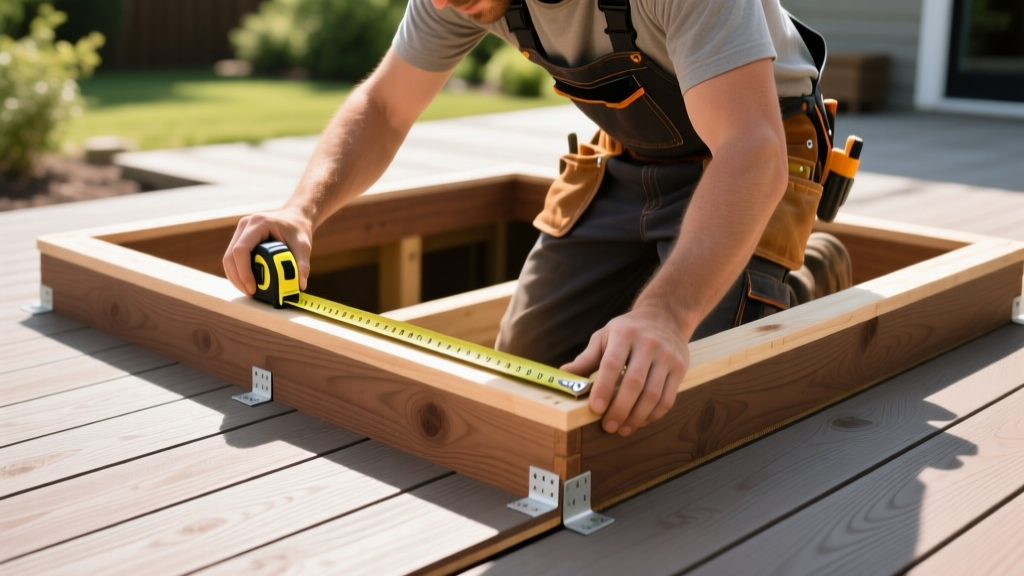
One of the most common mistakes in small deck construction is underestimating the cost of hardware. A 100 sq ft deck requires a surprising amount of specialized metal. Here is a realistic 2026 hardware shopping list for a 10x10 attached deck:
- Post Bases: 3x Simpson Strong-Tie EPB44Z (Elevated Post Bases) - $45 total
- Joist Hangers: 15x LUS210Z (for 2x10 joists) - $30 total
- Joist Hanger Nails: 2 lbs of 10d x 1.5" galvanized connector nails - $15 total
- Blocking/bridging: Simpson H2.5A hurricane ties for joist stability - $25 total
- Ledger Fasteners: 1/2" x 3" Galvanized Lag Screws with washers - $20 total
- Total Hardware Budget: ~$135 - $180
DIY vs. Professional Installation: The Financial Tipping Point
Because a small deck has a low total square footage, the 'economies of scale' that benefit large deck builds do not apply here. Mobilization costs (bringing tools to the site, setting up saws, waste disposal) are roughly the same for a 100 sq ft deck as they are for a 200 sq ft deck.
If you choose the DIY route, you can expect to spend $900 to $1,600 on a composite 10x10 deck (materials only). However, you must factor in tool rentals: a gas-powered earth auger ($75/day), a heavy-duty hammer drill for ledger bolts ($50/day), and specialized composite miter saw blades ($80).
The financial tipping point occurs when you factor in your time and the risk of failing a municipal framing inspection. If you lack experience with IRC Chapter 5 floor and deck framing codes, hiring a professional ensures the ledger board is properly flashed and the footings are placed below the frost line, preventing catastrophic structural heaving in subsequent winters.
Final Cost Summary (10x10 Attached Deck)
- Budget DIY (Pressure-Treated Pine): $850 - $1,200
- Budget Pro-Built (Pressure-Treated Pine): $2,200 - $3,500
- Premium DIY (Composite + Aluminum Railing): $2,800 - $3,800
- Premium Pro-Built (Composite + Aluminum Railing): $5,500 - $8,000+
Written by
David NakamuraDavid Nakamura is a licensed architect (AIA) and construction technology writer focused on sustainable building methods, mass timber engineering, and high-performance building envelopes. He holds a Master of Architecture from the University of Washington and is a certified Passive House Consultant (CPHC). David spent eight years at the Seattle firm Mithun, where he led the design of three LEED Platinum projects, before founding his own practice specializing in net-zero residential design. He serves on the editorial advisory board of GreenBuilder Magazine and has authored peer-reviewed papers on cross-laminated timber (CLT) connections for the Journal of Structural Engineering. In his spare time, David teaches woodworking at Pratt Fine Arts Center and kayaks the Puget Sound.
More from David Nakamura
View all
Construction Cost
Labor Cost to Build a Deck Per Sq Ft: 2026 Installation Guide
Discover the exact labor cost to build a deck per sq ft in 2026. This installation guide breaks down contractor rates, complexity factors, and hidden fees.
Aug 4, 2026

Construction Cost
How Much Does It Cost to Build a 3 Bedroom House? Financing Guide
Learn exactly how much it costs to build a 3 bedroom house and explore 2026 financing options, construction loan types, and budget frameworks for your build.
Aug 4, 2026

Construction Cost
Cost to Build a Tennis Court: 2026 Guide
How much does it cost to build a tennis court in 2026? Breakdowns for asphalt, concrete, and synthetic surfaces plus fencing and lighting.
Jul 30, 2026