Installing Dock Decking Material: Framing, Fasteners, and Spacing
Learn how to properly install marine-grade dock decking material. Covers aluminum and composite framing requirements, fastener types, and gapping rules.

Substructure and Framing Tolerances for Marine Environments
Installing dock decking material requires a fundamentally different approach than standard residential deck building. Marine environments subject structures to constant moisture, UV degradation, ice heave, and lateral wave loads. The substructure must be engineered to handle these dynamic forces before the first board is laid.
For floating docks and stationary piers, joist spacing is the most critical framing variable. While standard backyard decks often utilize 16-inch on-center (OC) joist spacing, marine applications demand tighter tolerances. Most capped composite dock decking material requires a maximum 12-inch OC spacing to prevent sagging under wet loads and to minimize the flex that can cause hidden fasteners to disengage. Interlocking aluminum decking systems, due to their extruded structural ribs, can typically span 16-inch or even 24-inch OC, provided the specific manufacturer's load tables are followed.
- Blocking and Bridging: Install solid blocking between joists every 4 feet to prevent lateral rolling and to provide secure fastening points for picture-frame borders.
- Ventilation: Ensure a minimum of 12 inches of clearance between the water's highest seasonal level and the bottom of the joists to allow for cross-ventilation, which is critical for preventing mold buildup beneath composite boards.
- Hardware Isolation: When using pressure-treated marine framing (such as MCA-C or CA-C treated southern yellow pine), the copper preservatives will rapidly corrode standard aluminum and carbon steel. Always apply a butyl-based joist tape over the top edge of every joist before laying the dock decking material.
Material-Specific Installation Protocols
The installation technique shifts drastically depending on the specific dock decking material selected. Below are the precise protocols for the three most common marine-grade surfaces.
Interlocking Aluminum Systems
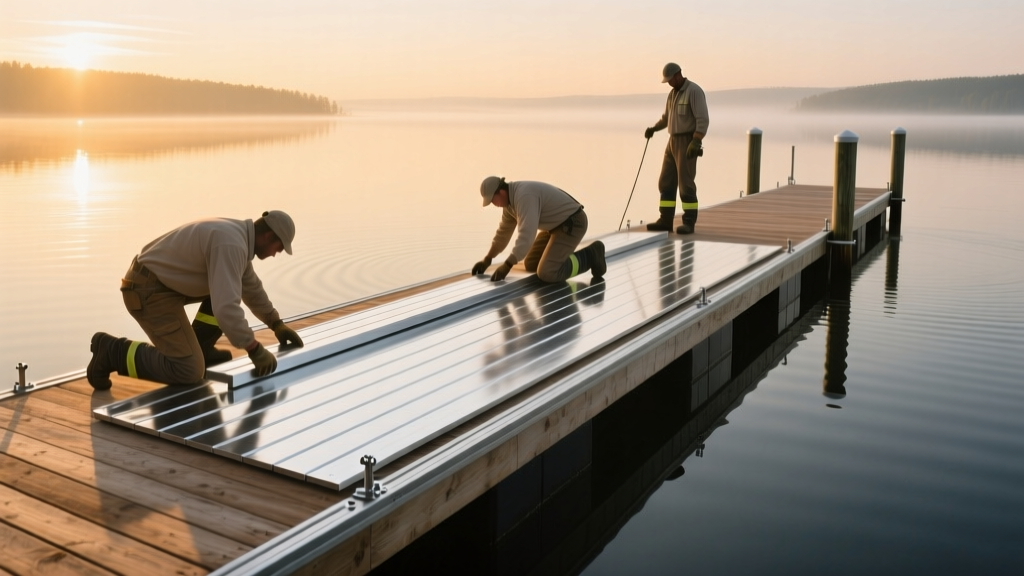
Extruded aluminum decking (such as Ariddek or Wahoo Decks) features an integrated interlocking lip that creates a watertight seal, channeling water to the ends of the dock rather than through the gaps.
- Starter Board: Secure the first board using stainless steel pan-head screws driven through the top flange, which will later be hidden by the dock's fascia.
- Interlocking and Fastening: Slide the next board's male edge into the female groove of the starter board. Fasten through the top nailing fin using 10-gauge, 1-inch stainless steel screws. Do not over-torque; the screw head should sit flush without dimpling the aluminum.
- Thermal Expansion: Aluminum expands and contracts significantly with temperature fluctuations. Leave a 1/8-inch gap for every 10 feet of board length per 100°F of expected temperature variation. Never butt aluminum boards tightly together end-to-end.
Marine-Grade Capped Composites
High-density capped composites (like MoistureShield Vantage or Trex Transcend) are engineered with a polymer shell that repels water absorption.
- Hidden Fasteners: Use marine-grade stainless steel hidden clips. Standard carbon-steel clips will rust and stain the composite edges within a single season. Insert the clip into the side groove and secure it to the joist with the provided 305-grade stainless steel screw.
- Face Screwing (Alternative):strong> If face-screwing is required for the perimeter boards, always pre-drill a 1/8-inch pilot hole and use a countersink bit. Driving composite screws without pre-drilling will cause the dense polymer cap to 'mushroom' and create a trip hazard.
Acetylated and Thermally Modified Woods
Chemically modified woods like Accoya or thermally modified ash (like Thermory) offer the aesthetics of hardwood with the rot resistance of plastic. These materials are incredibly dense and brittle. You must pre-drill every single hole using a carbide-tipped bit, leaving a 1/16-inch clearance hole in the top board to allow the wood to expand laterally without shearing the screw shaft. Seal all end-cuts immediately with a marine-grade penetrating oil to prevent end-grain checking.
Never allow bare aluminum dock decking material to rest directly on copper-based pressure-treated lumber (like ACQ or CA-C). The chemical reaction causes rapid galvanic pitting, compromising both the wood preservative and the aluminum extrusion. Always separate them using a heavy-duty polyethylene or butyl flashing tape rated for UV and marine submersion.
Fastener Selection and Galvanic Matrix
Selecting the wrong fastener is the most common point of failure in dock construction. According to the Stainless Steel Information Association, understanding the chloride content of your water body is mandatory for fastener selection. Below is the definitive matrix for marine fasteners.
| Fastener Material | Best Application | Lifespan Expectancy | Cost Premium |
|---|---|---|---|
| Type 304 Stainless Steel | Freshwater lakes, rivers, and low-humidity inland docks. | 15-25 Years | +30% over standard |
| Type 316 Stainless Steel | Saltwater, brackish estuaries, and heavily de-iced winter docks. | 25-40+ Years | +60% over standard |
| Hot-Dipped Galvanized (HDG) | Temporary structures or substructure framing only (never for surface decking). | 5-10 Years | Baseline |
| Ceramic-Coated Carbon Steel | Avoid in all permanent marine applications; coating chips during driving. | 2-5 Years | +10% over standard |
For structural lag screws connecting the joists to the pilings, consult the Florida Sea Grant coastal construction guidelines, which mandate heavily galvanized or 316 stainless steel through-bolts for any structural connections in splash zones to prevent catastrophic structural failure during storm surges.
Gapping, Overhangs, and Ice Heave Mitigation
Water management and physical movement dictate the longevity of your dock decking material. Improper gapping leads to ponding water, which accelerates algae growth and creates severe slip hazards.
Side-to-Side and End-to-End Gapping
Composite boards require a minimum 3/16-inch side-to-side gap to allow for thermal expansion and water drainage. If installing in cold weather (below 40°F), increase the end-to-end gap to 1/4-inch; if installing in peak summer heat (above 85°F), butt the ends tighter, leaving a 1/16-inch gap. Aluminum interlocking systems handle side-to-side gapping automatically via their extruded profiles, but end-joints must utilize specialized expansion splice joints provided by the manufacturer.
Overhang and Fascia Limits
Never allow composite dock decking material to overhang the final rim joist by more than 1.5 inches. Excessive overhang creates a lever arm that can snap the board under foot traffic or when a boat bumper catches the edge. Aluminum can safely overhang up to 2 inches due to its higher tensile strength, but the exposed hollow chambers must be sealed with manufacturer-specific end-caps to prevent wasps and debris from nesting inside the extrusions.
Ice Heave and Slip Joints
In northern climates, ice expansion can exert thousands of pounds of upward pressure on stationary pilings. According to the American Wood Protection Association, marine lumber structures must account for localized movement. When your dock meets a fixed structure (like a concrete seawall or a heavy boat lift), do not rigidly fasten the final row of decking. Instead, install a 1/2-inch slip joint filled with a marine-grade closed-cell backer rod and polyurethane sealant. This allows the dock to heave vertically during freeze-thaw cycles without buckling the decking surface.
Troubleshooting Common Installation Failures
- Symptom: Composite boards are cupping or warping upward at the edges.
Cause: Lack of under-joist ventilation or installing the boards directly over a solid surface (like a concrete pier) without sleeper strips. The trapped moisture causes the bottom of the board to expand faster than the UV-baked top cap.
Fix: Ensure a minimum 12-inch air gap below the joists, or install 2x4 pressure-treated sleepers on edge to elevate the framing. - Symptom: White, powdery oxidation stains on aluminum decking.
Cause: Galvanic reaction between the aluminum and untreated steel fasteners, or runoff from copper-treated framing.
Fix: Replace all offending fasteners with 316 stainless steel and apply a butyl barrier tape between the wood framing and the aluminum. - Symptom: Ponding water in the center of the dock span.
Cause: Joists have crowned or settled unevenly, creating a low spot that defeats the 1/8-inch-per-foot drainage slope.
Fix: Sister the low joists with straight, kiln-dried marine-grade lumber and plane the high spots to restore a uniform 1% slope toward the water's edge.
Pro-Tip for Dock Builders: When cutting composite or modified wood dock decking material on-site, always use a fine-tooth finishing blade (minimum 60 teeth for a 7-1/4 inch saw). Rough cuts leave open cellular structures at the board ends that wick moisture. Immediately seal these fresh cuts with a UV-stable end-grain sealer to lock out water and prevent delamination.
Written by
Marcus ChenMarcus Chen is a licensed structural engineer (PE) and building materials analyst with over 12 years of experience across residential, commercial, and industrial construction. He holds a Master of Science in Civil Engineering from UC Berkeley and spent six years at Thornton Tomasetti before transitioning to independent consulting and technical writing. Marcus specializes in material selection for seismic-prone regions, concrete reinforcement strategies, and lifecycle cost analysis. His work has been cited by the American Concrete Institute (ACI) and the Structural Engineers Association of California (SEAOC). When he is not on a job site or at his desk, you will find him hiking the Sierra Nevada or restoring a 1920s craftsman bungalow in Oakland, CA.
More from Marcus Chen
View all
Construction Cost
How Much Did the Eiffel Tower Cost to Build?
How much did the Eiffel Tower cost to build in 1889? We adjust for inflation and compare its budget to modern skyscraper construction.
Aug 4, 2026

Fire Resistance
What Is a Fire Resistant Material? Testing & Certification Guide
Discover what is a fire resistant material through ASTM and UL testing. Learn how fire ratings, certifications, and assemblies work in construction.
Aug 4, 2026

Construction Cost
How Much Did the Burj Khalifa Cost to Build?
How much did the Burj Khalifa cost to build? We break down the $1.5B project and extract 5 money-saving strategies for your next build.
Jul 30, 2026