Alternative Decking Materials: Lifespan and Durability Compared
Compare the lifespan, failure modes, and 25-year costs of alternative decking materials like PVC, composite, aluminum, and thermally modified wood.
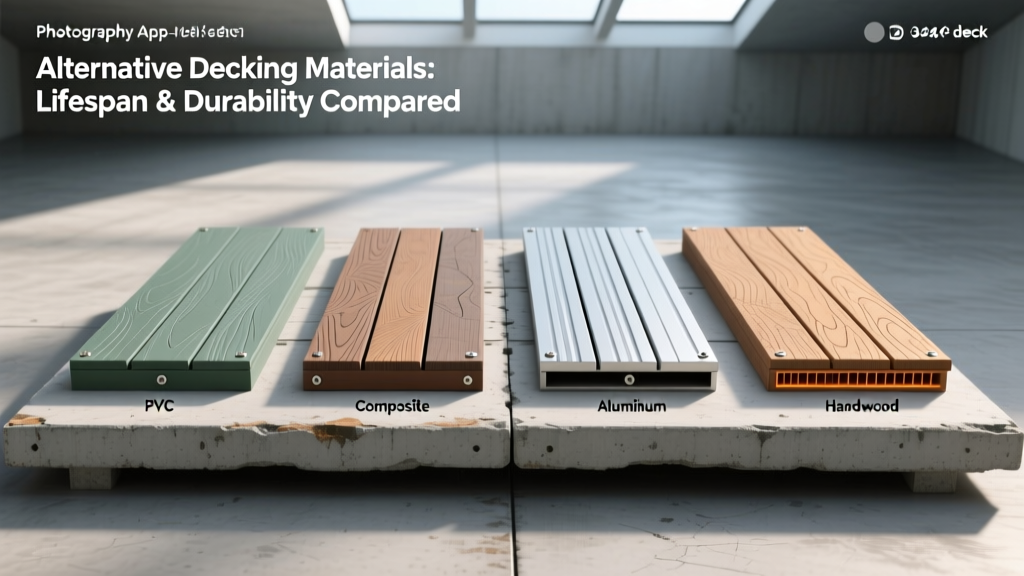
Decoding 'Lifetime' Warranties in Alternative Decking
When evaluating alternative decking materials, manufacturers frequently market 25-year, 50-year, or even 'lifetime' limited warranties. However, these warranties rarely guarantee a pristine deck for half a century. Most composite and PVC warranties are heavily prorated. A typical 50-year fade and stain warranty might cover 100% of replacement material costs for the first 10 years, but drops to 80% in year 11, decreasing by an additional 10% every subsequent five-year period. Furthermore, labor costs for removal and reinstallation are almost universally excluded after the first two to five years. Understanding the actual mechanical lifespan and specific failure modes of these materials is far more critical than reading the marketing gloss of a prorated warranty.
Material Lifespan and Specific Failure Modes
Alternative decking materials encompass a wide range of engineered and chemically altered products. Each category possesses a distinct degradation profile based on its chemical composition and environmental exposure.
Capped Wood-Plastic Composites (WPC)
Capped WPC boards, such as Trex Transcend Lineage or Fiberon Concordia, feature a wood-flour and high-density polyethylene (HDPE) core encased in a protective polymer shell. The realistic structural lifespan is 25 to 30 years.
Primary Failure Mode: Moisture intrusion at cut ends and routed grooves. If the uncapped core is exposed to standing water or constant ground contact, the wood flour absorbs moisture. According to the EPA's guidelines on moisture and mold, sustained moisture levels above 20% in organic materials trigger fungal decay. In WPC, this leads to core swelling, delamination of the polymer cap, and eventual structural softening. Installers must use specialized end-grain sealer or color-matched exterior caulk on every field cut to prevent this.
Advanced PVC and Mineral-Based Composites (MBC)
Advanced PVC (e.g., TimberTech AZEK) eliminates organic wood flour entirely, using a cellular PVC core. Mineral-Based Composites (e.g., MoistureShield Vision) replace wood flour with fly ash and minerals. Both offer lifespans of 30 to 50 years and are entirely immune to organic rot.
Primary Failure Mode: Thermal expansion and surface chalking. Cellular PVC has a high coefficient of thermal expansion, expanding up to 3/16 inch per 10 linear feet for every 100°F temperature swing. If installed without the manufacturer-mandated 1/8-inch to 3/16-inch gapping at butt joints, the boards will buckle and warp during summer heatwaves. MBC boards solve the moisture issue but can suffer from surface chalking (a powdery residue) in high-altitude, high-UV environments if the acrylic cap is scratched.
Thermally Modified Hardwoods
Thermally modified woods, like Thermory Ash, are real hardwoods baked at 400°F+ in an oxygen-deprived kiln. This process alters the hemicellulose structure, rendering the wood indigestible to insects and highly resistant to fungal decay, yielding a 25+ year lifespan. The USDA Forest Products Laboratory extensively documents how thermal modification drastically reduces the equilibrium moisture content (EMC) of wood.
Primary Failure Mode: Brittle mechanical failure. The thermal process significantly reduces the modulus of rupture (bending strength). These boards are brittle and will snap under heavy point loads if joist spacing exceeds 16 inches on-center. Additionally, face-screwing thermally modified ash without pre-drilling will cause catastrophic splitting; hidden stainless steel clip systems are mandatory.
Marine-Grade Extruded Aluminum
Extruded aluminum decking (e.g., Wahoo Decks Ariddek, Craft-Bilt) offers a 50+ year structural lifespan. It is non-combustible, impervious to rot, and features integrated water-shedding channels.
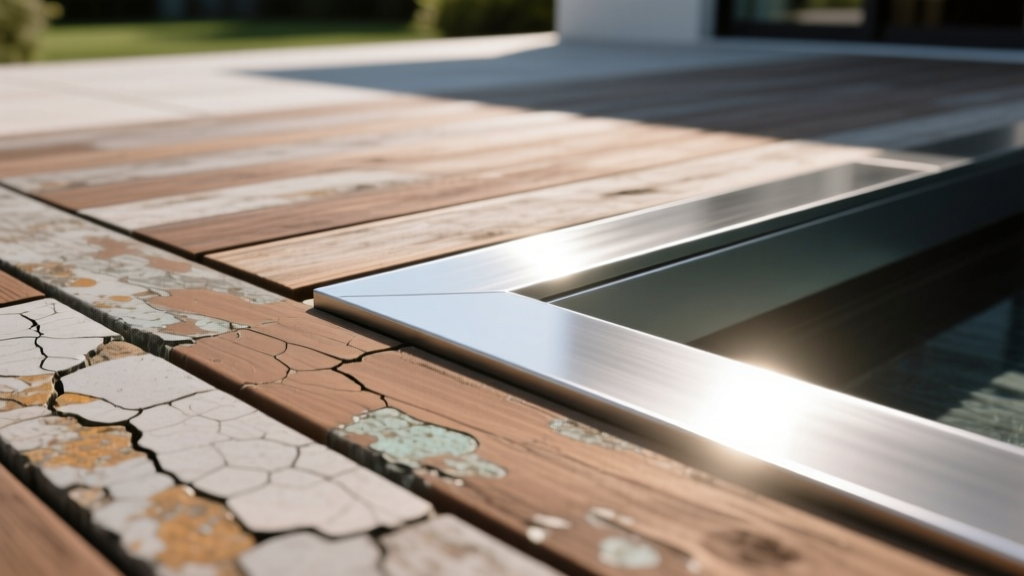
Primary Failure Mode: Galvanic corrosion. When aluminum comes into direct contact with modern pressure-treated lumber (which uses copper-based preservatives like ACQ or Copper Azole) in the presence of an electrolyte (rainwater), a severe galvanic reaction occurs. The American Galvanizers Association notes that aluminum will rapidly corrode when coupled with copper in a galvanic cell. Aluminum decking must never touch treated wood directly; installers must apply a continuous strip of butyl rubber flashing tape or a specialized neoprene membrane over every joist before laying the aluminum boards.
Climate-Specific Degradation Matrix
The lifespan of alternative decking materials is heavily dictated by regional microclimates. Selecting a material mismatched to your environmental stressors will cut its expected lifespan in half.
| Climate Zone | Primary Environmental Stressor | Optimal Alternative Material | Material to Avoid |
|---|---|---|---|
| Coastal / Saltwater | Salt spray, high humidity, UV reflection | Advanced PVC or Marine Aluminum | Capped WPC (salt degrades polymer caps) |
| High-Altitude / Intense UV | Extreme thermal cycling, UV degradation | Thermally Modified Hardwood | Dark-colored PVC (heat retention/buckling) |
| Humid / Subtropical | Constant moisture, mold, termite pressure | Mineral-Based Composite (MBC) | Uncapped or poorly sealed WPC |
| Northern / Freeze-Thaw | Ice damming, snow load, freeze-thaw spalling | Extruded Aluminum (sheds snow/ice) | Thermally Modified Wood (brittle in cold) |
The Hidden Lifespan Killers: Substructure and Fasteners
The most common reason alternative decking materials fail prematurely is not the degradation of the deck boards themselves, but the failure of the substructure and fasteners beneath them. A 30-year PVC deck board is useless if the pressure-treated pine joists supporting it rot in 15 years.
Substructure Upgrades
To match the lifespan of premium alternative decking, the framing must be protected. If using traditional pressure-treated lumber for joists, every horizontal surface must be covered with a butyl-rubber joist tape (such as Trex Protect or G-Tape). This prevents water from pooling on the joist tops, which is where rot typically initiates. For a true 50-year deck, builders are increasingly switching to light-gauge steel framing (e.g., Fortress Evolution or Dexerdry), which eliminates organic decay and twisting entirely.
Fastener Compatibility Rules
Using the wrong screws will result in rust streaks that permanently stain composite and PVC boards, and will eventually compromise the holding power of the deck.
- Inland / Standard Environments: Use polymer-coated carbon steel screws or standard 304 stainless steel. Never use bare galvanized screws on composite or PVC, as the chemicals in the plastic caps can react with the zinc coating, causing premature corrosion.
- Coastal / Within 3,000 Feet of Saltwater: Mandate 316-grade marine stainless steel fasteners. The molybdenum added to 316 stainless steel provides the necessary resistance to chloride pitting from salt air.
- Hidden Fasteners: When using grooved alternative boards, ensure the hidden clips are made of glass-filled nylon or stainless steel. Cheap plastic clips become brittle under UV exposure and will snap under the lateral load of thermal expansion.
25-Year Total Cost of Ownership (TCO) Analysis
While traditional pressure-treated wood has the lowest upfront material cost, the cumulative cost of maintenance, staining, and eventual replacement makes alternative decking materials highly competitive over a 25-year horizon. The following matrix assumes a 400-square-foot deck, professional installation, and standard regional material pricing for 2026.
| Material Type | Initial Material Cost (per sq. ft.) | 25-Year Maintenance Cost | Expected Replacements in 25 Years | Est. 25-Year TCO (per sq. ft.) |
|---|---|---|---|---|
| Pressure-Treated Pine | $3.50 - $5.00 | $18.00 (staining/sealing every 2 yrs) | 1 Full Replacement (Year 15) | $28.00 - $32.00 |
| Capped WPC | $9.00 - $12.00 | $2.50 (annual soap washing) | 0 | $12.50 - $15.50 |
| Advanced PVC | $11.00 - $15.00 | $2.50 (annual soap washing) | 0 | $14.50 - $18.50 |
| Extruded Aluminum | $15.00 - $22.00 | $0.00 (zero maintenance required) | 0 | $15.00 - $22.00 |
When evaluating alternative decking materials for long-term durability, the decision must move beyond the initial price tag. By matching the specific material's chemical properties to your local climate, isolating dissimilar metals to prevent galvanic corrosion, and upgrading the substructure to match the decking's lifespan, you can ensure the deck performs flawlessly for decades without requiring premature reconstruction.
Written by
Elena RodriguezElena Rodriguez is a civil engineer and technical writer specializing in concrete technology, masonry systems, and ASTM/ACI compliance. She earned her B.S. in Civil Engineering from Texas A&M University and spent a decade at a materials testing laboratory, performing over 2,000 concrete compressive strength tests and masonry prism evaluations. Elena is an ACI-certified Field Testing Technician (Grade I) and a member of ASTM Committee C12 on Natural Building Stone. She currently consults on forensic engineering cases involving concrete failures and moisture intrusion. Based in San Antonio, TX, Elena is a proud member of the Society of Women Engineers (SWE) and coaches her daughter's FIRST Robotics team.
More from Elena Rodriguez
View all
Walls & Panels
Cost Analysis: Light Gauge Steel Framing Advantages and Disadvantages
Evaluate light gauge steel framing advantages and disadvantages through a strict cost analysis lens, comparing material, labor, and lifecycle expenses.
Aug 4, 2026

Walls & Panels
Gypsum Board Types: Exact Specifications, Thickness & Dimensions
Compare standard, Type X, and moisture-resistant gypsum board types. Get exact specifications, thicknesses, dimensions, and ASTM standards for your project.
Aug 4, 2026

Fire Resistance
Best Fire-Resistant Outdoor Decking Materials: 2026 Buyer Guide
Discover the best fire-resistant outdoor decking materials for 2026. Compare Class A PVC, aluminum, and hardwood options for WUI compliance and safety.
Aug 4, 2026