Marine Dock Decking Materials: Planning & Selection Guide
Plan your waterfront build with our expert guide to marine dock decking materials, covering saltwater composites, aluminum, PVC, and structural framing.

Designing a dock in a marine environment requires navigating a hostile matrix of ultraviolet radiation, tidal fluctuations, salt spray, and biological threats like Teredo navalis (naval shipworm) and Limnoria (gribbles). Selecting the right marine dock decking materials is not merely an aesthetic choice; it is a structural engineering decision that dictates the lifespan, load capacity, and maintenance lifecycle of your waterfront investment. According to research from the USDA Forest Products Laboratory, traditional wood in marine splash zones can suffer severe structural degradation within 5 to 7 years if not rigorously maintained, making advanced alternative materials the standard for modern dock design.
Environmental Load & Material Degradation Matrix
Before selecting a surface material, you must quantify the specific environmental loads your dock will endure. A freshwater lake dock in Minnesota faces freeze-thaw cycling and ice scouring, while a saltwater dock in Florida faces continuous UV exposure and chloride-induced corrosion.
The most aggressive degradation occurs in the 'splash zone'—the area between the high and low tide marks. Materials here must resist both continuous moisture immersion and rapid drying, which accelerates salt crystallization and cellular breakdown in wood-based products.
Core Marine Dock Decking Materials Compared
The market for marine dock decking materials has consolidated around three high-performance categories: capped wood-plastic composites (WPC), cellular PVC, and marine-grade extruded aluminum. Below is a technical comparison to guide your material specification.
| Material Category | Leading 2026 Product Lines | Avg. Cost (per sq. ft.) | Slip Resistance (Wet) | Weight (lbs/lin. ft.) | Expected Lifespan |
|---|---|---|---|---|---|
| Capped Composite (WPC) | MoistureShield Vision, Trex Transcend | $9.50 - $13.00 | High (Embossed grain) | 2.8 - 3.2 | 25 - 30 Years |
| Cellular PVC | TimberTech AZEK, Wolf Serenity | $11.00 - $15.50 | Moderate (Requires texture) | 1.8 - 2.2 | 25 - 40 Years |
| Marine Aluminum | Wahoo Decks Ariddek, TitanDeck | $16.00 - $22.00 | High (Ribbed extrusions) | 1.2 - 1.5 | 50+ Years |
Deep Dive: Capped Composites in Saltwater
Modern capped composites feature a full polymer shield that encapsulates the wood-flour core. For marine applications, specify products tested to ASTM D7032 standards for water absorption and freeze-thaw durability. MoistureShield, for instance, utilizes a proprietary Solid Core technology that allows their boards to be submerged in water or installed in ground contact without voiding the warranty—a critical feature for low-freeboard docks that experience tidal overtopping.
Deep Dive: Marine-Grade Aluminum
Extruded aluminum decking (typically 6061-T6 or 6005A-T5 alloys) offers the highest strength-to-weight ratio. Wahoo Decks' Ariddek features an integrated interlocking tongue-and-groove design with a hidden drainage channel, keeping the substructure completely dry. This is the premier choice for commercial marinas or heavy-duty boat lifts where point-loads from cleats and winches exceed the capacity of polymer-based boards.
Structural Framing Synergy & Fastener Engineering
Your decking material dictates your substructure design. A common failure in dock planning is pairing premium marine decking with inadequate framing or incorrect fasteners.
Joist Spacing Requirements
- Capped Composite: Requires 12-inch on-center (OC) joist spacing for diagonal patterns and 16-inch OC for perpendicular layouts to prevent sagging under heavy marine loads (e.g., coolers, tackle boxes, wet foot traffic).
- Cellular PVC: Strictly requires 12-inch OC spacing due to lower flexural modulus compared to WPC.
- Aluminum: Can span up to 24-inch OC due to the structural rigidity of the extruded ribs, potentially reducing your substructure material costs by 15%.
Never use 304-grade stainless steel fasteners in a saltwater marine environment. You must specify 316-grade stainless steel (e.g., Simpson Strong-Tie or DeckWise marine lines). 316 SS contains 2-3% molybdenum, which dramatically increases resistance to chloride pitting and crevice corrosion. Using 304 SS in a saltwater splash zone will result in fastener failure and 'tea-staining' on your decking within 36 months.
Thermal Expansion & Contraction Planning
Marine environments experience extreme thermal swings, from intense midday solar radiation to cool ocean breezes. Failing to account for the Coefficient of Thermal Expansion (CTE) will result in buckled boards or pulled fasteners.
The formula for linear expansion is: ΔL = L × α × ΔT
- ΔL: Change in length
- L: Initial length of the board
- α (Alpha): Coefficient of Thermal Expansion
- ΔT: Temperature change (in °F)
Real-World Calculation: Consider a 20-foot (240-inch) decking board experiencing a 70°F temperature swing (from a 40°F winter night to a 110°F surface temperature in direct summer sun).
- PVC (α ≈ 3.0 × 10⁻⁵): 240 × 0.00003 × 70 = 0.504 inches of expansion.
- Composite (α ≈ 1.5 × 10⁻⁵): 240 × 0.000015 × 70 = 0.252 inches of expansion.
Design Action: When installing PVC marine dock decking, you must leave a minimum 1/2-inch gap at butt joints and use slotted fastener holes to allow the board to glide over the joists without buckling. Composites require roughly half this gapping tolerance.
Lifecycle Cost & ROI Analysis
While pressure-treated southern yellow pine remains the cheapest upfront option, the Florida Sea Grant and other coastal extension programs consistently demonstrate that the maintenance and replacement costs of wood in marine environments destroy its long-term ROI. Below is a 20-year cost projection per square foot, factoring in 2026 material costs, sealing/staining labor, and replacement probabilities.
| Material | Initial Install Cost | 20-Yr Maintenance | 20-Yr Replacement Risk | Estimated 20-Yr Total |
|---|---|---|---|---|
| Pressure-Treated Wood | $6.50 | $14.00 (Annual sealing) | 85% (Partial rebuild) | $28.00+ |
| Capped Composite | $13.50 | $1.50 (Occasional wash) | 0% | $15.00 |
| Marine Aluminum | $19.50 | $0.50 (Rinse only) | 0% | $20.00 |
Actionable Design & Planning Checklist
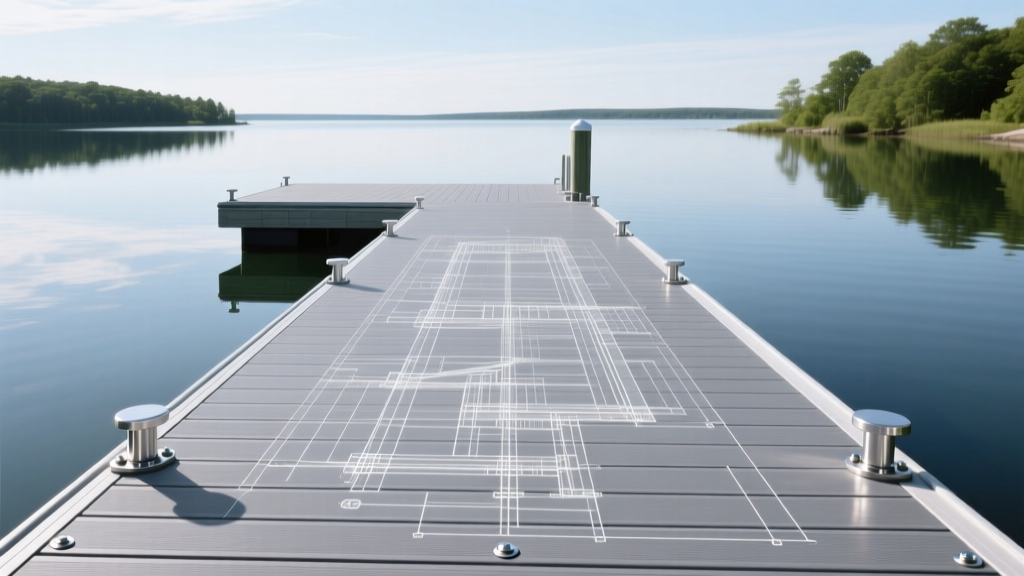
Before finalizing your dock blueprints and ordering materials, run through this engineering checklist to ensure your marine dock decking system is fully optimized for the waterfront environment.
- Verify Local Setbacks & Permits: Confirm riparian rights and environmental setbacks with your local Department of Environmental Protection (DEP) or coastal commission. Some regions restrict the total square footage of impervious dock surfaces to protect submerged aquatic vegetation (SAV).
- Specify 316 Stainless Hardware: Audit your entire Bill of Materials (BOM). Ensure every screw, hidden clip, joist hanger, and structural bolt is rated 316 SS or hot-dip galvanized (HDG) per ASTM A153.
- Calculate Dead & Live Loads: Design the substructure for a minimum 50 PSF live load, upgrading to 100 PSF in areas designated for heavy marine equipment, davits, or commercial gangways.
- Plan for Utility Routing: If running marine-grade shore power or water lines, select a hollow-core aluminum decking system or plan specific composite board removals for future access to sub-deck conduits.
- Integrate Flotation & Fenders: Design the dock perimeter to accommodate low-profile fender systems. Avoid decking materials with brittle edges (like some uncapped composites) that may chip when impacted by boat hulls during low tide.
By prioritizing material science and structural synergy over initial upfront costs, your marine dock will remain stable, safe, and visually pristine for decades, regardless of the tidal and environmental forces at play.
Written by
Sarah WhitfieldSarah Whitfield is a chartered quantity surveyor (MRICS) and construction cost analyst with 15 years of experience in material pricing, procurement strategy, and project budgeting. She earned her degree in Construction Management from the University of Reading (UK) and has worked on projects ranging from $2M custom homes to $180M mixed-use developments across North America and Europe. Sarah currently leads cost estimating for BuildMat Insight, maintaining a proprietary database of 4,000+ material price points updated quarterly. She is a frequent contributor to RSMeans cost data panels and has presented at the International Cost Engineering Council (ICEC) congress. Based in Denver, CO, Sarah is an avid trail runner and volunteer mentor for Women in Construction.
More from Sarah Whitfield
View all
Wood & Lumber
What Are the Different Types of Wood? A Builder's Guide
Compare structural softwoods, finish hardwoods, and engineered lumber. Analyze Janka ratings, MOE values, and 2026 pricing for construction.
Aug 4, 2026

Walls & Panels
Steel Framing vs Wood Framing: Corrosion and Moisture Defense
Compare steel framing vs wood framing for moisture resistance. Learn about galvanized coatings, condensation risks, and corrosion protection strategies.
Jul 21, 2026

Stone & Masonry
How to Cut Stone Veneer: Wet Saw vs Grinder Comparison
Compare the best tools for cutting stone veneer. We review wet saws, angle grinders, and chop saws to help you achieve clean, chip-free cuts.
Jul 21, 2026