Cost Analysis: Best Flooring Options for a Basement in 2026
Compare 2026 costs for the best flooring options for a basement. Breakdown of luxury vinyl, epoxy, tile, and engineered wood per square foot.

The Pre-Requisite: ASTM F2170 Moisture Testing
Before evaluating the cost of flooring options for a basement, you must quantify your slab's moisture vapor emission rate (MVER). The outdated calcium chloride test (ASTM F1869) only measures surface moisture and is no longer recognized by most major flooring manufacturers for warranty validation. In 2026, the undisputed industry standard is the ASTM F2170 in-situ relative humidity (RH) probe test.
Installing any adhesive-bound or wood-based flooring without an ASTM F2170 test will void your manufacturer warranty. If your slab reads above 75% RH (or 80% for specific SPC vinyl brands), you must budget for a moisture mitigation primer like Bostik MVP4 or Mapei Eco Prim PU, which adds $2.50 to $4.00 per square foot to your total project cost.
Professional RH testing typically costs between $150 and $300 for a standard 1,000-square-foot basement, requiring 72 hours for the probes to acclimate to the concrete's internal temperature. For DIYers, reusable RH probe kits cost around $85, though you must drill 40mm deep holes into the slab using a rotary hammer.
2026 Cost Matrix: Flooring Options for a Basement
The following matrix breaks down the fully installed costs (materials, labor, and standard subfloor prep) for the most viable below-grade flooring materials. Prices reflect 2026 national averages for a 1,000-square-foot rectangular basement.
| Material Type | Material Cost (sq ft) | Install Cost (sq ft) | Total Cost (sq ft) | Moisture Tolerance |
|---|---|---|---|---|
| Rigid Core SPC Vinyl | $3.50 - $6.50 | $1.50 - $2.50 | $5.00 - $9.00 | High (Up to 90% RH) |
| 100% Solids Epoxy Flake | $2.00 - $4.00 | $4.50 - $7.00 | $6.50 - $11.00 | Moderate (Requires Vapor Barrier) |
| Porcelain Tile (Large Format) | $4.00 - $10.00 | $6.00 - $12.00 | $10.00 - $22.00 | High (Mortar is permeable) |
| Engineered Hardwood | $7.00 - $14.00 | $4.50 - $7.50 | $11.50 - $21.50 | Low (Requires Dimpled Subfloor) |
Material Deep-Dive & Hidden Installation Costs
1. Rigid Core SPC Luxury Vinyl Plank (LVP)
Stone Plastic Composite (SPC) vinyl is the dominant choice for below-grade applications due to its limestone-dust core, which is entirely impervious to water. Unlike older WPC (Wood Plastic Composite) cores, SPC will not expand or contract with seasonal basement temperature fluctuations.
- The Hidden Cost: Many budget SPC planks feature a pre-attached cork or foam underlayment. While this saves installation time, if your concrete slab has imperfections exceeding 3/16-inch over a 10-foot radius, the rigid SPC core will snap at the click-lock joints. You must budget for floor leveling compound (approximately $45 per 50lb bag, covering 50 sq ft at 1/8-inch depth) to flatten the slab prior to installation.
- Specification Target: Look for a minimum 20-mil wear layer for residential basements, or 22-mil if you plan to use the space as a high-traffic home gym. Brands like CoreTec Pro Plus or Armstrong Rigid Core offer superior dimensional stability.
2. 100% Solids Epoxy with Flake Broadcast
For a seamless, industrial, or modern aesthetic, a 100% solids epoxy coating bonded directly to the concrete is highly durable. Avoid water-based or solvent-based epoxies sold in big-box store kits; they lack the chemical cross-linking density required to resist basement hydrostatic pressure and will peel within 24 months.
- The Hidden Cost: Mechanical preparation. Epoxy requires a Concrete Surface Profile (CSP) of 2 or 3. Acid etching is no longer considered sufficient by the Concrete Network and coating manufacturers. You must hire a contractor to shot-blast or diamond-grind the slab, adding $0.75 to $1.50 per square foot to the prep budget.
- Specification Target: A three-coat system: an epoxy primer/sealer to block vapor transmission, a 100% solids epoxy color coat with full vinyl flake broadcast (hides dirt and adds slip resistance), and a polyaspartic or aliphatic urethane topcoat to prevent UV yellowing from basement window light.
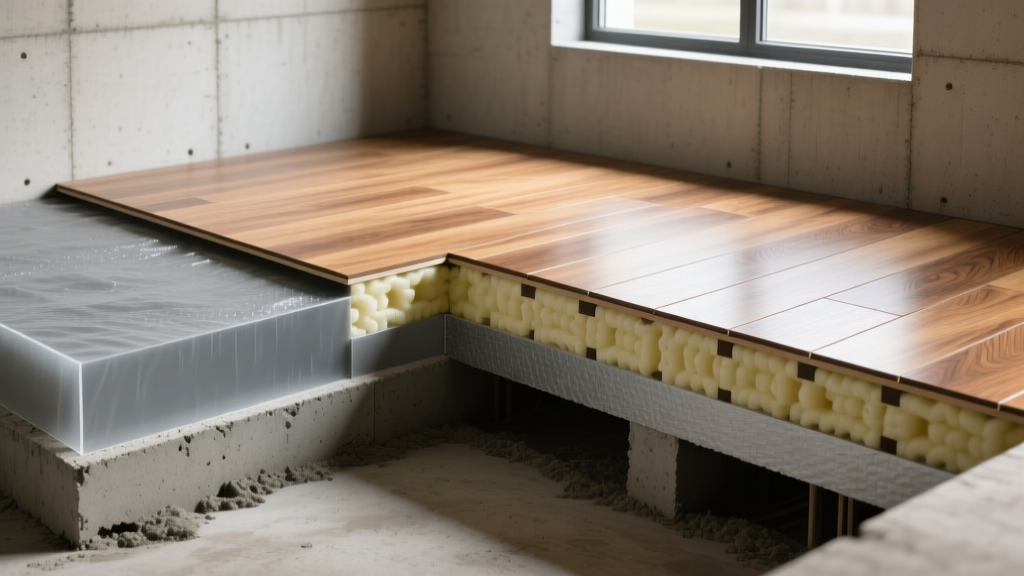
3. Engineered Hardwood over Dimpled Subfloor
Solid hardwood is strictly prohibited below grade due to ground moisture. However, engineered hardwood (which features a plywood core with a real wood veneer) can be installed if you decouple it from the concrete slab. According to the Building Science Corporation, managing bulk water and vapor diffusion is critical for below-grade organic materials.
- The Hidden Cost: The dimpled membrane subfloor. Products like Delta-FL or Dricore create a 5/16-inch air gap that allows moisture to evaporate laterally rather than migrating into the wood. This membrane costs an additional $2.20 to $3.50 per square foot and reduces your ceiling height, which may require undercutting door jambs and adjusting HVAC return vents.
- Specification Target: Use a minimum 5/8-inch thick engineered plank with a multi-ply birch core (not MDF/HDF, which swells if water ever breaches the membrane). The top veneer should be at least 3mm to allow for future sanding and refinishing.
Subfloor Remediation: Where Budgets Bleed
The most common point of failure in basement flooring is ignoring the condition of the concrete substrate. When calculating your total cost, factor in these common remediation requirements:
Common Concrete Remediation Costs (per 1,000 sq ft)
- Shot Blasting / Diamond Grinding: $750 - $1,500 (Required for epoxy or thin-set tile).
- Self-Leveling Underlayment (SLU): $900 - $2,500 (Depends on depth; requires a primer coat to prevent the concrete from sucking moisture out of the SLU too quickly).
- Crack Isolation Membrane: $600 - $1,000 (Liquid-applied or sheet membrane like Schluter-Ditra for tile installations to prevent slab cracks from telegraphing through the grout lines).
- Moisture Vapor Mitigation Primer: $2,500 - $4,000 (Two-part epoxy primers that chemically seal the pores of the concrete to stop alkaline moisture from destroying flooring adhesives).
Decision Framework: Matching Budget to Basement Use
Selecting from the available flooring options for a basement requires aligning your material choice with the room's functional purpose and your financial threshold. Use this conditional framework to finalize your decision:
- If the basement is a dedicated home theater or media room: Prioritize acoustic dampening. Choose Rigid Core SPC Vinyl with an attached acoustic cork underlayment. The cork reduces sound reflection, and the total cost remains under $9.00/sq ft. Avoid epoxy, which creates severe echo and reverberation.
- If the basement houses a home gym or heavy workshop: Prioritize impact resistance and chemical immunity. Choose 100% Solids Epoxy with a heavy flake broadcast and urethane topcoat. It will withstand dropped dumbbells and will not stain from sweat, oils, or solvents. Budget $8.00 - $11.00/sq ft.
- If the basement is a high-end guest suite or in-law apartment: Prioritize thermal comfort and aesthetics. Choose Engineered Hardwood over a dimpled subfloor. The air gap provided by the subfloor makes the floor noticeably warmer to the touch than direct-to-concrete options. Budget $14.00 - $21.50/sq ft.
- If you are finishing a basement on a strict budget for resale value: Choose glue-down LVT (Luxury Vinyl Tile) rather than click-lock SPC. Glue-down materials are cheaper ($2.00 - $3.50/sq ft), but you must ensure the slab is perfectly flat and sealed with a moisture-mitigating adhesive like Mapei Ultrabond ECO 995, which acts as both a glue and a vapor barrier.
Ignoring the EPA's guidelines on indoor moisture and mold prevention by installing non-breathable flooring over a damp slab without proper testing or mitigation will inevitably lead to microbial growth and catastrophic material failure. Always allocate 15% to 20% of your total flooring budget specifically for concrete preparation and moisture testing.
Written by
Marcus ChenMarcus Chen is a licensed structural engineer (PE) and building materials analyst with over 12 years of experience across residential, commercial, and industrial construction. He holds a Master of Science in Civil Engineering from UC Berkeley and spent six years at Thornton Tomasetti before transitioning to independent consulting and technical writing. Marcus specializes in material selection for seismic-prone regions, concrete reinforcement strategies, and lifecycle cost analysis. His work has been cited by the American Concrete Institute (ACI) and the Structural Engineers Association of California (SEAOC). When he is not on a job site or at his desk, you will find him hiking the Sierra Nevada or restoring a 1920s craftsman bungalow in Oakland, CA.
More from Marcus Chen
View all
Construction Cost
How Much Did the Eiffel Tower Cost to Build?
How much did the Eiffel Tower cost to build in 1889? We adjust for inflation and compare its budget to modern skyscraper construction.
Aug 4, 2026

Fire Resistance
What Is a Fire Resistant Material? Testing & Certification Guide
Discover what is a fire resistant material through ASTM and UL testing. Learn how fire ratings, certifications, and assemblies work in construction.
Aug 4, 2026

Construction Cost
How Much Did the Burj Khalifa Cost to Build?
How much did the Burj Khalifa cost to build? We break down the $1.5B project and extract 5 money-saving strategies for your next build.
Jul 30, 2026