Navigating Flooring Financing Options for Major Maintenance and Restorations
Discover how to evaluate flooring financing options for major restorative maintenance, subfloor repairs, and hardwood refinishing projects in 2026.
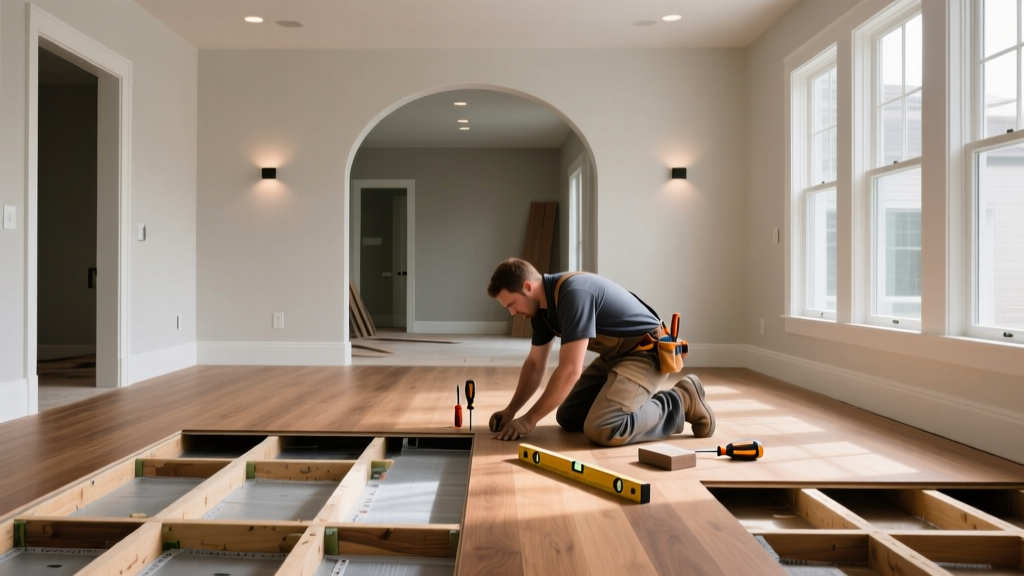
The Maintenance Tipping Point: When Repairs Require Capital
Routine flooring maintenance—vacuuming, damp mopping, and reapplying polyurethane topcoats—fits easily into a monthly household budget. However, restorative maintenance is a fundamentally different financial undertaking. When hardwood floors require full sanding due to deep gouges and UV discoloration, when large-format porcelain tiles suffer from thinset failure requiring a complete tear-out, or when a leaking dishwasher destroys the oriented strand board (OSB) subfloor, the costs quickly escalate from hundreds to thousands of dollars.
In 2026, the national average for sanding and refinishing 500 square feet of solid hardwood ranges from $2,250 to $3,750. Subfloor replacement due to water damage or dry rot typically costs between $3.00 and $6.00 per square foot, exclusive of the cost to remove and replace the finish flooring above it. When restorative maintenance crosses the $2,500 threshold, understanding your flooring financing options becomes just as critical as hiring the right restoration contractor.
Comparing Flooring Financing Options for Restorative Projects
Selecting the right capital source depends on your equity position, credit score, and the urgency of the floor restoration. Below is a comparison matrix of the primary flooring financing options available to homeowners in 2026.
| Financing Method | Best Use Case | Estimated 2026 APR | Funding Speed |
|---|---|---|---|
| Home Equity Line of Credit (HELOC) | Phased restorations, ongoing maintenance reserves | 7.50% - 9.50% (Variable) | 30 - 45 Days |
| Unsecured Personal Loan | Emergency subfloor repairs, mid-sized refinishing | 8.00% - 14.00% (Fixed) | 1 - 5 Days |
| Contractor Retail Credit Card | Promotional 0% periods for predictable sanding jobs | 0% (Promo) / 28.99% (Standard) | Instant (In-store) |
| Cash-Out Refinance | Whole-home remodels including extensive floor leveling | 6.25% - 7.25% (Fixed) | 45 - 60 Days |
The Deferred Interest Trap in Contractor-Backed Financing
Many flooring showrooms and restoration contractors offer point-of-sale financing through retail credit cards (commonly issued by Synchrony or Wells Fargo). These are heavily marketed as '12 Months No Interest' flooring financing options. However, homeowners must understand the critical difference between true zero-percent APR and deferred interest.
According to the Federal Trade Commission (FTC), deferred interest plans accrue interest silently in the background from the day of purchase. If your hardwood restoration project encounters delays—such as discovering asbestos in the old vinyl underlayment or waiting on backordered custom stain colors—and you fail to pay the entire principal balance before the promotional period expires, you will be charged retroactive interest on the original purchase amount, often at penalty APRs exceeding 28.99%.
Emergency Protocol: Financing Sudden Subfloor and Water Damage
When a water heater fails and saturates your engineered hardwood and the OSB subfloor beneath it, maintenance transitions into an emergency mitigation event. Engineered wood cannot be sanded down to dry; it must be extracted. Here is the step-by-step financial protocol for emergency flooring restorations:
- Mitigate and Document (Days 1-2): Hire an IICRC-certified water damage restoration team to extract water and set up commercial dehumidifiers. Document all moisture meter readings (anything above 12% on wood subfloors indicates a high risk for mold and structural delamination). Submit this data to your homeowners insurance.
- Secure Bridge Capital (Days 3-5): Insurance payouts for sudden damage can take 30 to 60 days to clear. To prevent secondary mold damage, utilize a high-limit credit card or a fast-funding unsecured personal loan to pay the mitigation crew immediately.
- Obtain Itemized Scopes of Work (Week 2): Get three bids specifically detailing the subfloor replacement (e.g., removing damaged 3/4-inch OSB, sistering compromised floor joists, and installing premium AdvanTech subflooring for moisture resistance).
- Deploy Long-Term Financing (Week 3): Once the insurance adjuster provides the depreciation and recoverable cash value report, use a Home Equity Line of Credit (HELOC) to cover the gap between the insurance payout and the actual cost of premium flooring replacement. The Consumer Financial Protection Bureau (CFPB) notes that HELOCs remain one of the most cost-effective ways to bridge insurance gaps for home repairs due to their draw-period flexibility.

Wrapping Restorations into Government-Backed Rehab Loans
If you are purchasing a distressed property or undertaking a massive structural renovation where the flooring requires extensive concrete slab mudjacking or joist leveling, standard personal loans will not provide sufficient capital. In these cases, look toward government-backed rehabilitation mortgages.
The FHA 203(k) loan program allows buyers and owners to wrap the cost of major structural repairs—including leveling severely deflected floors and replacing hazardous flooring materials (like lead-painted pine or asbestos-backed linoleum)—directly into the primary mortgage. According to the Department of Housing and Urban Development (HUD), the Standard 203(k) requires a minimum of $5,000 in repairs and mandates the use of a HUD-approved consultant to oversee the architectural exhibits and draw schedules. This is an ideal financing option for investors or homeowners tackling deep, systemic floor failures that go far beyond surface-level cosmetic maintenance.
Frequently Asked Questions
Can I use a home equity loan to pay for routine hardwood floor refinishing?
While you technically can, it is rarely advisable. Home equity loans come with origination fees, appraisal costs, and closing costs that can total $500 to $1,000. Using a $10,000 home equity loan to pay for a $3,500 hardwood screening and recoating job means you are paying disproportionate fees for a relatively small maintenance task. Reserve home equity products for structural subfloor repairs, concrete slab lifting, or full-home flooring replacements exceeding $10,000.
Does financing a floor restoration increase my home's appraised value?
Restorative maintenance returns the home to its baseline condition; it does not typically trigger a massive spike in appraised value like a kitchen remodel would. However, failing to address structural floor deflection or water-damaged subfloors will result in severe value deductions during a buyer's inspection. Financing the repair protects your existing equity rather than creating new equity.
What credit score is required for unsecured flooring repair loans in 2026?
To secure an unsecured personal loan with a competitive single-digit or low double-digit APR for home maintenance, lenders generally require a FICO score of 720 or higher. Borrowers with scores between 660 and 719 will still qualify but should expect APRs in the 12% to 18% range, making HELOCs or secured lines of credit a vastly superior alternative if equity is available.
Written by
Priya KapoorPriya Kapoor is a real estate market analyst and construction economics researcher with expertise in housing affordability, development feasibility, and infrastructure investment. She holds a Master of Regional Planning from Cornell University and previously worked as a senior analyst at CBRE's Investment Properties group, where she modeled returns for $4B in mixed-use development pipelines. Priya now runs an independent research practice advising developers, municipalities, and REITs on construction cost forecasting and market timing. She publishes the quarterly "BuildMat Market Pulse" report tracking material price indices across 12 commodity categories. Based in Austin, TX, Priya serves on the board of Habitat for Humanity Austin and is a marathon runner.
More from Priya Kapoor
View all
Construction Cost
Cost to Build a 1600 Sq Ft Home in 2026: Full Breakdown
Accurate 2026 cost to build a 1600 sq ft home—material, labor, and regional pricing breakdowns included. Plan your budget with real-time estimates.
Aug 11, 2026

Wood & Lumber
Name the Types of Wood for Pressure Treatment and Preservation
Learn how to name the types of wood best suited for pressure treatment. Compare species treatability, chemical retention levels, and 2026 preservation costs.
Aug 4, 2026

Stone & Masonry
Stone Veneer Suppliers Lindenhurst: 2026 Cost Analysis
Analyze 2026 stone veneer costs in Lindenhurst, NY. Compare local supplier pricing, delivery fees, and Suffolk County installation labor rates.
Aug 4, 2026