Laminate Flooring Options: The Ultimate Selection Framework
Navigate laminate flooring options with our 2026 selection framework. Compare AC ratings, waterproof cores, thickness, and costs for every room.

The Core Anatomy of Modern Laminate
Evaluating laminate flooring options requires looking past the surface design. Modern laminate is a multi-layer synthetic product fused through a high-pressure lamination process. To make an informed selection, you must understand the four distinct strata that dictate performance:
- Wear Layer: A transparent top coat infused with aluminum oxide particles. This dictates scratch, stain, and UV resistance.
- Design Layer: A high-resolution photographic image of wood, stone, or tile, sealed with melamine resin.
- Core Board: The structural heart, typically High-Density Fiberboard (HDF) with a density between 800 and 950 kg/m³. Premium options now utilize hybrid polymer cores for total waterproofing.
- Backing Layer: A moisture-balancing melamine sheet that prevents the plank from cupping or warping after installation.
The 4-Step Laminate Selection Framework
Choosing the right product is not about finding the 'best' laminate universally, but matching specific technical specifications to your environmental variables. Use this four-step framework to narrow down your laminate flooring options.
Step 1: Traffic & AC Rating Matching
The Abrasion Class (AC) rating, established by the European Producers of Laminate Flooring (EPLF), is the single most reliable metric for durability. Do not purchase laminate without verifying its AC rating.
| AC Rating | Classification | Ideal Applications | Expected Lifespan |
|---|---|---|---|
| AC3 | Residential Heavy | Bedrooms, home offices, low-traffic living rooms | 10-15 Years |
| AC4 | Commercial Light | Kitchens, hallways, entryways, small retail shops | 15-20 Years |
| AC5 | Commercial Heavy | Mudrooms, high-traffic commercial spaces, cafes | 20+ Years |
Step 2: Moisture Exposure & Core Technology
Traditional HDF cores will swell and disintegrate if exposed to standing water for more than a few hours. When evaluating laminate flooring options for moisture-prone areas (kitchens, powder rooms, basements), you must specify waterproof rather than merely water-resistant products.
- Water-Resistant (Standard HDF): Relies on tight click-lock joints and surface sealants. Spills must be wiped within 30 minutes.
- Waterproof (Treated HDF): Features hydrophobic edge treatments (e.g., Quick-Step's HydroSeal or Pergo's WetProtect) that prevent water from penetrating the seams for up to 72 hours.
- Waterproof (Polymer Core): Utilizes a Wood Plastic Composite (WPC) or Stone Plastic Composite (SPC) rigid core. These are 100% impervious to water but technically blur the line between laminate and luxury vinyl plank (LVP).
Step 3: Visual Realism & Texture
The visual depth of laminate is determined by the texturing technique. For high-end aesthetics, filter your search strictly for Embossed in Register (EIR) options. EIR aligns the physical texture of the wear layer exactly with the grain pattern printed on the design layer. When you feel a knot in the wood, the physical indentation matches the visual knot perfectly. Additionally, look for painted micro-bevels rather than pressed bevels; painted bevels mimic the subtle shadow lines of solid hardwood much more convincingly.
Step 4: Thickness & Acoustics
Laminate thickness ranges from 7mm to 14mm, with 8mm, 10mm, and 12mm being the industry standards. Thickness does not inherently increase scratch resistance (that is the wear layer's job), but it drastically impacts acoustics, impact resistance, and subfloor forgiveness.
- 8mm: Budget-friendly, but prone to a hollow, 'clicky' sound when walked on with hard-soled shoes. Requires a perfectly level subfloor.
- 10mm: The sweet spot for most residential applications. Offers improved structural rigidity and deeper EIR texturing capabilities.
- 12mm: Premium tier. Provides the closest acoustic profile to solid hardwood and bridges minor subfloor imperfections (up to 3/16 inch over a 10-foot radius).
Pay close attention to the IIC (Impact Insulation Class) and STC (Sound Transmission Class) ratings. For multi-story homes or condos, select an underlayment and laminate combination that achieves an IIC rating of 55 or higher to mitigate footfall noise transfer.
2026 Market Pricing & Cost Breakdown
Pricing for laminate flooring options has stabilized following the supply chain fluctuations of the early 2020s. Below is the current cost matrix for materials and professional installation.
| Tier | Material Cost (per sq. ft.) | Installation Cost (per sq. ft.) | Total Project Cost (per sq. ft.) |
|---|---|---|---|
| Builder Grade (7-8mm, AC3) | $1.50 - $2.50 | $1.75 - $2.50 | $3.25 - $5.00 |
| Mid-Tier (10mm, AC4, EIR) | $2.80 - $4.20 | $2.00 - $3.00 | $4.80 - $7.20 |
| Premium (12mm+, AC4/5, Waterproof) | $4.50 - $6.50 | $2.50 - $3.50 | $7.00 - $10.00 |
Note: Always factor in an additional 10% to 15% for material waste, cuts, and future repairs. Do not forget to budget $0.40 to $0.90 per square foot for a high-quality acoustic underlayment if it is not pre-attached to the plank.
Environmental & Health Certifications
Because laminate cores are manufactured using resins and adhesives, off-gassing of volatile organic compounds (VOCs) and formaldehyde is a valid concern. Never purchase laminate without verifying third-party indoor air quality certifications.
- EPA TSCA Title VI Compliance: The EPA TSCA Title VI mandates strict formaldehyde emission limits for composite wood products. Ensure the packaging explicitly states compliance, limiting formaldehyde to 0.09 ppm for HDF cores.
- FloorScore Certification: Administered by SCS Global Services, FloorScore tests the final flooring product (including adhesives and backing) for VOC emissions, ensuring it meets rigorous indoor air quality standards for schools and healthcare facilities.
- GREENGUARD Gold: The most stringent certification available, guaranteeing the product emits extremely low levels of VOCs, making it safe for environments with vulnerable populations like children and the elderly.
Common Selection & Installation Mistakes
Never use a steam mop on any laminate flooring, even products marketed as '100% waterproof.' The combination of high heat and pressurized moisture can bypass the wear layer, degrade the click-lock sealants, and cause irreversible edge swelling within 48 hours. Stick to a damp microfiber mop and a pH-neutral laminate cleaner.
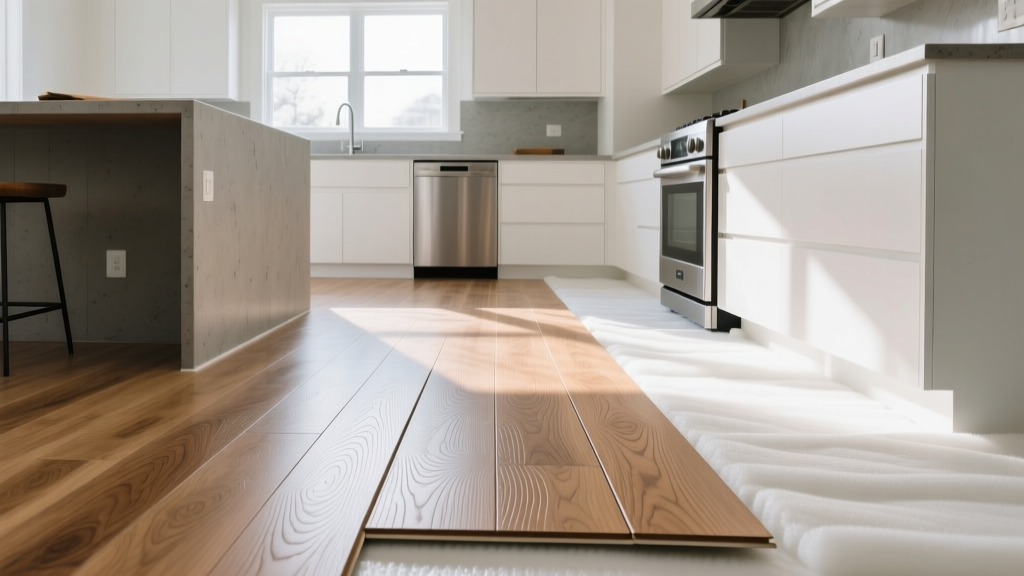
Laminate is a floating floor that expands and contracts with ambient humidity changes. Failing to leave a strict 3/8-inch expansion gap around the entire perimeter of the room (and around fixed objects like kitchen islands) will result in 'peaking'—where the plank edges push against each other and lift off the subfloor.
Final Decision Matrix
Use this rapid logic flow to finalize your selection based on your specific room requirements:
- If installing in a Kitchen or Powder Room: Select a 10mm or 12mm AC4 product with hydrophobic edge sealing (e.g., RevWood Plus or Pergo Outlast+). Ensure all perimeter expansion gaps are filled with a color-matched 100% silicone caulk to prevent surface water from migrating beneath the floor.
- If installing in a Basement (Below Grade): You must lay a 6-mil polyethylene vapor barrier over the concrete subfloor before installing the underlayment and laminate. Opt for a 12mm plank to bridge minor concrete imperfections and provide thermal insulation.
- If installing in a Second-Story Condo: Prioritize acoustics over extreme thickness. Choose a 10mm laminate paired with a premium cork or high-density rubber underlayment that guarantees an IIC rating of 55+ to satisfy Homeowner Association (HOA) noise bylaws.
- If installing over Radiant Floor Heating: Verify the manufacturer's explicit warranty for radiant heat compatibility. The maximum surface temperature of the heating system must not exceed 85°F (29°C), and the laminate thickness should not exceed 12mm to ensure efficient heat transfer.
Written by
Marcus ChenMarcus Chen is a licensed structural engineer (PE) and building materials analyst with over 12 years of experience across residential, commercial, and industrial construction. He holds a Master of Science in Civil Engineering from UC Berkeley and spent six years at Thornton Tomasetti before transitioning to independent consulting and technical writing. Marcus specializes in material selection for seismic-prone regions, concrete reinforcement strategies, and lifecycle cost analysis. His work has been cited by the American Concrete Institute (ACI) and the Structural Engineers Association of California (SEAOC). When he is not on a job site or at his desk, you will find him hiking the Sierra Nevada or restoring a 1920s craftsman bungalow in Oakland, CA.
More from Marcus Chen
View all
Construction Cost
How Much Did the Eiffel Tower Cost to Build?
How much did the Eiffel Tower cost to build in 1889? We adjust for inflation and compare its budget to modern skyscraper construction.
Aug 4, 2026

Fire Resistance
What Is a Fire Resistant Material? Testing & Certification Guide
Discover what is a fire resistant material through ASTM and UL testing. Learn how fire ratings, certifications, and assemblies work in construction.
Aug 4, 2026

Construction Cost
How Much Did the Burj Khalifa Cost to Build?
How much did the Burj Khalifa cost to build? We break down the $1.5B project and extract 5 money-saving strategies for your next build.
Jul 30, 2026