2026 Cost to Repair a Foundation: Complete Pricing Breakdown
Discover the 2026 cost to repair a foundation. Get exact pricing for piering, slab jacking, and crack injection, plus hidden variables impacting quotes.

The Real Cost to Repair a Foundation in 2026
As of early 2026, the national average cost to repair a foundation ranges from $4,800 to $12,500, with severe structural overhauls exceeding $35,000. Unlike cosmetic home upgrades, foundation stabilization is an engineered necessity. Pricing is rarely based on square footage; instead, it is dictated by the failure mechanism, soil composition, and the specific underpinning or sealing method required. According to market data tracked by the National Association of Home Builders (NAHB), material costs for structural steel and high-density polyurethane resins have stabilized over the last 18 months, but specialized labor rates continue to drive overall project costs upward.
Homeowners facing settlement, bowing walls, or slab heaving must understand that a low-ball quote often indicates a band-aid fix rather than a permanent structural solution. Below is a comprehensive breakdown of current market rates, engineered repair methods, and the hidden variables that dictate your final invoice.
2026 Foundation Repair Cost Matrix by Method
The following table outlines the standard unit costs and total project ranges for the most common engineered foundation repair techniques utilized in 2026.
| Repair Method | Primary Application | Unit Cost (2026) | Typical Project Range |
|---|---|---|---|
| Polyurethane Foam Jacking | Sunken concrete slabs, minor settlement | $12 - $22 per sq. ft. | $1,800 - $6,500 |
| Cementitious Mudjacking | Heavy exterior slab lifting (driveways, patios) | $6 - $12 per sq. ft. | $900 - $3,500 |
| Steel Push Piers | Deep foundation underpinning, heavy structural loads | $1,600 - $2,600 per pier | $12,000 - $35,000+ |
| Helical Piers | Light to medium loads, new construction tie-backs | $1,900 - $3,200 per pier | $14,000 - $40,000+ |
| Carbon Fiber Straps | Bowing basement walls, minor shear cracking | $450 - $850 per strap | $3,500 - $10,000 |
| Epoxy / Polyurethane Injection | Sealing active leaks and structural crack welding | $350 - $900 per crack | $800 - $4,000 |
Deep Foundation Underpinning: Push Piers vs. Helical Piers
When a structure experiences differential settlement due to unstable load-bearing strata, surface-level fixes will fail. Underpinning transfers the structural load to stable soil or bedrock deep underground. Steel push piers (typically 2-7/8 inch outer diameter, high-strength steel tubing) are hydraulically driven through unstable soil until they reach refusal (bedrock or dense load-bearing strata). They are ideal for heavy masonry and multi-story homes. Helical piers, featuring helical bearing plates welded to a steel shaft, are mechanically torqued into the ground like a screw. They are preferred for lighter structures, porches, and areas where bedrock is too deep to reach economically. According to guidelines from the FEMA Building Science branch, proper pier spacing must be calculated by a licensed structural engineer based on the specific dead and live loads of the building, typically ranging from 5 to 8 feet on center.
Slab Stabilization: Polyurethane vs. Mudjacking
For sunken slab-on-grade foundations, voids beneath the concrete must be filled and the slab lifted. Traditional mudjacking uses a slurry of topsoil, sand, and Portland cement. While cheaper, the heavy slurry (approx. 100 lbs per cubic foot) can cause secondary settlement in weak clay soils. In 2026, high-density polyurethane foam injection is the industry standard for precision lifting. The two-part resin expands rapidly, curing in 15 minutes and weighing only 2.5 to 4.0 lbs per cubic foot. It is impervious to water degradation and allows for millimeter-precise leveling through 5/8-inch injection ports.
Bowing Wall Remediation: Carbon Fiber and Wall Anchors
Basement walls subjected to lateral hydrostatic pressure from expansive soils often bow inward. If the deflection is less than 2 inches, carbon fiber straps (woven Kevlar-carbon grids bonded with structural epoxy) can lock the wall in place, providing a tensile strength exceeding 100,000 PSI. For walls bowed beyond 2 inches, mechanical helical tie-back anchors must be installed through the wall into the exterior soil to physically pull the wall back toward plumb over time.
Engineering Standard Note
All crack injection and concrete bonding procedures should strictly adhere to the standards set forth by the American Concrete Institute (ACI), specifically ACI 546R (Guide to Concrete Repair). Low-viscosity epoxy is required for structural welding of dormant cracks, while flexible polyurethane is mandated for sealing active, water-leaking cracks.
Hidden Variables That Inflate Your Repair Quote
Contractors base initial estimates on visible symptoms, but the final invoice is often dictated by site-specific constraints. Be prepared for cost adjustments based on the following variables:
- Expansive Clay Soils and Root Barriers: If your settlement is caused by aggressive tree roots extracting moisture from clay soils, piering alone will not solve the problem. You will need to budget an additional $1,500 to $3,500 for deep root barriers and localized drip-irrigation systems to maintain constant soil moisture.
- Interior Finishes and Excavation: Installing interior push piers requires breaking through the concrete slab floor and excavating soil manually. If your basement is finished with drywall, flooring, and HVAC ductwork, expect demolition and reconstruction costs to add $4,000 to $12,000 to the project.
- Hydrostatic Pressure Mitigation: Repairing a bowing wall without addressing the water causing the pressure is a guaranteed path to failure. Installing an interior French drain system and a high-capacity sump pump (minimum 4,000 GPH) is often a mandatory prerequisite, adding $5,000 to $9,000 to the total project cost.
- Access Constraints: If heavy machinery (like skid steers or mini-excavators) cannot access the rear of the property due to narrow side yards or fencing, manual excavation is required. Hand-digging foundation footings can increase labor costs by 40% to 60%.
DIY vs. Professional Foundation Repair: Decision Framework
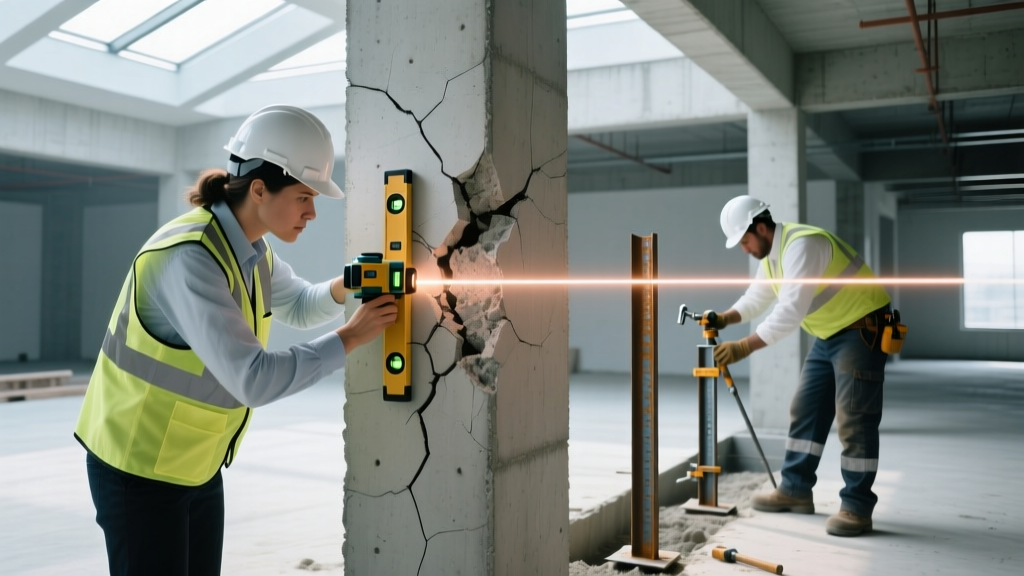
Foundation repair is highly unforgiving. Misdiagnosing the failure mechanism can lead to catastrophic structural collapse. Use this matrix to determine when to hire a professional.
| Symptom | DIY Feasible? | Required Action |
|---|---|---|
| Vertical hairline shrinkage cracks (< 1/16 inch) | Yes | Seal with DIY polyurethane crack injection kit to prevent moisture intrusion. |
| Stair-step cracking in brick or cinder block | No | Hire a structural engineer to assess differential settlement. |
| Doors/windows sticking, drywall corner tears | No | Requires professional laser leveling and potential underpinning. |
| Horizontal cracking in basement walls | No | Immediate structural emergency. Indicates active lateral soil failure. |
Navigating Insurance and Warranties
A common misconception is that homeowners insurance covers foundation repair. In reality, standard policies explicitly exclude damage caused by earth movement, soil settlement, and expansive clay. Insurance will typically only cover foundation damage if it is the direct, sudden result of a covered peril—such as a burst plumbing pipe under the slab that washes away the subgrade, or structural damage from a fallen tree. Always review your policy's 'earth movement' exclusion clause. Furthermore, when hiring a contractor, demand a lifetime, transferable warranty backed by a third-party insurance company, not just a 'company promise' that becomes void if the contractor goes out of business.
5 Red Flags in Foundation Repair Estimates
Protect your investment by walking away from contractors who exhibit any of the following warning signs during the bidding process:
- No Structural Engineer Involvement: If the salesperson designs the repair plan without a stamped engineering drawing from a licensed Professional Engineer (PE), the repair may not be permitted or structurally sound.
- Guarantees to 'Make the House Level': Ethical contractors guarantee to stabilize the foundation and maximize recovery. Attempting to force a severely settled, decades-old home back to perfect plumb can snap plumbing lines and tear roof trusses.
- High-Pressure, One-Day Discounts: Foundation repair is a major capital expenditure. Any company offering a '20% discount if you sign today' is artificially inflating their baseline pricing.
- Recommending Piers for Shrinkage Cracks: If a contractor suggests $20,000 in steel piers for a home that only exhibits minor, seasonal shrinkage cracks caused by drought, they are upselling unnecessary structural intervention.
- Lack of Soil Testing Data: For deep underpinning projects, the contractor should reference soil boring logs or geotechnical reports to determine the exact depth of the load-bearing strata before quoting a per-pier price.
Written by
Marcus ChenMarcus Chen is a licensed structural engineer (PE) and building materials analyst with over 12 years of experience across residential, commercial, and industrial construction. He holds a Master of Science in Civil Engineering from UC Berkeley and spent six years at Thornton Tomasetti before transitioning to independent consulting and technical writing. Marcus specializes in material selection for seismic-prone regions, concrete reinforcement strategies, and lifecycle cost analysis. His work has been cited by the American Concrete Institute (ACI) and the Structural Engineers Association of California (SEAOC). When he is not on a job site or at his desk, you will find him hiking the Sierra Nevada or restoring a 1920s craftsman bungalow in Oakland, CA.
More from Marcus Chen
View all
Construction Cost
How Much Did the Eiffel Tower Cost to Build?
How much did the Eiffel Tower cost to build in 1889? We adjust for inflation and compare its budget to modern skyscraper construction.
Aug 4, 2026

Fire Resistance
What Is a Fire Resistant Material? Testing & Certification Guide
Discover what is a fire resistant material through ASTM and UL testing. Learn how fire ratings, certifications, and assemblies work in construction.
Aug 4, 2026

Construction Cost
How Much Did the Burj Khalifa Cost to Build?
How much did the Burj Khalifa cost to build? We break down the $1.5B project and extract 5 money-saving strategies for your next build.
Jul 30, 2026